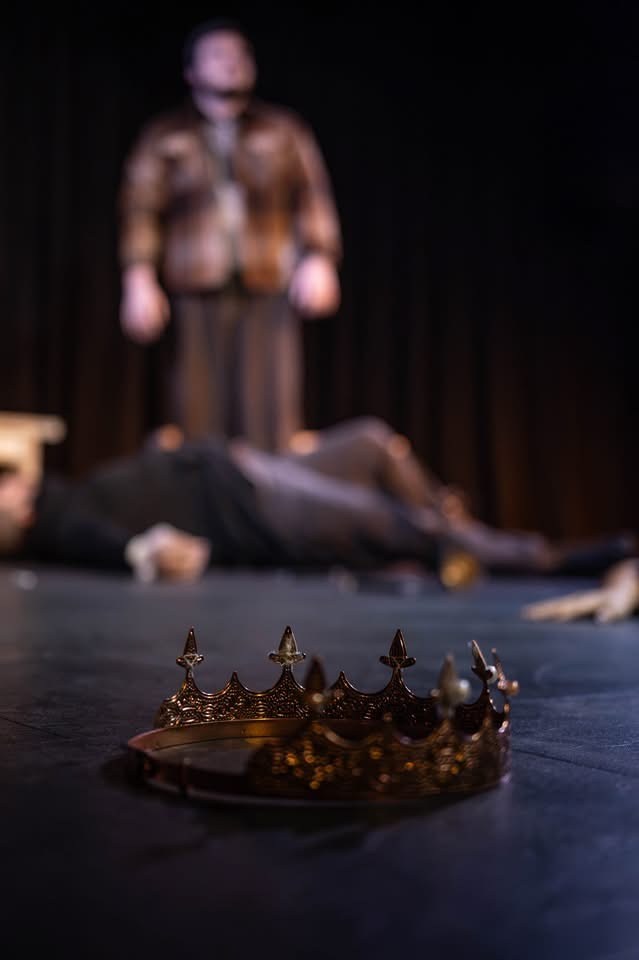
Tulsa Shakespeare Company: Hamlet
Lynn Riggs Theater
Through November 8, 2026
Unlike the Prince of Denmark, Tulsa Shakespeare Company’s Hamlet never hesitates. It pounces, it shouts, it capers and spooks—in short, it’s the most fun you can have at a 400-year-old tragedy.
It’s also a great way to exorcise whatever haunts you’ve got still hanging around after Halloween. The perfection of Hamlet as a bit of spooky season programming is right there in the text: “‘Tis now the very witching time of night,” Hamlet says, right after staging a play that calls out his parents for absolutely wrecking the natural order of things. This production leans into that spirit with sound and lighting effects by Ben Morgan and Anna Puhl that bring this kingdom right into hex house territory.
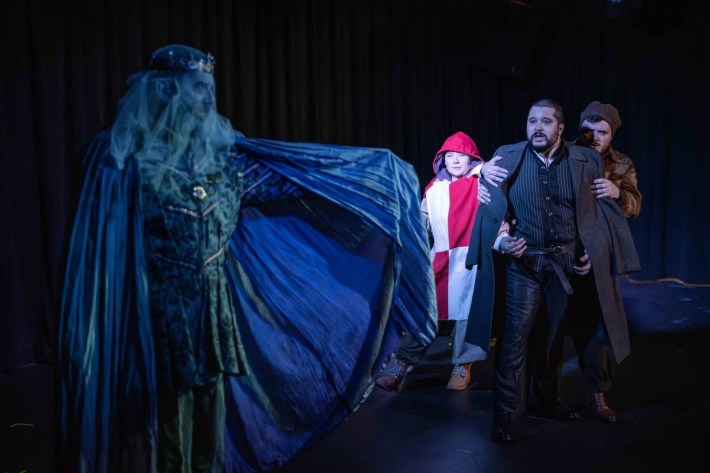
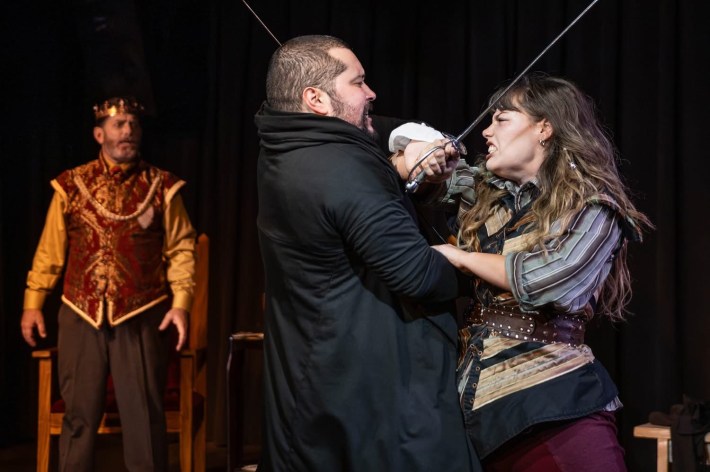
In the Lynn Riggs Theater black box, director Brock England scales the story down to feel very up-close and very personal, focused on the relationships that ultimately make all of Denmark rattle. This is a hot-blooded Hamlet, not a cool, reserved one. The era-spanning mixed-and-matched costumes by Paulette Record and the spare set—a couple of benches and two throne-like chairs—radically foreground the people of Elsinore who go bump against each other in the night.
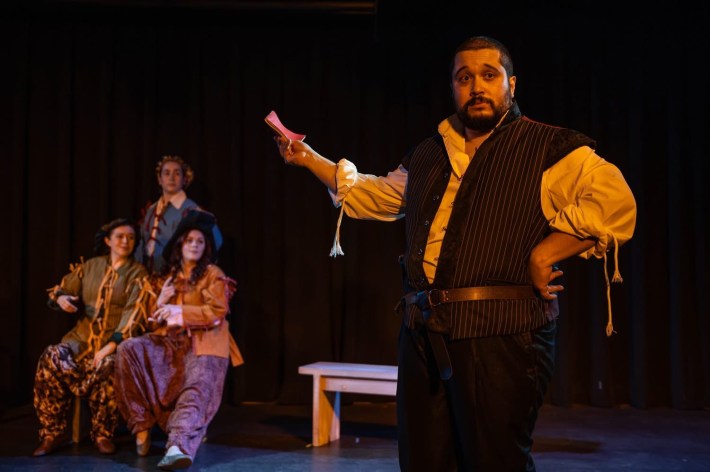
Though the play bears one man’s name, this is very much an ensemble production. Alternately jostled and supported by everyone in his world, this Hamlet, played with spirited clarity by Armando Rivera, is like a lantern flame flickering in the dark. The question of what’s real and what’s not is a big one throughout the play, which seethes with paranoia and subterfuge from its first scene. But the heart of TSC’s production is family, not politics: family found and lost, bonds restored and betrayed, the friction of love and loss that pulls at the seams of living.
As the fractures in known reality rise to the surface, this Hamlet can’t anchor anymore in the places he might previously have found steadiness. People ebb and flow around him—elders like Polonius (Steve Kollmorgen, whose sensitive vocal modulation helps make this one of the best acting performances I’ve seen this year); his mother and uncle (Jenny Guy as a blowsy Gertrude, Jeremy Geiger as a try-hard Claudius); Laertes (Ashe Baileigh, full of strong emotion); Ophelia (a vivid, heartbreaking Anna Joie); and even friends like Rosencrantz and Guildenstern (Alex Isaak and Rachel Steed, side-eyeing with concern), the players (Caitlin Morton, Coral Kestler, and Justine Prince, all wonders), and Horatio (a warm, steadfast Tanner Morton).

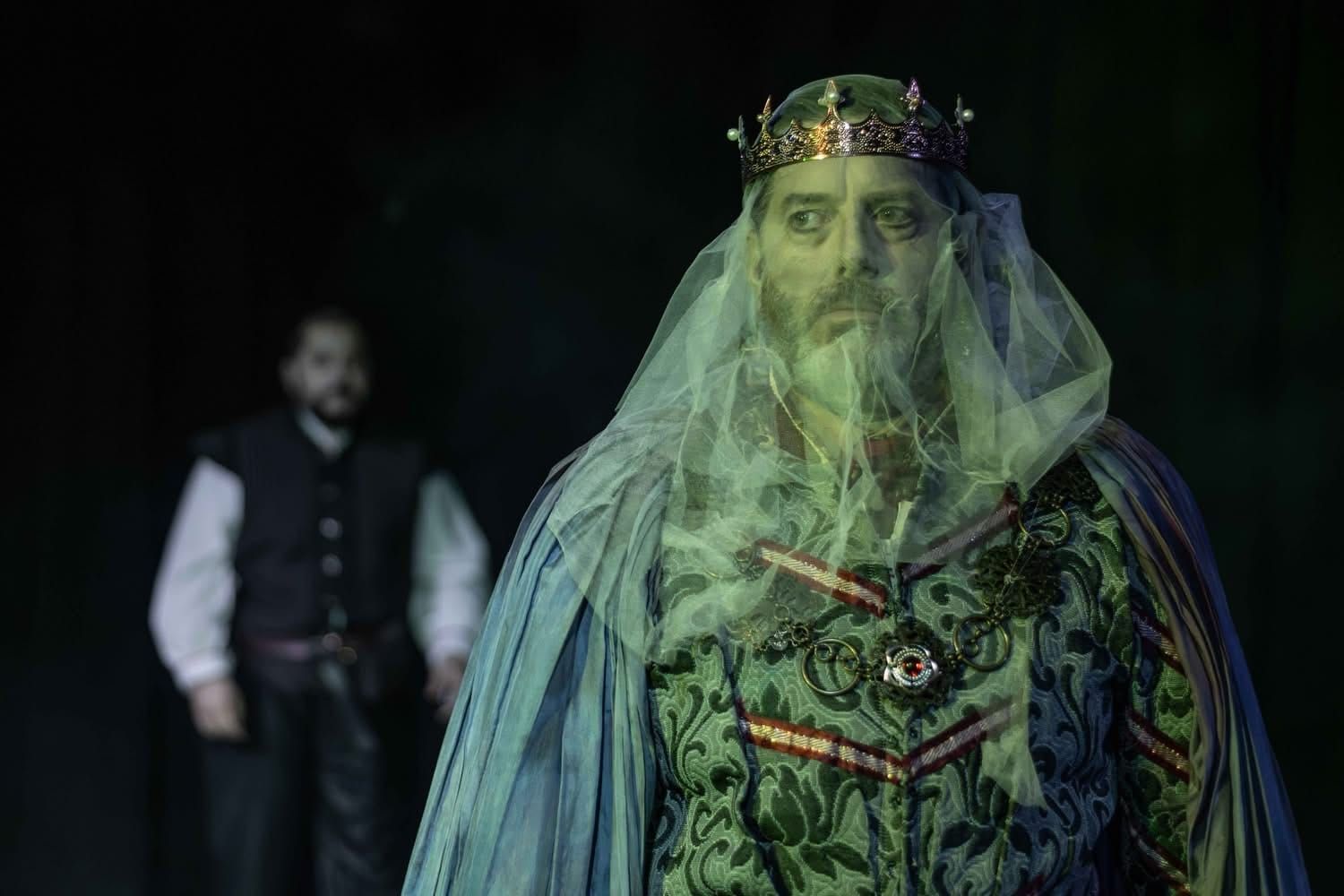
The most substantial person in this Hamlet’s cracked mind’s eye? The ghost of his dead father. In a smart bit of casting, Geiger plays both the current king and the brother he murdered, and his monumental monologue as the Ghost—channeling everything from Vincent Price and Mel Brooks to Sophocles and some sort of Häxän vibe—is reason enough to see this production.
Hamlet often dances right at the edge between horror and hilarity, and England’s direction lets both of those dimensions loose. He makes the most of little moments, consistently letting each tile in this mosaic be as present as every other. Minor characters like the courtier Osric (a floridly obsequious Caitlin Morton) and the gravedigger (a pitch-perfect, jest-forward Kestler) carry variants of the same dark mania you see in Rivera’s spinning dances and fist-raised screams. Tobie Minor’s fight choreography is muscular and believably unpredictable; I especially loved a big curving recoil Baileigh did after a hit from Rivera in the Laertes/Hamlet swordfight.
As usual with Tulsa Shakespeare Company, every word comes through simple and clear (no British accents here) and the lines roll and bounce with their own natural music—which makes silences, when they come, all the more resonant. There’s no attempt at artiness here, no avant-garde pretension, no ponderous weight. This is a Hamlet that moves, and what moves me most is the text itself, trusted by a committed cast and crew to deliver its own genius.