
“Tosca”
Detroit Opera
Detroit Opera House
Detroit
Through Nov. 7, 2026
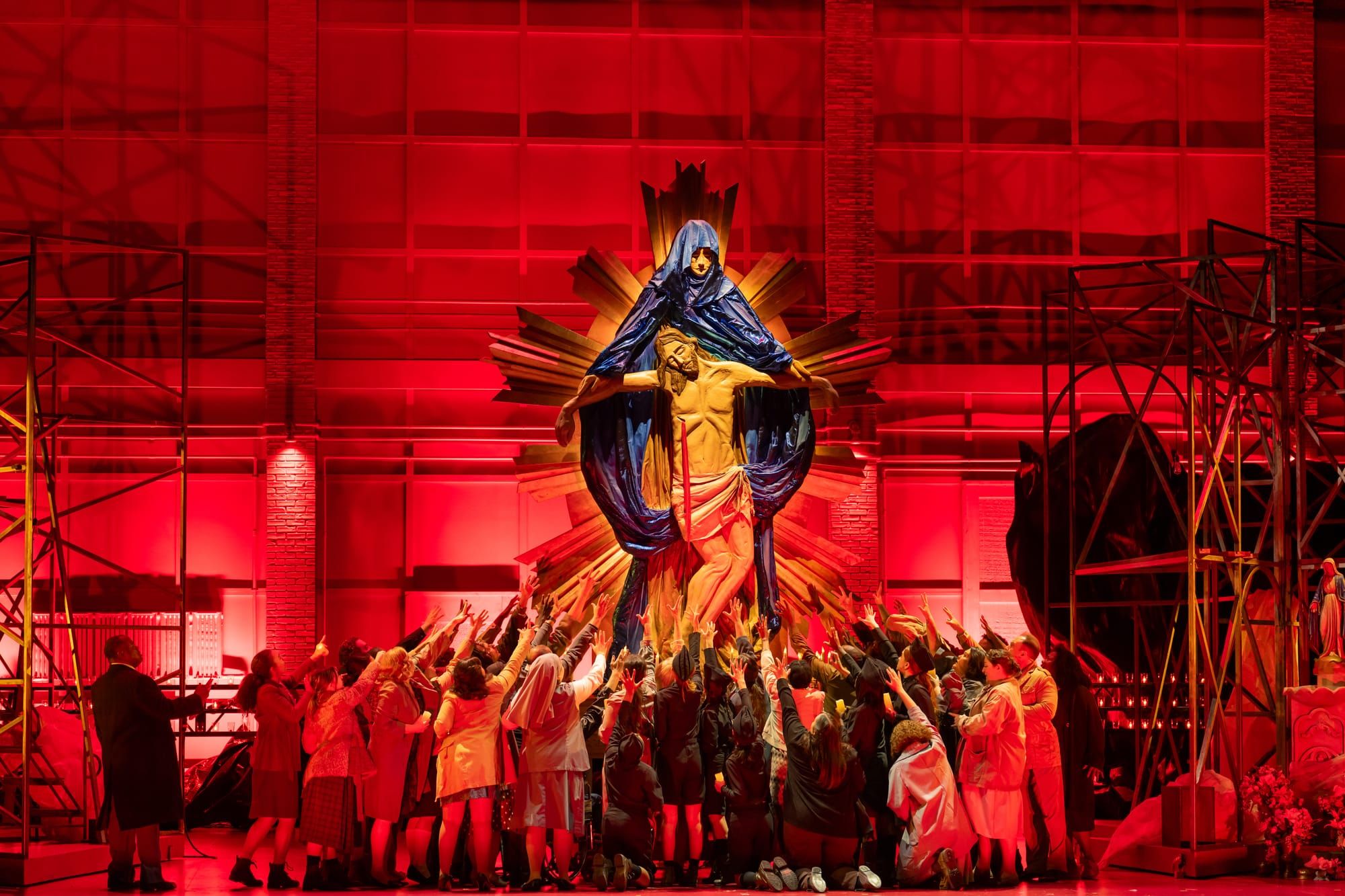
A giant statue of a crucified Christ and Madonna moves downstage, saturated by vibrant, blood-red lighting. Below, a crowd of worshippers sings a “Te Deum” in devotion, as an evil police chief calmly stands to the side. He’s unfazed with a sly smirk as he fans himself with the fan that will be instrumental in his kidnapping and murder scheme as he stares at the Christ. The Act I finale of Detroit Opera’s current production of Puccini’s “Tosca” is chilling and powerful, an encapsulation of a production that takes on love, lust, murder, and faith. Detroit Opera’s production is directed by Louisa Proske and conducted by Detroit Opera Music Director Roberto Kalb.
“Tosca” follows the tragic love story between opera singer Tosca and painter Cavaradossi, living under the control of evil police chief Scarpia whose lust for Tosca endangers both their lives. “Tosca” is traditionally set in 1800 Rome during the Napoleonic Wars. Detroit Opera’s production — created by Proske for the 2025 Glimmerglass Festival — brings the story to an unspecified country under a totalitarian government in the latter half of the 1900s, where artists, in particular, are persecuted and silenced for challenging the regime. The choice does little to take away from the classic interpretation and brings its themes closer to modern politics.
Making her role debut, Masabane Cecilia Rangwanasha commanded the stage as the titular passionate diva. You feel her intense love for Cavaradossi, and its corresponding jealousy, her anguish when faced with impossible choices, and power when she takes back control — which led to enthusiastic applause from the audience.
Nathan Granner’s Cavaradossi soars, his rich, resonant tenor felt throughout the theater paired with a convincing portrayal of a man both madly in love and quietly defying an evil regime.
As Scarpia — the epitome of evilness who literally sings about preferring to rape women rather than woo them — Alfred Walker is terrifying. But his full, deep baritone offered some beauty to an otherwise despicable character, earning both claps and boos with his standing ovation.
Detroit Opera’s production leans into “Tosca’s” religious themes as part of its 2026-27 opera series with works that explore faith, which is especially compelling. Tosca’s torment about staying true to her faith while fighting for her life — and the life of her lover — is palpable. Her “Vissi d’arte,” questioning why God has abandoned her during her time of need, is both lovely and heart-breaking.
One of the production’s most striking aspects is the crowd of spectators watching the climactic execution scene. Dressed to the nines, like classic depictions of operagoers, the group casually observes the murder of an innocent man for entertainment. It’s an observation of how a rigid totalitarian class system successfully manages to control and dehumanize marginalized people — which eerily resonates with our current political climate.
It’s easy to detach oneself and simply enjoy a piece of fiction set in a foreign country over two centuries ago. But Detroit Opera’s production of “Tosca” brings the tragic story closer to home, challenging us to examine our role when facing a totalitarian regime or, perhaps, the approach of one. Are we willing to risk our lives resisting, like Cavaradossi, or quietly succumb to survive? And as we watch our mirror image of operagoers across the stage, we’re left with the question — which side are we on?


