

Beauty Unadorned: “Fire!!” and the Harlem Renaissance; Cave Canem: A Home for Black Poetry
Beinecke Rare Book & Manuscript Library
New Haven, CT
Through May 30
Richard Bruce Nugent's "Smoke, Lilies, and Jade" is full of pearls of thought, strung together on a chain of ellipses from start to finish; it's a story as full of the things unspoken as the words written on the page.
The ellipses lend a supple sensuousness to every phrase, which reach their full flower when form and subject meet — as when the protagonist, a young man named Alex, has a tryst with another young man: "as they undressed by the blue dawn…Alex knew he had never seen a more perfect being…his body was all symmetry and music…and Alex called him Beauty…long they lay…blowing smoke and exchanging thoughts…and Alex swallowed with difficulty…he felt a glow of tremor…and they talked and…slept…"
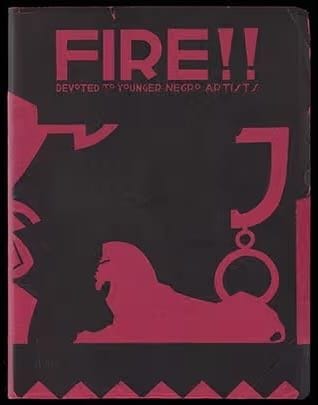
The passage's prose is fresh enough that it could have been written today, but it's from 1926. It appeared in Fire!!, a publication from the Harlem Renaissance in which the writers tried to expand the boundaries of what was possible, in art, sex, social mores, and commerce. Fire!! is the subject of Beauty Unadorned: “Fire!!” and the Harlem Renaissance, a show running at the Beinecke Library concurrently with Cave Canem: A Home for Black Poetry, about the decades-old summer retreat for Black poets that has created a community of like-minded people and a lasting place for Black poetry in American literature. Both shows run through May 30, giving viewers ample opportunity to explore the tensions between them, and what they have to say about the rewards and risks that await Black writers who put pen to paper, or fingers to keys, to express themselves.
Fire!! represented "the emancipation of a 'younger' cohort from the strictures of respectability imposed on them by the renaissance's architects," the accompanying notes relate. "The cohort of seven writers and artists who collaborated to produce Fire!! were young and audacious. Though they counted themselves part of the movement or renaissance that was using the name 'New Negro,' they were more radical than that movement's older leadership" – like W.E.B. DuBois and Alain Lock – "and they explicitly opposed some of those leaders' key tenets. All born at or near the dawn of the 20th century, they were loosely led by Wallace Thurman and Langston Hughes, both just 24 years old."
The exhibition is full of spicy details illustrating just how edgy the young artists of the Harlem Renaissance were, artistically and personally. It begins with Zora Neale Hurston: "Of the other editors — Gwendolyn Bennett, Aaron Douglas, Zora Neale Hurston, Richard Bruce Nugent, and John P. Davis — only Hurston was over 30, not that her collaborators knew it. Born in 1891, she had taken 10 years off her age to register and complete high school in Baltimore and kept things that way; in 1926 she claimed to be 25."
The pieces in Fire!! pushed boundaries in subject and form at the same time. "The stories, poems, and drawings in the magazine featured sex, same-sex desire, prostitution, violence, murderous revenge, and intraracial color prejudice as well as formal experiments drawn from the latest literary innovations on both sides of the Atlantic," the notes relate. "Smoke, Lilies and Jade," a famous Nugent contribution, "follows Alex, a young bisexual artist, through hazy, stream-of-consciousness wanderings, including dalliances with both a man and a woman." Bennett had just come back from a year in Paris on an art fellowship, and her contribution showed how much she soaked up the avant-garde culture there. Her story, "Wedding Day," "takes the City of Lights as its setting and follows protagonist Paul Watson, a Black American boxer who has been in Paris since, in Bennett's arch phrasing, 'the days before the colored jazz bands were the style,'" the notes relate. She got her stream-of-consciousness style straight from the source, having bought a copy of James Joyce's Ulysses right from Shakespeare & Company, publisher Sylvia Beach's Paris bookshop; the novel was, at the time, banned in the United States on the grounds that it was obscene.
The boundary-pushing appeared in the artists' social and personal lives as well, in ways that cross lines today. We may be accustomed to thinking of Black artists reclaiming a certain racial slur as a hip hop-era move. But the Fire!! crew did it decades earlier. Either Thurman or Hurston — the record is unclear as to which — described their group as the "N—rati" and referred to Thurman and Nugent's apartment on West 136th Street as "N—r Manor." And while "only Nugent was open about his same-sex desire," the notes relate, "several members of the group, including Thurman, Hughes, and Nugent, were sexually as well as artistically experimental," and "Hughes and Thurman developed a fast, flirtatious friendship in the summer of 1926."
The exhibition boils down to a statement that feels ageless and startlingly contemporary. The Fire!! group "wished for an outlet for their art that would be less contingent on uplifting the race." Other publishing outlets for young Black writers "came with a price: upholding the respectability of Black Americans in the face of discrimination, violence, and oppression." By contrast, they "longed for the chance to make art that would celebrate the race, but with more freedom to be, as Hughes famously put it in an essay published the same year, both beautiful and ugly, 'free within ourselves.'"
It's a sentiment Black artists have expressed over and over again since, whether it's jazz musicians and Civil Rights-era writers like James Baldwin in the 1950s and 1960s, the artists of the Black liberation movement of the 1970s, or artists at the peak of the foment of the Black Lives Matter movement just a few years ago. Understanding this has its sobering side. Today the Harlem Renaissance is packaged as a triumph, and in so many ways it was, in art, music, and letters; but the story of Fire!! shows us that the artists themselves didn't see it that way. There was so much more they wanted and couldn't have, and the fences they pushed against are the same ones holding back Black artists today.
The publication of Fire!! made this evident. Producing the first and only issue, which came out in November 1926, "nearly bankrupted" Thurman and Hughes, who "borrowed money and skipped rent to pay the printer — debts that they would spend years paying off," the show's notes relate. "The reception of Fire!! was mixed. Some lauded its fresh experimentation, but many vilified it.... One reviewer encouraged readers to cast their copies into the fireplace." The magazine struggled with distribution. "Then, according to legend, the building whose basement held the back stock of issues burned in a fire. Fewer than 50 copies of Fire!! survive in libraries today." The publication had a second life in the 1980s "as academic interest in the Harlem Renaissance surged" and it was "embraced by queer artists and the scholarly field of queer studies for its radical portraits of sexual experimentation." But those artists were being oppressed in their time, and ravaged by the AIDS epidemic.
The story of Fire!! puts the Beinecke's concurrent show about poetry collective Cave Canem in a more interesting frame. In 1995, the show relates, "poet Toi Derricotte long imagined creating a writing workshop exclusively for Black poets. She had often been the only Black person in the classroom, whether as a student or as a teacher. She mentioned the idea to fellow poet Cornelius Eady while they were on vacation with their partners in Italy. Eady and his wife, novelist and designer Sarah Micklem, immediately agreed to help plan a summer retreat for Black poets the next year."
Derricotte's and Eady's motivations echo and build on those of the Fire!! crew: "Both recognized a need for resources to support the development of Black poets, including spaces devoted to honing their craft in the company of other writers. Both were deeply knowledgeable about the long history of Black poetry in American literature — the rich artistic traditions that existed and the many challenges their predecessors and peers faced as they sought space and opportunity in the largely white worlds of poetry and publishing. 'How many before us,' Eady once said in an interview, 'practiced the very old and venerable African American tradition of making do?'" He might as well have been talking about Hughes and Thurman.
They got the name — Latin for "beware the dog" — from a visit to Pompeii days later, where they "saw its famous dog mosaic, which includes the words." Micklem designed the logo for the retreat and incorporated the mosaic, except that she "broke the dog's chain." The first Cave Canem Summer Retreat happened the next June, funded out of Derricote's and Eady's pockets. It was held at a religious retreat center in the foothills of the Catskills and involved Elizabeth Alexander and Afaa Michael Weaver, who were already well-established poets in 1996. The retreat has been a yearly event ever since, and the resulting cohorts have "evolved into an enduring poetry community and a force in literary arts advocacy." It has also become a standalone nonprofit with enough funding to keep the retreats tuition-free, with room and board scholarships and travel stipends available. It promotes work by attendees, publishes anthologies, and awards the Cave Canem Book Prize each year. As the notes tell it, "in the 25 years since the prize's inauguration, its winners have gone on to receive every major honor available to American poets."
"The devoted friendship of the founders and their shared love of Black poetry created a solid foundation on which to build the organization that would come to be known as 'a home for Black poetry,'" the notes relate. "The name and image evoke a dynamic mix of safety and freedom, protection and creative spirit, the inherent value of Black poetry and the power of artistic self-determination."
The language of "safety and freedom, protection and creative spirit" suggests an artistic diplomacy that the Fire!! crew eschewed. The Fire!! crew obliterated the lines of respectability and paid for it. Cave Canem, reading between the lines, appears to have been more savvy; surely some of the poets have crossed the same lines as the writers in Fire!! did, but if so, the institution itself is quiet about it, and if that's a strategy, it has paid off. Participation in the retreats has yielded success: as one participant wrote, "my life was irrevocably altered," recalled one participant in their written feedback. "It is no accident that all of my professional achievements over the past two-and-one-half years occurred as a direct result of the nurturing spirit of Cave Canem."
The Beinecke will be celebrating Cave Canem's successes with a reading by Elizabeth Alexander on Nov. 4 and an official opening for both shows on Nov. 12. The accolades are warranted; the respect is hard-earned. But putting the shows side by side reminds us of the friction involved. What must the poets leave unsaid to be let through the gates? And what truths — what ecstasies and hurts, what dreams and nightmares — still burn on the other side of the fence?


