

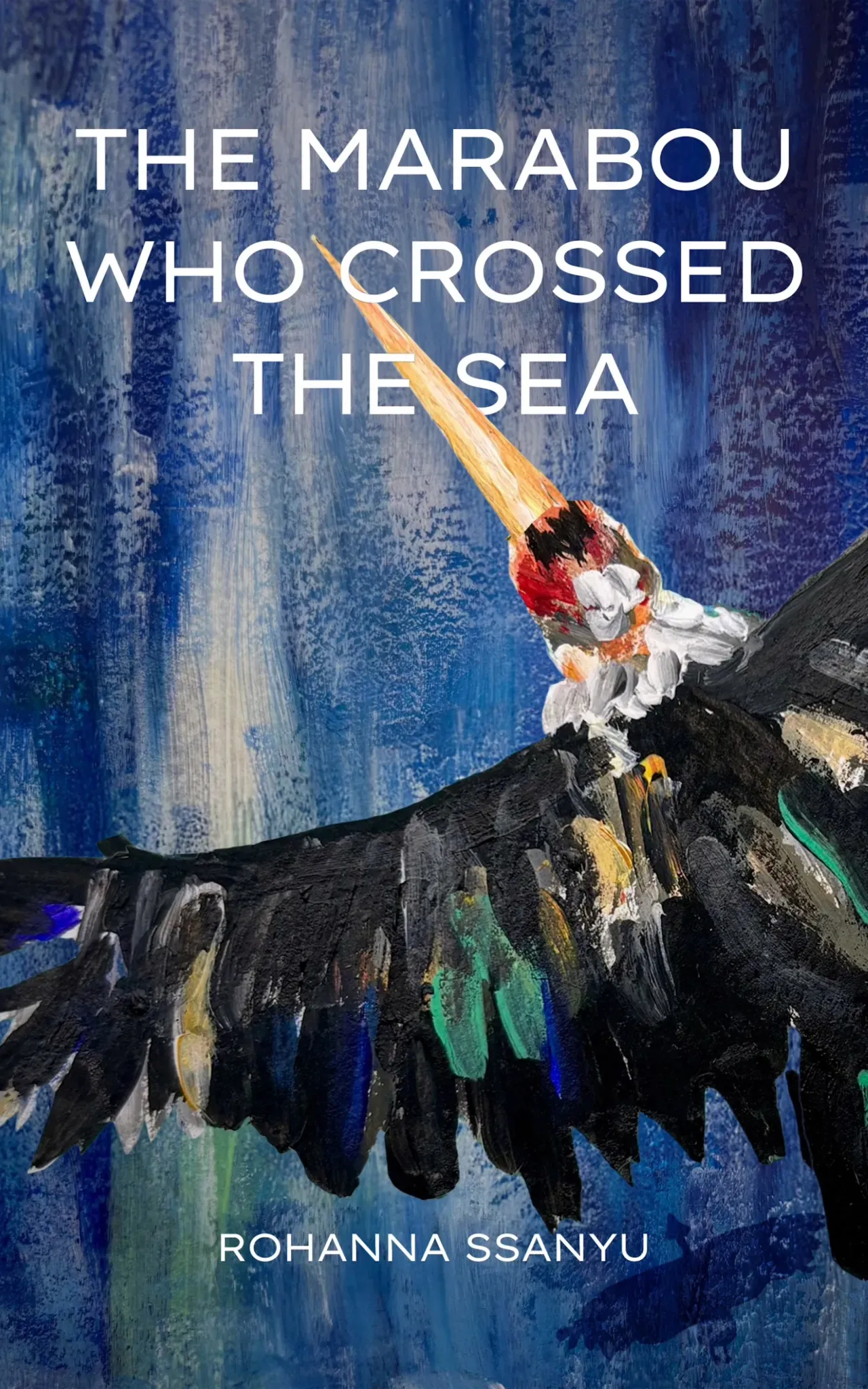
The Marabou Who Crossed the Sea
By Rohanna Ssanyu
Small Harbor Publishing
Before you look up what this African stork looks like, read an excerpt from “Marabou,” the second poem of The Marabou Who Crossed the Sea, a newly published chapbook by New Haven Adult Ed teacher Rohanna Ssanyu:
Skeletal legs, an inkblot held
to cloud, a grainy beak, pink flesh,
a nape of hair, a head splattered
in orange blood!
This ugly marabou goes on a long journey, popping in occasionally throughout the book. Originally from the savanna, it eats black plastic in Kampala, then crosses oceans to go to a Lord & Taylor. He is clearly far from home. (Ssanyu is Ugandan-American.)
The chapbook in parallel also follows a second-generation daughter, who is trying to understand her mother and overall family history in the context of the Ugandan diaspora. What is lost, and what has been baked into her identity?
She is overeager in “Time Traveler Hears Dancing Queen,” when she relays her stories from the future, and of empire, to her younger mother’s closed ears. Perhaps she learns her lesson enough that later in the “Time Traveler Catches the Akamba Bus,” she just observes. She sees the last time her mother and her siblings are “together in life, before the scattering, before the taped funerals.”
I was reminded of how tight-lipped my first-generation immigrant relatives are about the past. And if I time traveled and witnessed the pain of someone I loved, especially in their formative years, I think I, like this daughter, could also understand more about myself.
Ssanyu’s most humorous poem is “Confession,” which is addressed to the ancestors. The Hi-C her mother bought from Safeway is what made her a “raspberry lime and wild berry baby.” It’s rhythmically snappy, and matter-of-fact, too. Take me as I am.
Or maybe not. Maybe this daughter can change. In “Notes on Turning Self into Muganda Girl,” she stuffs herself with Luganda, one of the major languages in Uganda, only to “burp” or “cough” them out to her Auntie, who is almost disgusted.
Throughout, Ssanyu so richly describes the beauty of Uganda, which I imagine is a reason why the daughter seeks to understand her connection to the land. The poem “Kazinga Channel” was particularly striking, and a reprieve from the hustle and bustle of the capital, “Kampala.” The animals on the Kazinga Channel are resting near, against, and on top of each other, but there is calm and peace (unlike some of the busyness that we humans can create for ourselves).
And the marabou, who once called that large river home? Now enclosed in a zoo in “African Aviary,” where there’s “painted sand” and “dried gumballs.” There to be gawked at, but at least in a home with other misfits.
The poet Ssanyu will give a reading of her chapbook, “The Marabou Who Crossed the Sea,” and lead a still-life drawing program at the Pardee-Morris House on Sunday, Aug. 9 at 2 p.m. The event is free and open to all ages.


