人間을 보다 (Seeing Humans)
박하선 (Park Ha-seon)
Gallery Hwa
Gwangju
Sept. 29, 2026
(Jisu Sheen recently moved from New Haven to Gwangju, South Korea, where she’s covering local arts and culture for the New Haven Independent and Midbrow.)
A golden Buddha figurine sits among chilled ingredients on a refrigerator shelf. A group of people walks through a field of human remains. In a different country, another group of people watches rain feed vegetation growing over the site of a massacre decades past.
These are just a few sights from solo photography exhibit "人間을 보다" (Seeing Humans), which wrapped Tuesday at Gallery Hwa in downtown Gwangju. In both his title and subject matter, Gwangju photographer 박하선 (Park Ha-seon) crafts the impression of a field guide to humanity.
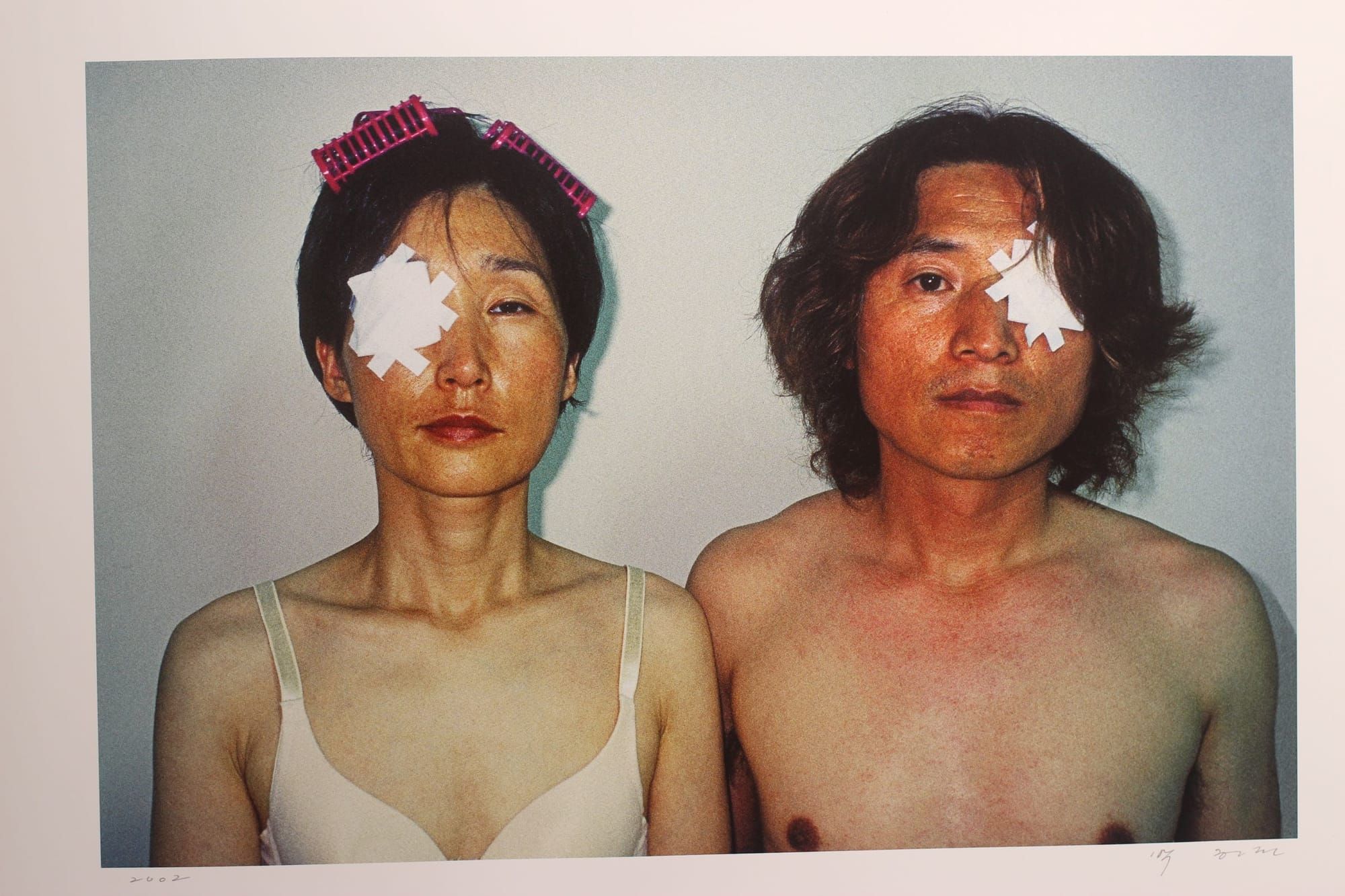
Park's photos are stark, with simple titles and rich shadows. Many of them are in black and white. They're printed on large matte paper with deckled edges, foregoing a glossy photo finish in favor of layers of visual texture. The titles — like a repeating one that just states "In the World of Humans" — reveal recurring themes: humans, what they eat, and the violence that defines their eras.
Winner of the 2001 World Press Award for his work documenting the Tibetan "sky burial" and a traveler whose photographs include fallout of war in Iraq and the Papua Korowai tribe of Indonesia, Park does seem like the right person to make an intro to humans. In his description for the show, in Korean, Park calls our Earth a "small star hanging in infinite space." He talks about the Gwangju massacre and the Sewol Ferry disaster, doubting the ability of laws to reign in chaos when many of humanity's most chilling acts have been state-sanctioned.
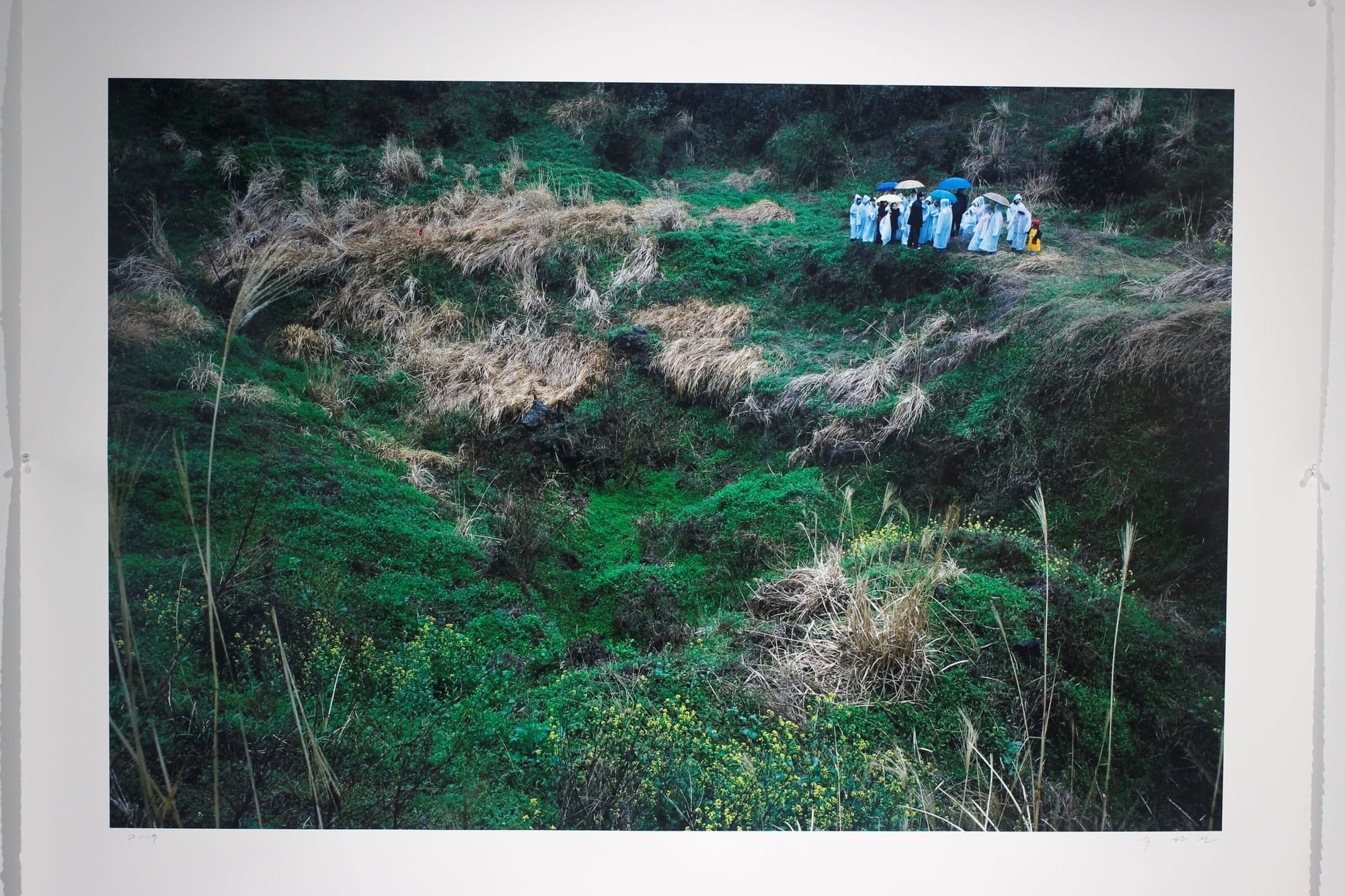
Across from the gallery's entrance, I faced a large photo with organic greens and browns sweeping over a landscape. Tucked into a single spot on a ledge are a group of people with umbrellas, looking like scientists in their white ponchos. There is a sense of investigation; something happened here.
And something did. In 1948, as the government of South Korea was being established, civilians led an uprising on Jeju Island, in what is known as the 4.3 incident. Military police killed thousands in a brutal crackdown that included South Korea's first instance of martial law, not even a year into the new government's existence. Park's photo is of the place where many of the killings happened.
The visual is a loop from nature to the unnatural and back again. At first glance, it seems like it could be a search party. The people look somber, standing in the rain. The scene is framed with a few tall blades of grass in the foreground, each one multiple times taller than the humans in the distance. Jeju, an island known for its views and lush greenery, looks beautiful.
If the humans are searching for anything, it's something abstract, like: the truth. They look tiny, like they could be folded up into one of the massive curves of grass at any moment. Looking at the photograph, I thought about how people use the understanding of humans as animals both to emphasize a fundamental, cold-hearted violence and to say the opposite: that evil is an aberration, a man-made invention.
At times, the collection of photos in "Seeing Humans" feels cynical and world-weary. How can humans tear each other apart like this, time and time again? Is it some perpetual curse? Yet in displaying these works, Park holds onto potential for change. His photos serve as part of ongoing movements to unearth long-suppressed secrets of history.
Park's closes his description of the show by returning to our place in the universe: "Still to this day, the Earth, that little blue star that carries us, drifts through the universe—as if it knows, or maybe doesn't at all."
Sign up here to get Gwangju Midbrow email updates delivered straight to your inbox.