
Wonderland
Yale Summer Cabaret: Spectra
217 Park St.
New Haven
Aug. 13-15, Aug. 20-22, 2026
Wonderland director Tess Cruz was faced with a challenge: How to stage a play that’s meant for a 17-person cast when you are allotted only five actors and actresses?
Thanks to a versatile and dynamic cast, flamboyant costuming and captivating stage design, she and her creative team managed to pull it off in the Summer Cabaret's production of Wonderland, which has a second run this coming Thursday through Saturday.
Wonderland was adapted by Victoria Lynne Barclay from Alice Gerstenberg’s 1915 play Alice in Wonderland staged in Chicago. Like Gerstenberg’s version it contains elements of Lewis Carroll’s Alice in Wonderland and Through the Looking Glass.
In the Yale Summer Cabaret version I saw this past weekend, the audience met a bewildered Alice (Junah Jang) as she stumbled into the club. Madonna’s “Hung Up” blasted through the room: Time goes by so slowly/ Time goes by so slowly… Time, we later found out, would play an important role in Alice’s Bildungsroman.
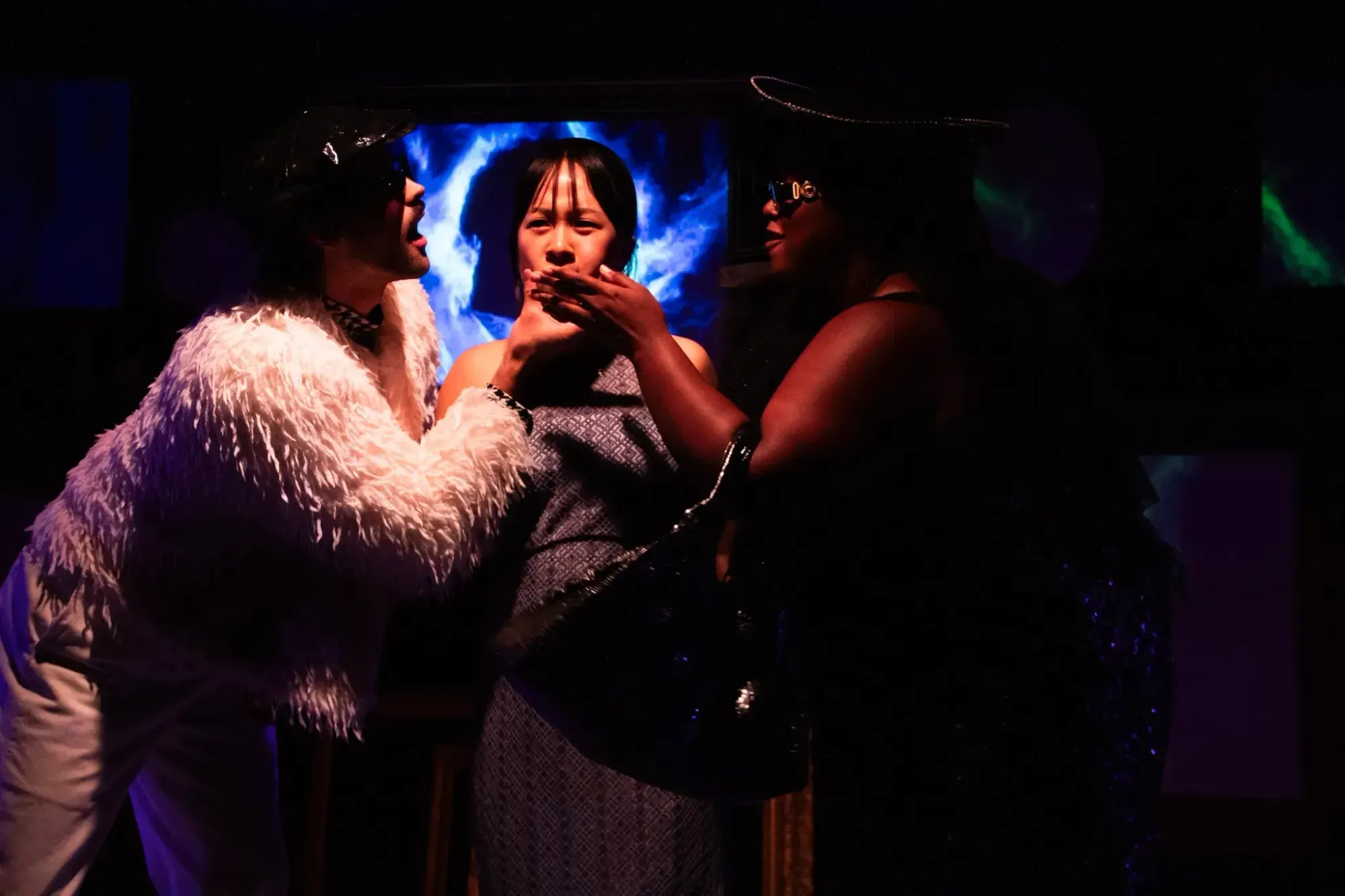
Alice’s effervescent friends stormed the club, and they all danced around the checkerboard floor and downed shots of alcohol under the club’s red lights. Eventually, they sat at a table to discuss the phenomenon of the Hadron Collider, a particular accelerator that enables scientists to study the creation of the universe. The Collider created thousands of portals to other worlds.
“What does that do to time?” Alice asked despondently.
Her friends told her she is time’s pawn. (With friends like those…) They also likened life to a chessboard, speaking to the concept that life is full of calculated moves as well as risk.
It was a heavy revelation for Alice to ponder and she went to the bathroom to reflect in the mirror. (We’ve all been there on a drunken night, am I right?) In the original story, Alice climbs into the mirror herself; in this version someone forcibly pushed Alice into the mirror, and she entered a portal.
Then the madness ensued.
Alice found herself in Wonderland with a wacky rotating cast of characters: Talking animals and insects and antagonistic human denizens. The play required the audience to lose logic and keep up with its dizzying pace. The supporting characters spoke in circles and riddles to Alice and made her read nonsensical texts. “I used to be able to read,” she said with a sigh as the audience laughed.
The inhabitants of Wonderland spent their time proving their fealty to the Queen of Hearts, who was portrayed as a shiny red heart with a crown in a projection on one of the myriad frames on the wall. She’s a huge proponent of beheadings, which her subjects tried their damnedest to avoid.
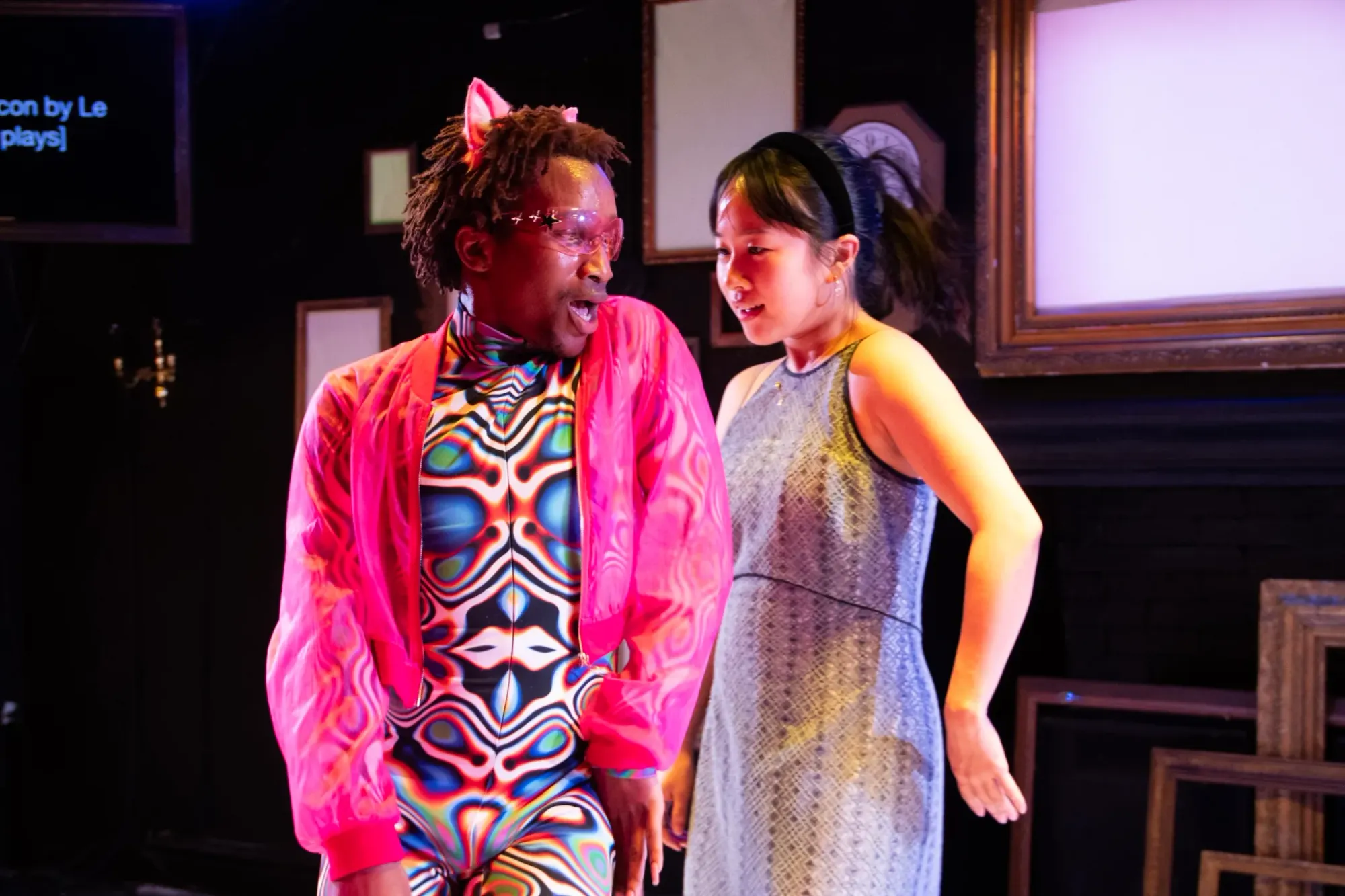
The framed mirrors on the wall were put to imaginative use. When Alice first entered Wonderland, the frames depicted disorienting swirls of black and white. In one of the coolest scenes, Alice disappeared through a door and then reappeared floating through the frames. Once Alice finally arrived at home in the end, the mirrors reflected a tranquil blue sky, signifying that she was in a safe, serene world.
The script was frenetic. (Thank God for open captions.) So were the wardrobe changes; the cast played a minimum of four characters each. They would slip backstage in one costume and come out seemingly in seconds in entirely different, elaborate get-ups. The shifts in body language and personality were impressive, too.
Jack Kelley played Mock Turtle with depressive panache; next he was a boisterous frat boy as Tweedle Dee. Amara Neal was Alice’s overly extroverted friend in the opening scene, then an austere Dutchess who sternly lectured Alice on how to live her life.
Sboniso Thombeni’s pocket-watch-carrying White Rabbit was buttoned-up and filled to the brim with anxiety; his Cheshire Cat was a slinky mischievous creature who danced his way onto the stage with aplomb in a technicolor jumpsuit. That improvised dance number was a hit with the audience.
Of his metamorphosis, Thombeni said, “I come from a physical/movement theater background, so I love being in my body and finding the character in the body first before I even make sense of why I'm saying why I'm saying. [I think:] How does this person exist in their body? How do they sit? How do they live? What do they do when they wake up? And finding those distinctions makes it clearer when I'm this person versus when I'm this person versus when I'm this person. [It’s] also [about] being playful and going to the extreme.”
As nonsensically playful as Wonderland was, there was underlying darkness – especially when we met Humpty Dumpty, played to sinister effect by Ruben Carrazana. His blistering negging was so hurtful I winced when he was on stage. “Who the fuck is Alice?” he said at one point.
Later, it became clear that these over-the-top characters were stand-ins for people and issues in Alice’s real life: emotionally abusive exes, obnoxious siblings, her cat, among others.
Jang played Alice with a grave vulnerability that conveyed a woman who was lost and struggling with accepting and loving herself. Her journey to Wonderland was one of self-discovery. When she finally told evil Humpty Dumpty off at the end, the audience watched her grow up right in front of our eyes.
Eventually, she arrived home. “There’s still time,” Alice said to herself satisfyingly.
Alice spent much of her time in Wonderland being told who she was and how she should behave. By the end, it seemed she felt more in control.
For all of the production’s delightful absurdity, that was the idea that lingered after the bedlam subsided: There is still time to become yourself.


