
W. Eugene Smith and the Art of Witnessing
Yale University Art Gallery
New Haven
Through Dec. 6
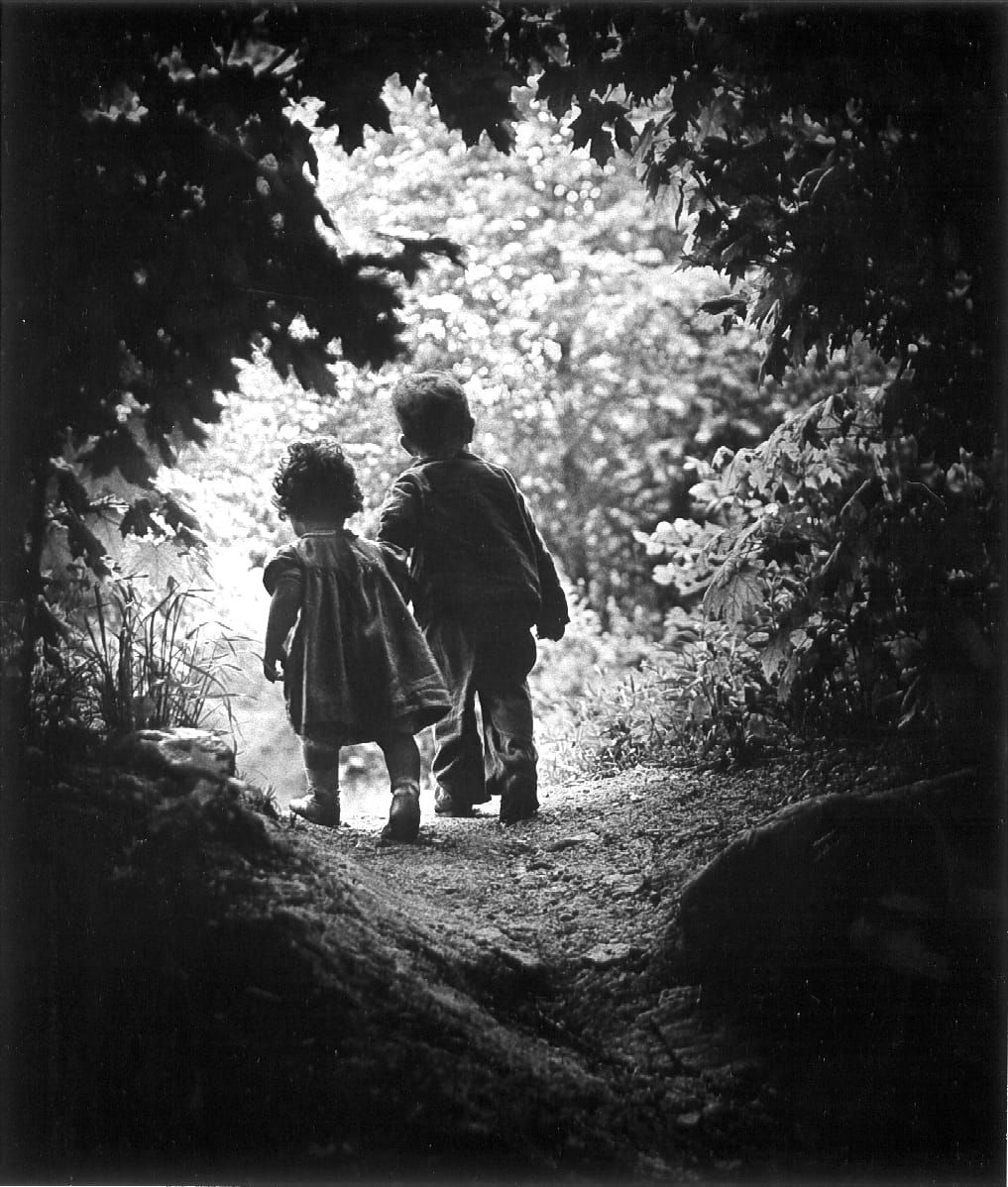
Photojournalist W. Eugene Smith's A Walk in Paradise Garden is one of the more famous photographs of the 20th century — two children walking out of shadow into light. It conveys innocence and hope as few images do. But the darkness around it is just as important. It shows us the danger of innocence, and thus the need to protect it for our kids. It also makes the hope feel earned. Maybe we don't know what light really is until we've walked in the dark first.
The accompanying notes in W. Eugene Smith and the Art of Witnessing — a stunning show running at Yale University Art Gallery through Dec. 6 — gives the iconic photo a deeper context. "This work was Smith's first photograph after two years of recovery from the wounds he sustained in Okinawa," they explain. "It shows Smith's children Juanita and Patrick moving hand in hand toward a sunlit clearing. The image became an emblem of hope and renewal, a private icon of recovery that resonated far beyond Smith's own life. Edward Steichen chose it as the closing photograph of The Family of Man, his landmark 1955 exhibition at the Museum of Modern Art, New York, celebrating the shared human experience."
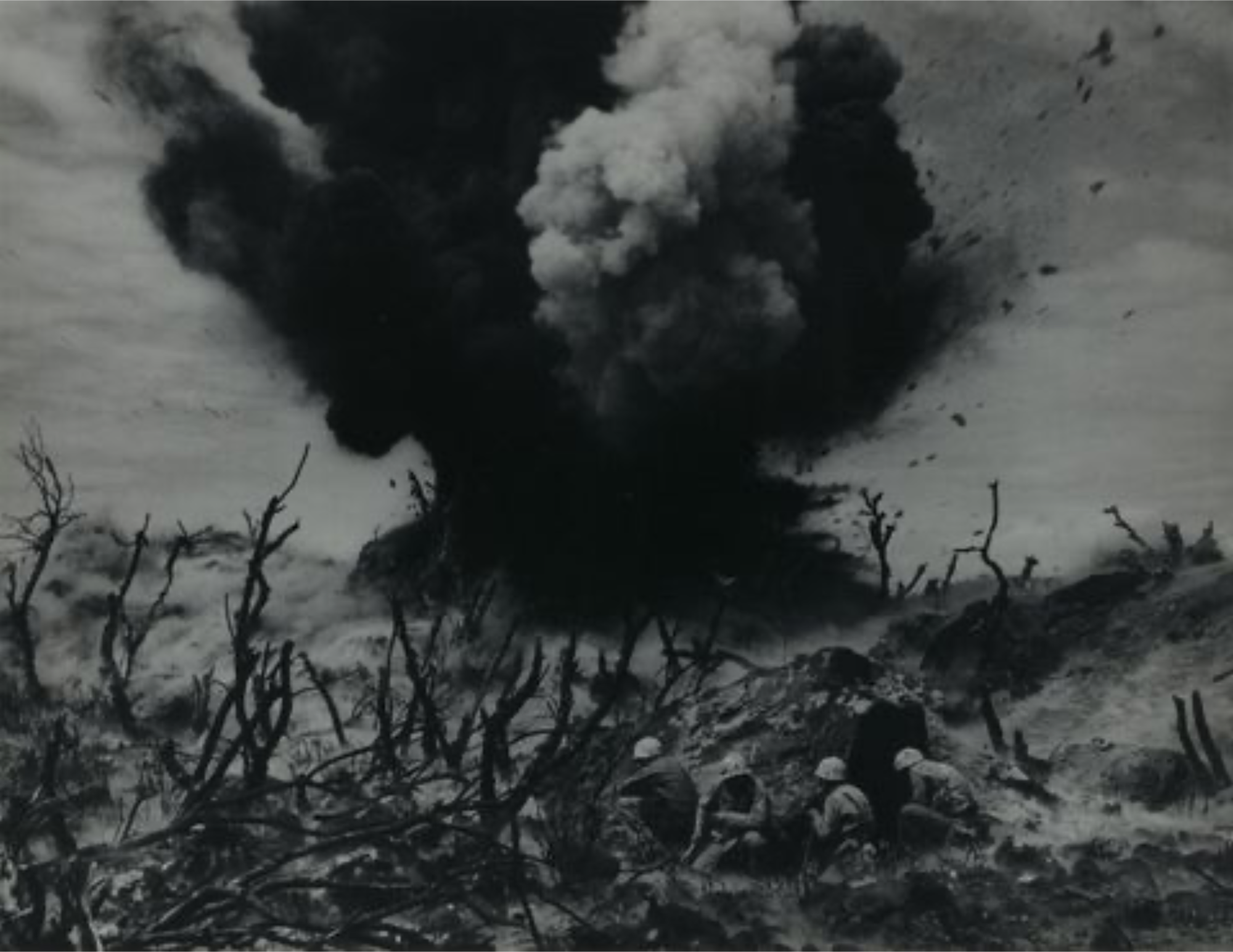
Elsewhere in the show, we see how Smith sustained those wounds, by his willingness to endanger himself for the sake of his work. "Smith covered the Pacific Islands-hopping campaign of World War II as a correspondent for Life magazine, going ashore with U.S. Marines at each landing," the notes explain. "At Saipan in 1944, he documented the brutal cave-by-cave fighting across the island, photographing both Marines and Japanese prisoners of war. At Iwo Jima, he took pictures of demolition teams that destroyed Japanese tunnels and bunkers on Hill 382, capturing the stifling proximity of the battle." His shrapnel wounds to his left hand and face at Okinawa in April 1945 — just months from the end of the war — "kept him from working for two years."
The rest of the exhibition shows just how much work he did. His mastery of his medium, and his willingness to show up, earned him a job with Life magazine, for which he documented combat in World War II, and after that, the life of a country doctor, the lives of people in a Spanish village, and the work of a midwife. He also covered the lives of factory workers in Pittsburgh and, in his "final major series" in the 1970s, the "residents of a Japanese village suffering neurological harm from corporate pollution."
"Journalism, idealism and photography are three elements that must be integrated into a whole before my work can be of complete satisfaction to me," Smith is quoted as saying in the exhibition's accompanying text. The statement works as a guide for appreciating the power of his images, regardless of the subject he trained his camera on. He took many of his photos for journalism assignments, but they also, as the text states, "reveal the abiding humanity he conveyed through careful process, skill, and fearlessness."
Smith's photographs thus work as a primer for how to understand the aims of good journalism as something more complex than being "objective," a goal that is, in any case, an illusion. "Smith's approach was to first acknowledge his own biases and then construct a narrative sequence using thousands of daily notes about what he had photographed and what was still missing," the show's text relates. "Truth was always his mission, though the means to best impart it could vary." Smith himself said that he was "constantly torn between the attitude of the conscientious journalist, who is a recorder of facts, and the artist, who is often necessarily at poetic odds with the facts." It's understandable that he experienced this dynamic as tension. With the passage of time, however, we can see how this tension fueled his work. One fed the other, creating images that did far more than document the historical events Smith witnessed. The empathy in his images drags each moment out of the past and into the present. In doing so, he makes us care about history the same way we care about what's happening right now.
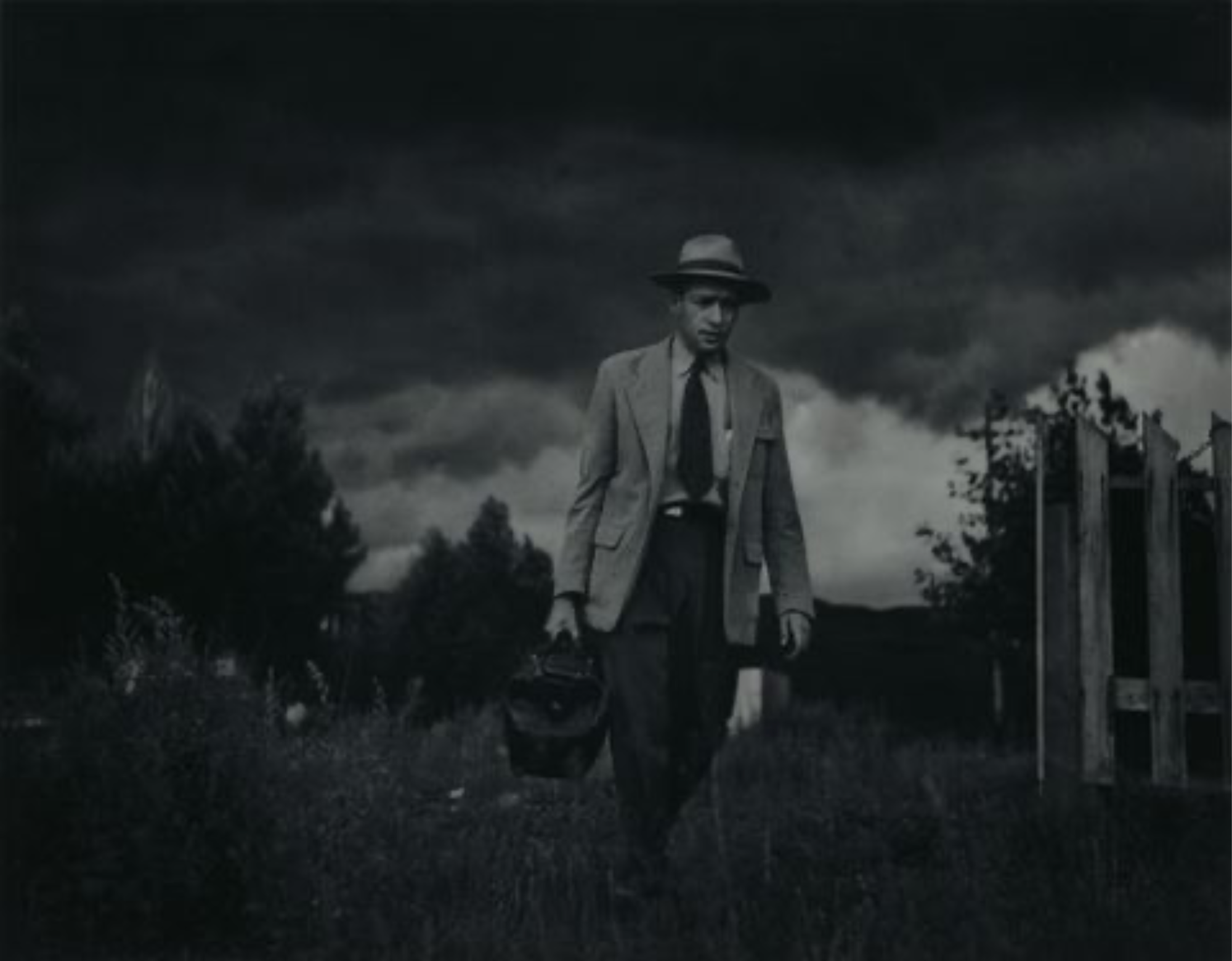
Dr. Ceriani Making House Calls is a photograph that demands to be seen in person. The concern and weariness on the doctor's face are plain to see. The reproduction doesn't capture just how much the landscape, and the clouds behind him in particular, amplify the doctor's emotions, conveying the sense of one man working against mounting odds.
The image was part of Smith's series Country Doctor, which, "published in Life magazine on Sept. 20, 1948, marked a turning point in photojournalism," the notes relate. "Commissioned against a backdrop of growing concern about the shortage of rural physicians in America, Smith spent 23 days with Dr. Ernest Ceriani, the only doctor available to a scattered community of roughly two thousand people in Kremmling, Colorado. Smith immersed himself completely in Ceriani's world-following him through surgeries, house calls, and moments of quiet exhaustion. The essay established a new benchmark for intimate, narrative photography."
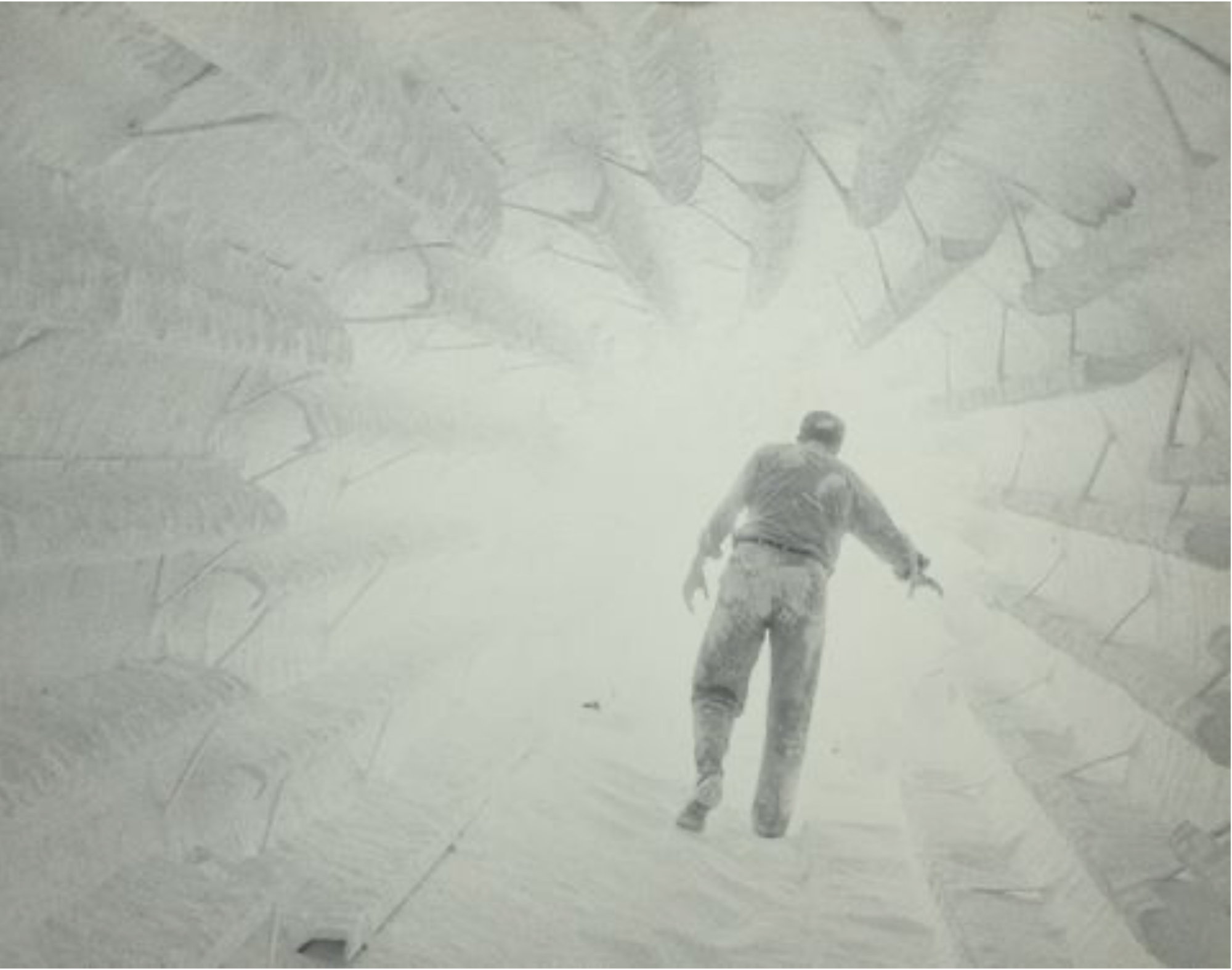
Part of what made that intimate narrative work was the way Smith framed his subjects within their surroundings. Another part was the sheer artistry and technical ability Smith could deploy, as he did for Calciner in a Detergent Factory. "Photographed inside a Monsanto phosphate furnace for The Reign of Chemistry, Smith's essay in the Jan. 5, 1953, issue of Life, this print confronts the central problem of available light when recording industrial work; there is a gulf between what the eye perceives in a high-contrast interior and what film can record. The inspector groping his way into the bright furnace hovers at the edge of visibility. In the darkroom, Smith burned along the frame's edges and bleached around the figure with ferricyanide to lift the worker clear of the glare, preserving the body's presence while letting the machine's scale overwhelm it."
In the context of the show, Calciner in a Detergent Factory can also be understood as a riff on A Walk in Paradise Garden. The human figures are photographed from behind, moving from darkness into light. But in the earlier photograph, where the light conveyed hope and renewal, in Calciner it conveys heat and danger.
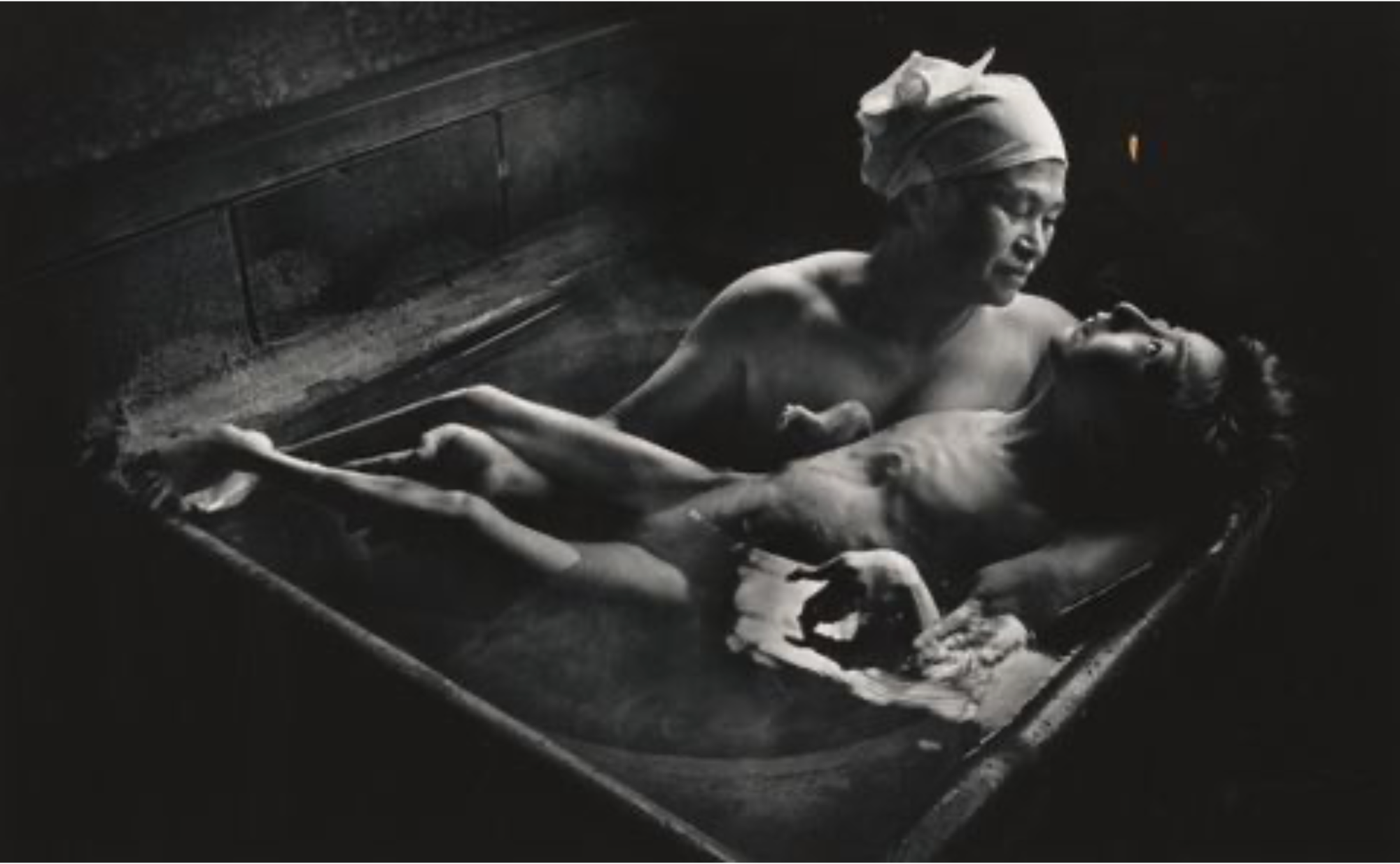
The show allows a full meal of what Smith was capable of with his camera, but it also makes space for his most arresting images, like Tomato Uemura Bathed by Her Mother. "In 1971 Smith and his wife, Aileen Mioko Smith, moved to Minamata, a fishing city on the Japanese coast where the Chisso chemical company had been discharging methylmercury into the bay for decades," the notes relate. "The pollution had caused severe neurological damage across generations of residents. Smith spent three years documenting the victims, their families, and their fight for justice. His photo-essay appeared in Life in 1972, and the full book Minamata was published in 1975."
Smith's personal history around the photograph suggests just how much he walked the walk in his mission to communicate the truth. "During the project, Smith was assaulted by company-hired assailants, suffering injuries that damaged his eyesight. This was his last major work, and many consider it his most morally urgent," the notes relate. His values, however, are even suffused in individual images. "In this photograph, Smith renders an act of maternal care with the formal gravity of a pietà. Ryoko Uemura cradles her daughter Tomoko, whose body was ravaged by mercury poisoning, in the dim warmth of a Japanese bath. Smith's use of chiaroscuro and his signature heavy printing transform the scene into something elemental, closer to painting than photojournalism. The composition was staged collaboratively: Ryoko had suggested the bathing chamber as the setting. The image became one of the most reproduced photographs of the 20th century, a catalyst for environmental accountability. Tomoko died in 1977 at the age of twenty-one. In 1998 Aileen Smith, the artist's widow and collaborator on the project, transferred copyright to the Uemura family."
Today the ability of images to convey truths has been called into question by the proliferation of AI slop. We are being trained to doubt much of what we see if it doesn't happen right in front of us. Smith's work can feel like an antidote to that, not 0nly in the facts of his biography and his subject matter, but in the quality of his images. Where AI is gloss and detail, Smith gives us complex shades and shadows. Where AI gives us faces that are all too easy to read, Smith captures expressions of emotional complication. Through his art, he leaves his fingerprints on his pictures. The subjectivity conveys its own message about how much we can trust them. We know he was a human being with his own biases and blind spots. But we also know, in every frame, that he was there, and he saw what he saw.


