Namtaeryeong: The Longest Night
Women's Film Festival in Gwangju 2026
Geumnam Street CGV Theater
Gwangju
Nov. 12, 2026
(Jisu Sheen recently moved from New Haven to Gwangju, South Korea, where she’s covering local arts and culture for the New Haven Independent and Midbrow.)
In 2024, when Korea was ousting its second president in eight years, I wanted to see what a successful impeachment looked like. So I visited Seoul.
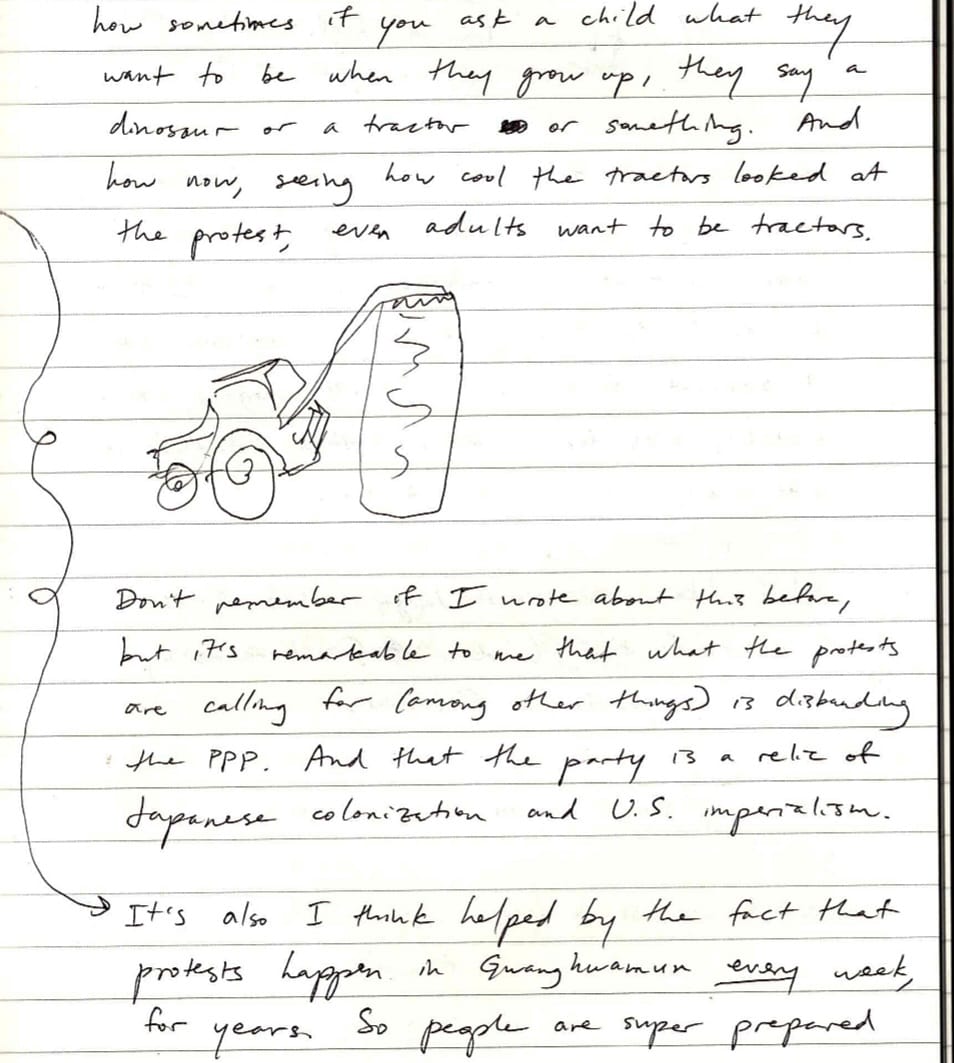
In my diary from that time is a sketch of a tractor carrying a protest banner in its claws. It was an illustration of a story I heard when I reached Korea—one that might have remained a hazy memory if not for a documentary that came out this year, Namtaeryeong: The Longest Night.
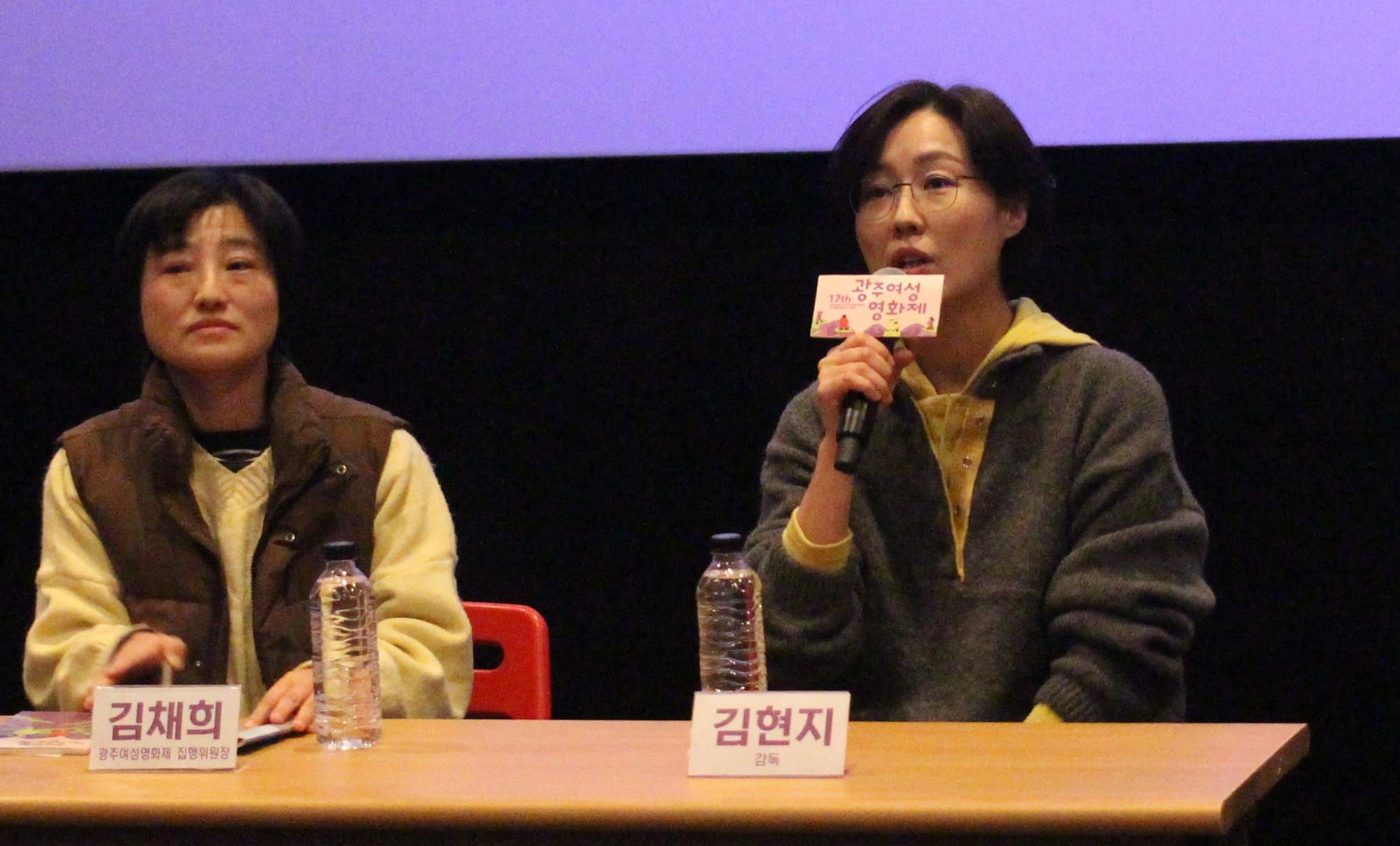
I attended a screening of the film Thursday, the second day of the Women's Film Festival in Gwangju.
The five-day event is a celebration of women's on-screen stories from Korea and beyond. Specialized short film sections let debut directors shine, while feature-length slots show off the hits making this year's festival rounds—including Namtaeryeong, which was the Jeonju International Film Festival's closing film back in May.
The documentary focuses on a single night two years ago, when crowds of young women and queer people in their twenties and thirties descended on Namtaeryeong Pass to support the passage of a farmer's movement tractor protest, which had been blocked by police on its way to Seoul. The protest, led by Jeong Bong-jun Struggle Group from the Korean Peasants League, had a 12-point agenda including demands for the arrest of former president Yoon Suk Yeol and the dissolution of his party.
Yoon, who was actively being impeached, had made enemies on multiple fronts long before his declaration of martial law earlier that month. The far-right figurehead had vetoed a grain management bill that would help farmers earn a living wage, dismissing it as a "typical populist bill." He had built his platform on anti-feminist politics. By the time Yoon pulled his strongest card, he'd already stacked the deck against himself.
As the film puts it, "The president's attempts to end democracy backfired on him and opened up the square."
In the documentary, a young woman in her early twenties stands on the claw of a tractor, addressing the crowd. She had been on her way to an otaku party in Seoul's hip Hongdae neighborhood. Now, her plans had changed.
The story follows the protestors through nightfall as police continue to refuse the tractors entry into Seoul. With no more buses home, the crowd settles in for a cold night. It will be a while before dawn; this is the winter solstice, the longest night of the year.
Police barricades go from blocking the tractors to trapping protestors from all sides. In the film, pear farmer and activist 김후주 (Kim Hu-ju) recalls that it was like the police were "telling us to die."
The film's power lies in its emotion: farmer activists remembering how they cried at Namtaeryeong, and their new comrades recalling the catharsis of shouting with the crowd.
In the director talkback after the movie, an audience member connected Namtaeryeong's scenes of protestors sharing food with Gwangju's history of sharing rice balls during the 1980 uprising against that era's declaration of martial law. It's a phenomenon of care whose simplicity is often undermined—or treated as incomprehensible—by the powers that be.
The documentary mentions how quickly right-wing outlets jumped to claim that the tractor protestors were some pro-North Korean faction. Near the theater where I was watching the doc, over in Gwangju's Jeonil Bulding 245, historical exhibits still work hard to debunk the claim that the civilian uprising of 1980 was a result of secret, coordinated North Korean influence.
Over in the U.S., in Atlanta, Georgia, in 2023, "Stop Cop City" activists protesting the building of a new police training center were hit with RICO charges—racketeering charges meant for mob-type activity. The state's case, which was eventually thrown out by a judge, included definitions of terms like "Mutual Aid," "solidarity," "collectivism," and "zines" as some of the "anarchist ideals and actions [that] undergird the occupation of the forested area that will be the site of the Atlanta Public Training Center."
For decades, across continents, state authorities have had an interest in suppressing the idea that activism can come from a spontaneous human response to injustice—that people can share food with strangers for non-nefarious reasons.
In the film, a young woman talks about arriving at the protests by way of a taxi driver who was giving rides for free. He kept saying, "I'm sorry," she remembers. He was apologizing that while the young people were standing their ground, all he could do was drive back and forth.
Every bit helped.
A food delivery driver, searching for a way past the barricades, ended up walking the final leg of his route.
"I should be part of history for once," he recalls saying. His wife and child had come with him to witness the moment.
In an interview on his farm after the tractor protest, activist Baek Nam Gi sounds out the word "feminism" in English. He admits in Korean that he's not sure what it means and that he now understands "transgender" and "sexual minority" but is unclear on "nonbinary." He remembers someone telling him about the colors of the rainbow flag. Now, he feels a warm familiarity when he sees it.
"Shall I try once again? Fe-mi-ni-sm," Baek repeats. "It's a bit better the second time."
The film shows how, amid multi-pronged pressure, the police finally back down the day after the solstice, allowing the tractors passage into Seoul.
Then the story continues into the months following, making a point not to glorify Namtaeryeong as a singular victory that turned the tide of activism in Korea. Instead, for the thousands that participated and witnessed, the night was a blueprint for what is possible.
As one interviewee puts it: "We did it, so now we know how."
Sign up here to get Gwangju Midbrow email updates delivered straight to your inbox.