
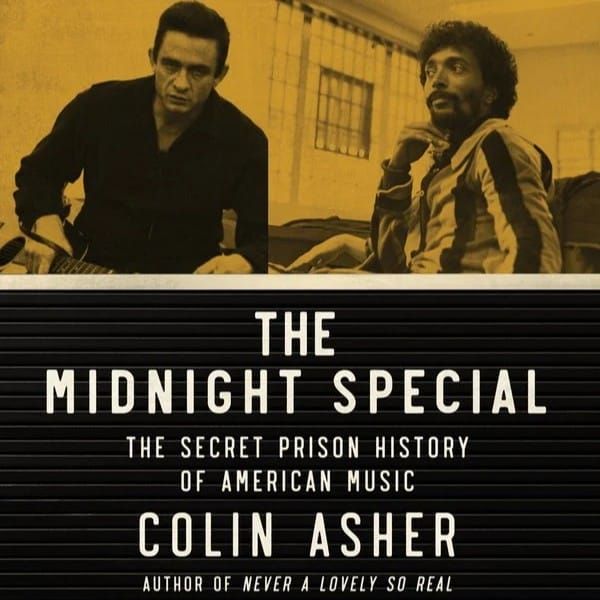
The Midnight Special: The Secret Prison History of American Music
By Colin Asher
W.W. Norton & Co.
Music, as musician and producer T Bone Burnett has said, might be America's "greatest cultural export," and has been for at least a century, from blues, folk, and country to jazz, rock, and hip hop: "We’ve spread our culture all over the world with this music. Music is an important part of our national identity. ... It’s all regional, it’s a never-ending story, and it’s who we are.” What unites a lot of it, across styles and decades, is its devotion to a heavy backbeat, which—unlike so many other rhythmic elements in American music—doesn't seem to have been a direct import from West Africa. The backbeat is what sets America apart, and what brings the world together.
It's impossible to say how that beat got invented. One tantalizing and excoriating possibility comes from field recordings ethnographer Alan Lomax captured at the Mississippi State Penitentiary, also known as Parchman Farm, in 1947. The people held in Parchman Farm did hard labor. Before it was a prison, the farm had been a plantation; Parchman's prisoners did work all too similar to the work enslaved people had done a few generations before. As they did that labor, they sang, keeping time with the rise and fall of their tools.
As the recording captures, plain as day, those tools fall together on the backbeat that has made American music what it is. The backbeat already existed before 1947. But the field calls and songs, we know, are much older than that. What if that's where that big beat comes from? What if the beat the world loves is the sound of slavery, the sound of imprisonment—but also the sound of uplift, emancipation, and liberty, all at once?
The Parchman Farm recordings are just one of thousands of connections between music and prison in the United States. It's natural that so many researchers and reporters are drawn to the subject. Ethnographers have made hundreds of recordings of people making music behind bars. The Marshall Project this year has run a series of fascinating articles about music made in prison across the decades. And this summer sees the release of The Midnight Special: The Secret Prison History of American Music, by journalist Colin Asher. In it, we learn about five musicians — blues musician Huddle Ledbetter, better known as Leadbelly; jazz pianist Elmo Hope; country star Johnny Cash; rock musician Ike White; and hip hop artist Tupac Shakur — almost all of whom served serious time in jail or prison, all of whose art was shaped by it.
Each story is fascinating enough. Asher makes clear that, in the stories he tells, he's chasing something bigger, about what art made in the crucible of incarceration might be able to tell us about American culture.
"There's a repressive strain present in the American psyche — a fearful instinct, rooted partly in our history of slavery, that breeds distrust and leads us to legislate and police away our freedoms," Asher writes in his introduction. "That tendency has driven us to amass the world's largest incarcerated population — but it coexists, dissonantly, with an unparalleled creative drive that has gifted a grateful world the blues, jazz, country, rock, soul, and hip hop. And where those strains of American exception converge, great art is sometimes born."
In the same introduction, Asher is aware that maybe his game might escape him, and he hedges. "Trying to write a definitive history of American prison music would be quixotic. This book isn't that," he writes. "This book tells the story of a criminal justice system that has grown exponentially in size and cultural impact over the last century, shaping our musical culture and the lives of our musicians while they, simultaneously, documented it in song."
This push and pull, going for broke and pulling back, can be felt all the way through The Midnight Special. There is a sense of abundance of information, interesting details, sources to wade through. Asher is deft in distilling them into sharp, glimmering narratives. The bigger story — what does it all add up to? — always feels just out of reach. This is so for a few reasons. Part of it has to do with the way Asher looks back, whom he chooses to focus on, whom he leaves behind. Part of it, as Asher seems to know from the beginning, has to do with the subject itself. The history of American music is a pond with a glimmering surface. Jump in, try to dive below it, and it gets dark fast.
Asher begins with Ledbetter, a blues musicians who famously sang his way to a pardon from the governor of Texas in 1925 after being convicted of shooting and killing a cousin. He found his way to fame after John and Alan Lomax — foundational figures in capturing American music of several genres in the first half of the 20th century — recorded him in 1933 at the Louisiana State Penitentiary at Angola, while he was serving time for an attempted homicide. Asher positions Ledbetter as the archetype of a musician shaped by incarceration. He suffered under the depredations of the prison system. After his release, as Asher writes, the Lomaxes and others marketed his "criminality" as a "shorthand for the authenticity of Black musicians — a formulation" that "white audiences" were "primed to accept." He set "a precedent that musicians have been trying to escape, or exploit, ever since."
Ledbetter might also have the first documented use of the phrase "stay woke," which he recorded in 1938 in a song called "Scottsboro Boys" about nine Black teenagers sentenced to death for raping two white women in 1931, then freed after repeated retrials spearheaded by the NAACP. Asher views Ledbetter through a modern, well, woke, lens. In doing so, he sheds more light on the ways Ledbetter had to deal with systemic White supremacy than previous accounts have. But Ledbetter's story, in turn, sheds light on the ways our modern lens can refract or distort a complex story.
Ledbetter was born in 1888 or so in Mooringsport, Louisiana, a child of sharecroppers. He taught himself to sing and play guitar and accordion, but "there was no such thing as a career in music in Mooringsport, or Harrison County, in 1903 or 1904," Asher writes. His dad called a guitar a "starvation box." Asher's prose turns poetic in describing Ledbetter's musical development, his travels across the seedy parts of the south, teaming up with fellow blues musician Blind Lemon Jefferson. He zooms out to show that Ledbetter was among a cadre of blues musicians who served time and sang about it: "Using nothing but their lyrics, a person could compose a comprehensive and detailed account of post-Reconstruction justice. Incarceration would haunt that work like a looming threat."
Asher is also adept at pointing out the racism inherent in the Lomaxes' project of recording Black people in person. He quotes John Lomax letting his condescension show: "In the prison farms camps," Lomax wrote, music flourished because "conditions were practically ideal. Here the Negro prisoners were segregated, often guarded by prison trusties, with no social or other contact with the whites, except for occasional official relations. ... Negro songs in their primitive purity can be obtained probably as nowhere else from Negro prisoners in state or federal penitentiaries."
Asher relates how John Lomax's racism shapes Ledbetter's career after release; Lomax even makes Ledbetter one of his servants when Ledbetter isn't performing. Asher makes sure we also know that Ledbetter got famous, but not rich, from his music; the money went elsewhere, often to the Lomaxes. It's not a good look, and Asher's portrayal is a good antidote for those out there who see the Lomaxes' ethnomusicological project — vast and important as it is — with stars in their eyes.
Asher seems less sure how to handle Ledbetter's own proclivity toward violence. He takes a curious turn in casting doubt on whether Ledbetter killed his cousin's husband, a fact very few people before Asher have disputed. He portrays Ledbetter's multiple escape attempts from prisons and chain gangs as one thing, a proud Black man refusing to be cowed by an oppressive system. He downplays the crime that got him sentenced in Lousiana, and is inconclusive about the stabbing in New York City in 1939 that lands Ledbetter in Rikers Island for eight months. Asher's New Jim Crow-style argument that Ledbetter suffered under a racist, oppressive system is hard to argue with, and his prose is strong when he writes about it. But it's also true that Ledbetter was involved with an awful lot of violence, and this Asher shies away from. In doing so, he avoids the more complex realities scurrying around his material — questions that many seem to try to dodge these days — in which victims can also be perpetrators, and flawed people can make great art.
Similar strengths and weaknesses play out in Asher's treatment of his other cases. In discussing gifted jazz pianist Elmo Hope — an apprentice to Bud Powell and Thelonious Monk, then a fearsome player in his own right — Asher is at his best in showing him trapped in the maw of zealous police and a system that sets the stage for slow destruction.
Hope is one person in a steady drumbeat of police shootings in the 1940s that continue to this day. He also gets addicted to heroin and arrested for possession and burglary. He's sentenced to Rikers Island for a year and ends up playing with Sonny Rollins in the prison's church band. ("Some of New York's finest jazz talents" ended up in that group, Asher relates.) When Hope gets out, his criminal record means he can't work in New York, and he's forced out to the West Coast. "The New York Police Department's focus on drug arrests, and its control of cabaret cards, gave it, arguably, more influence over the development of the city's jazz scene that any other institution," Asher argues, and in jazz, "Black musicians understood that a history of addictions, or convictions, was a liability." Meanwhile, "fear of Black cultural influence guided law enforcement's focus on the jazz scene." But Hope's own responsibility in his dissolution is given a light touch. Asher says that it follows a typical arc: "An artist of great talent rises, stumbles in the face of adversity, and ends their career with their body failing and their talent dissipated." By not separating adversity from society and adversity from within, Asher avoids some complications. It also makes his telling of Elmo's story stop short on delivering insight.
Asher's choice to visit the genre of outlaw country is laudable. He's astute in pointing out that "the country outlaw is white so his violent urges read as an expression of his prideful masculinity, not wickedness our debasement. There's something valorous in the way he lashes at the world," as opposed the complications Black musicians face. Asher shows how Johnny Cash's genuine interest in prison and prison reform created a feedback loop between creativity and political activity for him. He also points out that Cash never served time himself, despite several run-ins with the law for drugs and bad behavior. He "paid no price for his association with criminality and wasn't constrained by it." It's a good point to make, but one might wonder why Asher didn't focus on Merle Haggard instead — a juvenile delinquent who heard Cash while serving a sentence in San Quentin. Haggard, like Ledbetter, embodies tough questions with no easy answers. Cash's story allows for an easier out.
Similar attention to some details and not others shoot through Asher's depictions of Ike White, whose musical talents flourished in prison, but who floundered after release. By the time he gets to Tupac Shakur, the problems in dealing with the material are laid out in front of him. Asher spends a high word count on Shakur's mother and her activities with the Black Panthers, to frame Shakur as a poet of conscience for Black people. He documents Shakur's conflicted feelings with being associated with gangster rap. It still makes it hard to square with Shakur's shooting of two cops, and the sexual assault and weapons possession case that led to his imprisonment.
Asher finds his footing in a critique of the framing around Shakur.
"Prison moves some musicians to greatness." but "that wasn't Tupac's experience," he writes. "Instead of escaping into his art, he became preoccupied with gaining his freedom." He points out how hip hop managed to regain some of the clout of serving time that some white country musicians had: "The outlaw image used so effectively by country artists could, suddenly, be claimed by Black artists too." And he ably connects the musical genres he touches on by pointing to them all as documenting systemic abuses from authorities. Both hip hop and blues, he points out, discuss "law enforcement as hunters, law enforcement as oppressors, and law enforcement as illegitimate."
But as Asher himself writes, "as a great man once said, 'Yes, I know this book is incomplete.'" The Midnight Special is long on good storytelling but short on analysis. But it's not just the lens of contemporary politics that gets in the way. There is also the broader and unexplored way that music and prisons are connected in the United States because music and crime are connected.
Outside of the classical world and the precious and few rich and famous, musicians (and I am one) are a caste, a notch above petty criminals, and inextricably associated with crime, organized and otherwise. The modern music industry got its start in the speakeasies of the Prohibition Era, and mafia and other organized crime lurk around nightclubs, places where it's easy to launder money. Musicians work at hours most people are asleep, and when many crimes are committed. They're often paid under the table and in free alcohol. Drugs, and the drug trade, are close at hand. The low-grade tension of being a musician is taken as part of the job. But it's not something most of us will talk about outside of a joke or two, and definitely not something the criminals within arm's reach will go on record to discuss. For someone chasing it, the story will always bob and feint, recede into the shadows, and the shadows go way back. Maybe way back in the darkness, there are a group of people who can decode the questions a book like The Midnight Special opens up. Maybe they even have something like answers. But they're not telling.


