
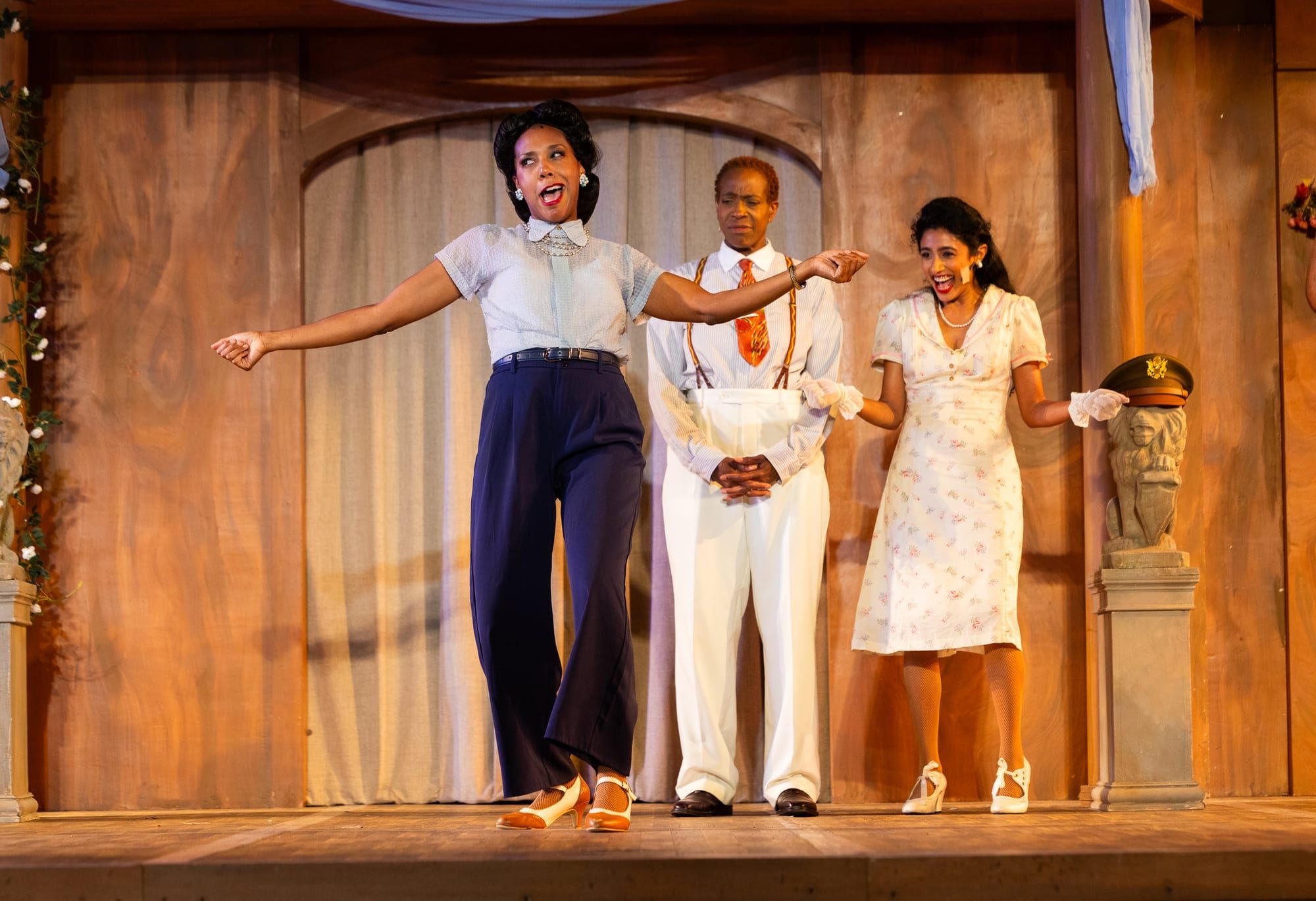
Much Ado About Nothing
Elm Shakespeare Company
Edgerton Park
New Haven
Through Sept. 6
It seems as if this is just the ideal time for Elm Shakespeare Company to stage one of Shakespeare’s most popular comedies, Much Ado About Nothing.
At last, following years of Much Ado About National Strife, we can all bring our folding chairs, blankets, and libations to a glorious outdoor setting in Edgerton Park and cast off our cares of consequence for at least two hours and ten minutes or so..
Given the promise of the performance as judged from its delayed opening night Friday—after much ado about the rainy weather the evening prior—this savvy cast and crew largely deliver.
For those in the alfresco audience, aware of the noise and despair rife in our society, here was a chance to revel in a different, less stressful level of deceit, betrayal, tricksterism, and conspiracy, confined merely to private matters in the city of Messina, Italy.
The issues are the rocky road to matrimony and the true character of the characters. The shooting war they fought is over, and they are left with only good old domestic strife.
There is no point in relating the complex plot in great detail here, except to say that nearly all the leading characters are sufficiently nuts until, almost by magic, they regain their sanity before it is too late.
Chief among this confused crowd are Leonato, father of the fair Hero, a highly eligible young woman; her boneheaded beau, Claudio; and the two primary figures, Beatrice and Benedick, who spend much of the evening slaying each other’s spirits with destructive witticisms. As Benedick puts it, “Thou and I are too wise to woo peaceably.”
Christina Acosta Robinson as Beatrice and Gregory Phelps as Benedick make the most of the Bard’s nuance and wisdom—and of the considerable physical and linguistic comedy available to them.
Suffering Benedick alleges that “there was never yet philosopher that could endure the toothache patiently,” and Beatrice, much against her apparent nature, insists she is “as merry as the day is long.” The two are especially adept at the stage acrobatics required as each eavesdrops on false assertions that the other is secretly in love.
James Keegan as Leonato, Veda Baldata as Hero, Balfour Clark as Claudio, and the rest of the cast articulate the comedy’s dialogue persuasively but are especially adept at the theatrical body language their roles require.
If audience members are distracted even for a minute by the chorus of park crickets, they may miss theater of the absurd long before there was a Theater of the Absurd.
All of the actors acquit themselves well, despite a few opening-night snags, including body mics that occasionally buzzed in and out. They even evoke a crowd reaction that brings to mind, if only faintly, the groundlings at the old Globe Theatre in London.
There, audiences held back nothing—shouting, swearing, warning characters onstage about the deceits floating around them.
Here in New Haven, the crowd is customarily more tempered and considerate —something the Bard himself might not have preferred. The interaction is far more muted, though late in the play the comically incompetent constable Dogberry, as played by Elizabeth Daingerfield, provokes considerable merriment while carrying on one of literature’s more memorable riffs on the word “ass.” Who says we common folk can’t quote Shakespeare with ease?
The Bard might also be surprised to discover that he had written popular music.
For this production is replete with intervals of 20th-century classics, both recorded and performed live: “The Way You Look Tonight,” “Don’t Sit Under the Apple Tree (With Anyone Else but Me),” and even the march from The Bridge on the River Kwai whenever Dogberry and the constable’s crew of idiots appear. In all, it is something of a symphony for nostalgic ears.
But then, the Bard did write the line, “Speak low, if you speak love,” which centuries later inspired the poet and lyricist Ogden Nash to write “Speak Low,” set to music by Kurt Weill for the Broadway musical One Touch of Venus.
No doubt some of the crowd that decries the updating of classics will also find fault with this production, perhaps dismissing it as Shakespeare for Dummies. As one of the dummies, I was delighted to find myself practically dancing to “Sing, Sing, Sing” and Gene Krupa’s drumming.
Veterans of these magical nights in the park (now in its 31st year) will notice immediately that the stage is no longer in its traditional location but has moved nearby to a spot that allows the audience to surround much of the action rather than watch from the more formal arrangement of previous years. The change suits this play particularly well. Shakespeare, after all, was never meant to be approached with excessive reverence.
And perhaps that is the particular pleasure of Much Ado About Nothing in Edgerton Park at this particular moment: The conspiracies are ridiculous, the betrayals repairable, the wars already over, and even the fools eventually stumble toward something resembling happiness.
That alone may be worth bringing a folding chair.
The admission-free run of Much Ado About Nothing continues through September 6, with performances Tuesdays through Sunday beginning at 7:30. Music by cast members precedes the play performance and culminates in a rousing rendition of Louis Prima’s “Buona Sera, Signorina.” Elm Shakespeare Company’s production is made possible by corporate and civic donors and by audience members who contribute during the evening,.


