
TPAC Produces: Rodgers and Hammerstein’s Oklahoma!
Tulsa Performing Arts Center, Williams Theatre
July 24, 2026
For its third foray into in-house professional theatre, TPAC Produces brings a Golden Age classic and regional crowd-pleaser to the Williams Theatre: Rodgers and Hammerstein’s first collaboration, Oklahoma! Based on the play Green Grow the Lilacs by Lynn Riggs (the Claremore native whose name and likeness appears on the Dennis R. Neill Equality Center’s black box theater), the story follows a settlement of farmers and cowboys who live on unincorporated, northeast Oklahoma land in 1906. The interpersonal drama that unfolds in their lives complements the larger movements outside of this small settlement, where advancements in urban hotspots like Kansas City and the promise of statehood on the horizon incite a wholesome thrum of hope for what the future holds.
It might seem odd for an Oklahoma-based theatre critic, but I’d never actually seen the state’s namesake musical before. Not being Oklahoma-born, and not having grown up with these songs ringing through my consciousness, Oklahoma!’s frequent, often fervent inclusion into the state zeitgeist has always eluded me. (We don’t sing “Meet Me in St. Louis” during the seventh inning stretch at Cardinals games, you know?) I purchased my ticket both excited to finally see this classic and curious why Okies go so hard for it.
TPAC has gone all out to make this event special for Oklahoma! enthusiasts. With staff decked out in cowboy hats and boots, a pre-show barbecue dinner as an optional add-on (with exclusive access to the original surrey with the fringe on top), and a mini lobby exhibit that features show artifacts and a nod to Lynn Riggs, there’s a lot happening around this production to build it up. My one recommendation would be to include descriptive placards in the exhibit. Talking with some fellow audience members on my walk around the lobby, I heard non-fans and fans alike express confusion about what exactly we were looking at, let alone why it was important enough to be on display.
The pre-show chatter ran the gamut of expectations. One woman said she loves Oklahoma! She was a bit worried about the quality of the show we were about to see, having walked out of a production in the Williams before (I didn’t press to ask which), but felt an obligation to support. Another woman said she last saw the musical decades ago at Discoveryland with indifference. My seat buddy, Wes, was an excited first-timer like me.
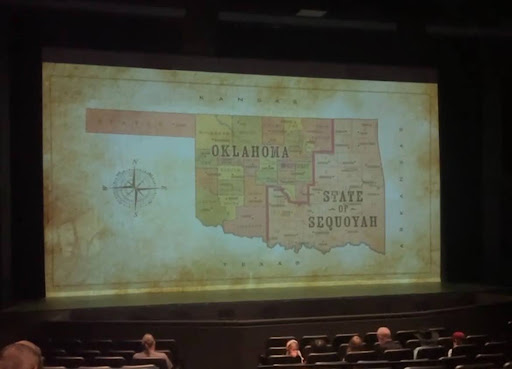
Before music director Cathy Venable raised her baton, the production was already surprising me. One unexpected moment fills the visual space right away: the state map projected onto the curtain prominently includes the State of Sequoyah, an unapproved state for Indian Territory that tribal nations proposed in 1905. Also notable: the female lead (Ruby Shadley as Laurey) is the first-billed actor on the program. Both decisions felt rather progressive for a musical that made its Broadway debut in 1943.
But don’t be fooled, this is not the modern, gritty 2019 Broadway revival that stirred up some big feelings when it debuted. In TPAC’s production, director Peter Otis embraces the luxurious indulgence often associated with traditional, feel-good, Golden Age musicals, though with a more relaxed start. A fluttering overture slowly welcomes the audience into the story. About halfway through, the lights slowly illuminate the stage in warm, high-contrast hues that resemble a breathtaking early morning sunrise. All we see on the stage is Aunt Eller (Thesa Loving) slowly churning butter. It’s a deliberately slow but not boring start, a warm welcome into Rodgers and Hammerstein’s world.
This alluring feeling continues into the opening song. Like an echo in the recess of your mind, Curly’s buttery voice lofts in the air as Conor Jordan sings the chorus of the opening song, “Oh, What a Beautiful Mornin’,” announcing his entrance. Jordan’s rendition of the song is masterful: slow, billowy, and filled with a good-hearted, confident charm that made me like him immediately.
We’re introduced next to Laurey, whom Shadley plays as warm but reserved and clearly burdened, not just with choices but with certain knowledge we learn about later. While this acting choice in conjunction with the Southern accent made it difficult for me to understand what Shadley was saying at times, her singing was crisp, precise, and truly beautiful.
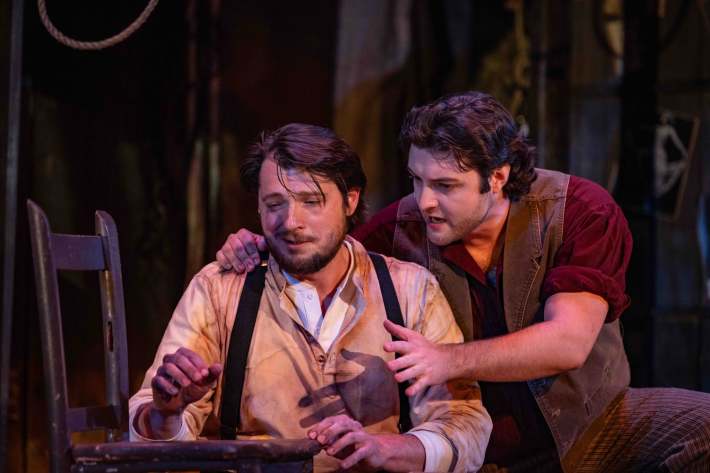
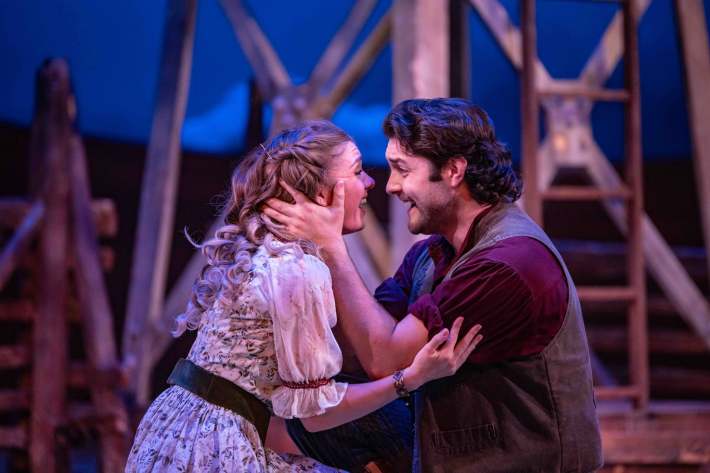
I’ll add, Laurey’s reserve did nothing to damper her chemistry with Jordan. Whether they were bickering or singing the dreamy duet “The Surrey with the Fringe on Top,” their pull toward one another was apparent. In fact, it was so strong that I was surprised and confused when Laurey was so insistent that Jud, the surly stablehand with a consuming infatuation, take her to the box social. I could tell she hesitated to even entertain the idea, and she clearly already had Curly’s attention without riling up his jealousy … so why was going out with a man who was creeping her out an option to begin with?
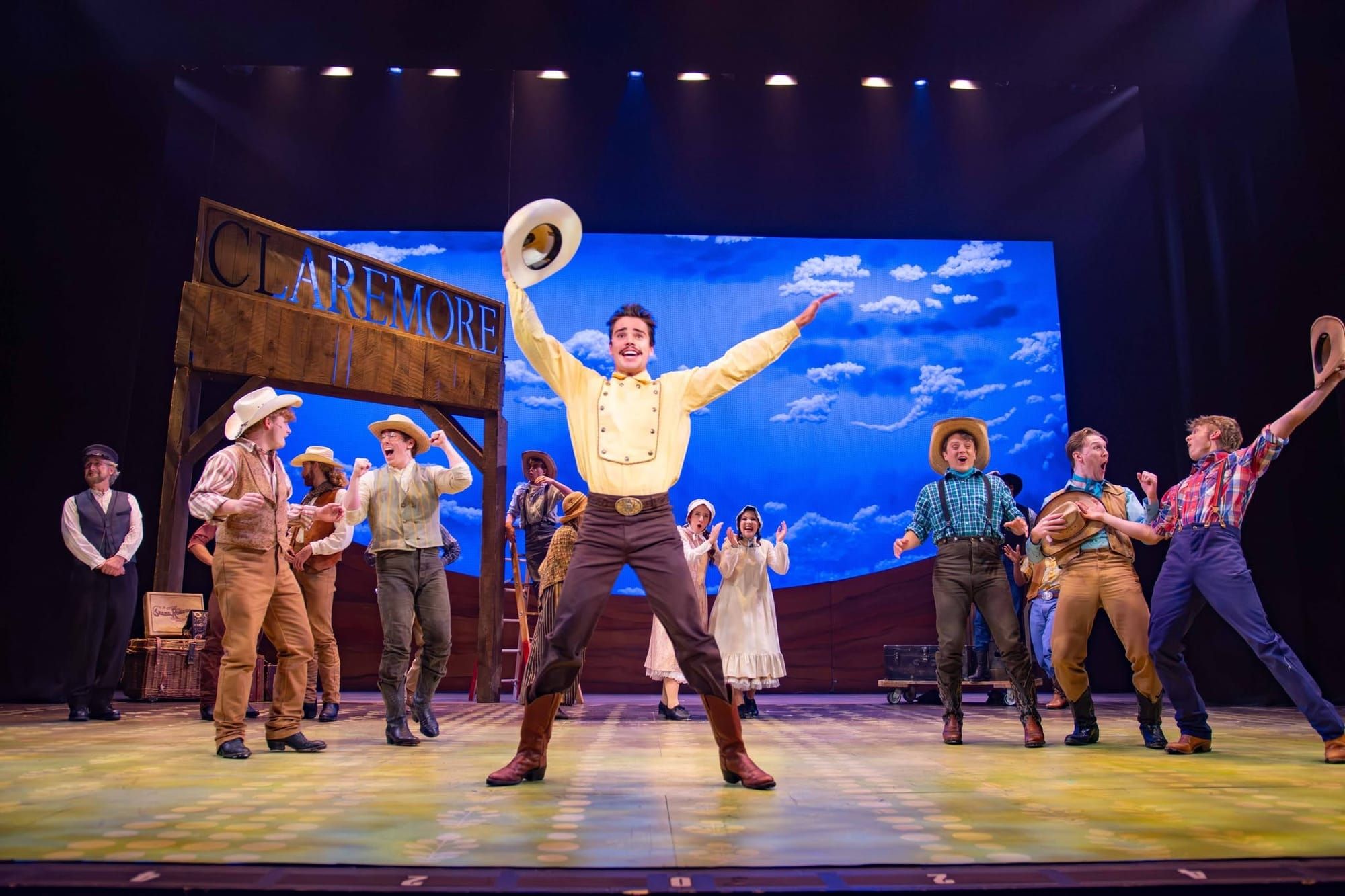
Oklahoma! might not answer all its own questions, from Laurey’s choices to the future of this settlement in Indian Territory, but let’s face it: this is a musical about dreams, not necessarily explanations. After its gentle introductory scenes, the show continues as the sort of high energy song-and-dance spectacle I was expecting. We arrive in Claremore for the rousing number “Kansas City,” featuring a near-perfect tap number that the male chorus performed in cowboy boots, followed by the equally entertaining song “I Cain’t Say No,” Ado Annie’s comedic lament about her woes with monogamy, performed by the energetic and hilarious Becca Worthington.
Act one continues through another swoony duet featuring our leads, Jud’s villain anthem “Lonely Room” (performed by Grayson Schreiber), and an enthralling 15-minute dance (choreographed by Jen Alden) that depicts a trippy dream Laurey has after she huffs some laudanum from a peddler, all in an attempt to figure out whether she truly loves Curly or Jud.
Act two starts a little slower: a lunch basket auction didn’t keep quite the urgency needed to bring us all the way back from intermission, but it didn’t break the high energy for long. The songs, dances, and drama sustained my attention until the 11 o’clock titular number—a truly rousing, show-stopping moment. The entire audience erupted in a standing ovation; the most non-musical-theatre-looking Gen X’er I’ve ever seen gave a quiet and guttural “yes!” The applause for Oklahoma’s state song went on and on, only stopping because the actors cut it off. I still wonder how long the audience would’ve gone if left uninterrupted.
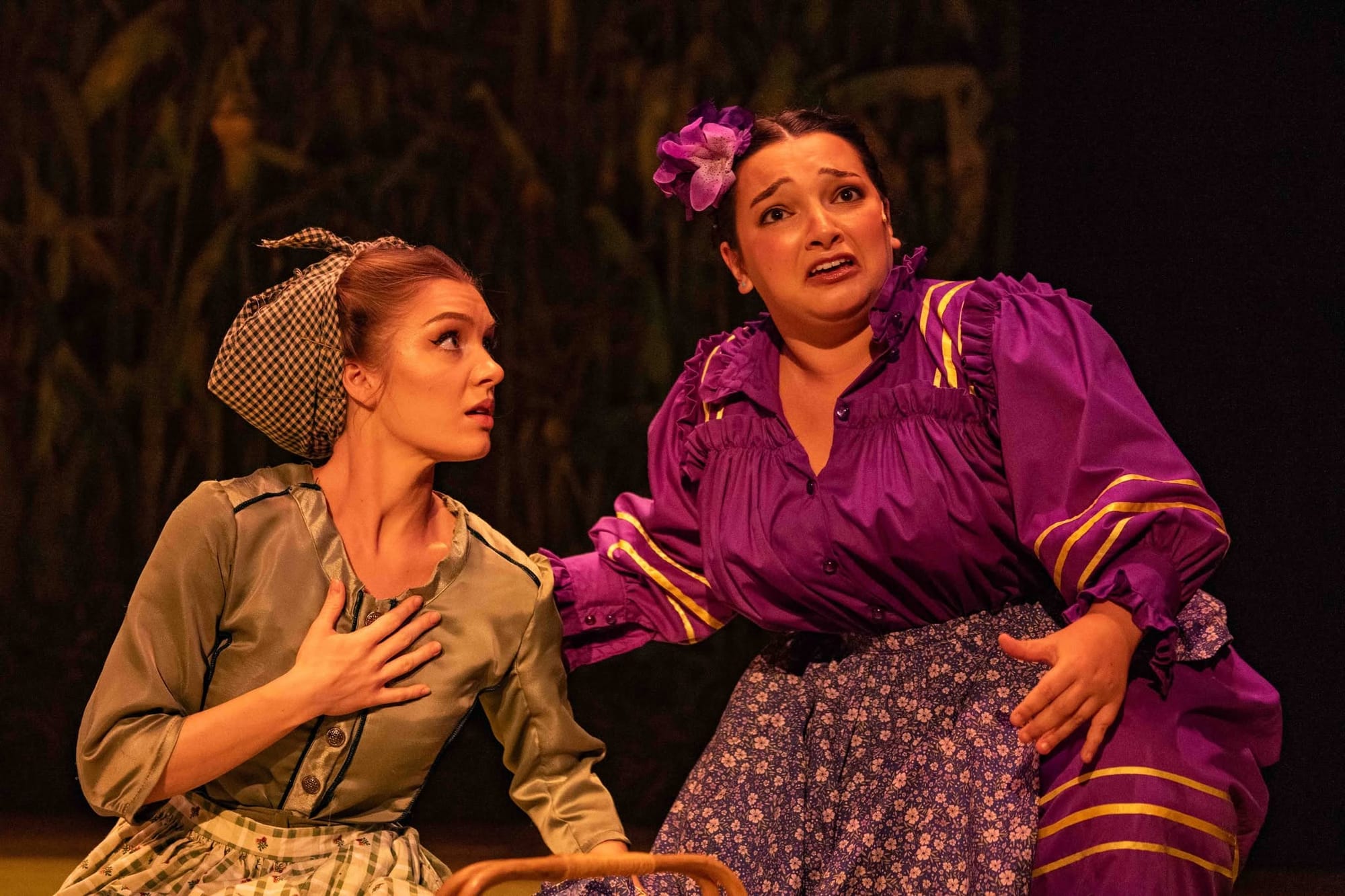
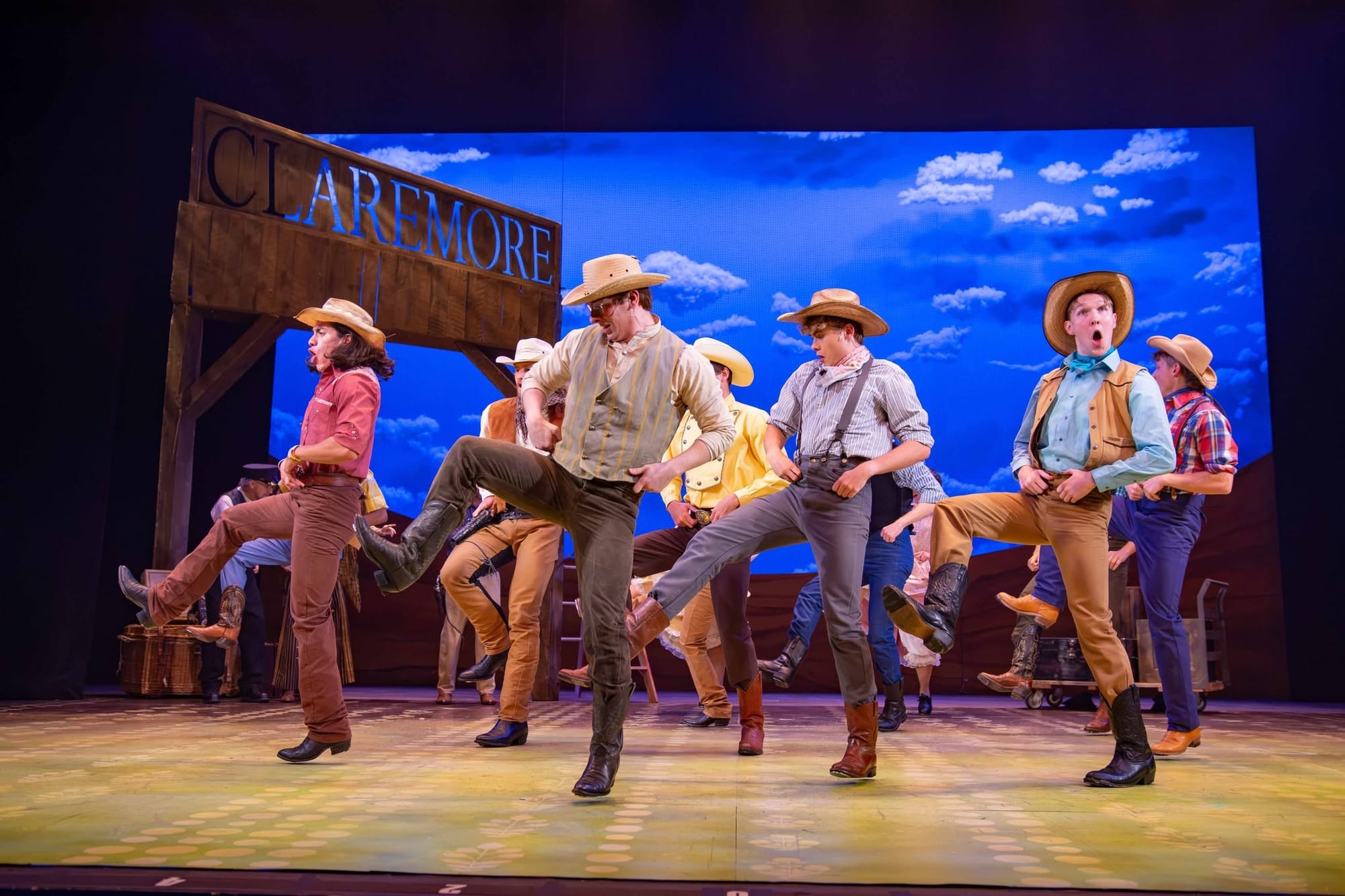
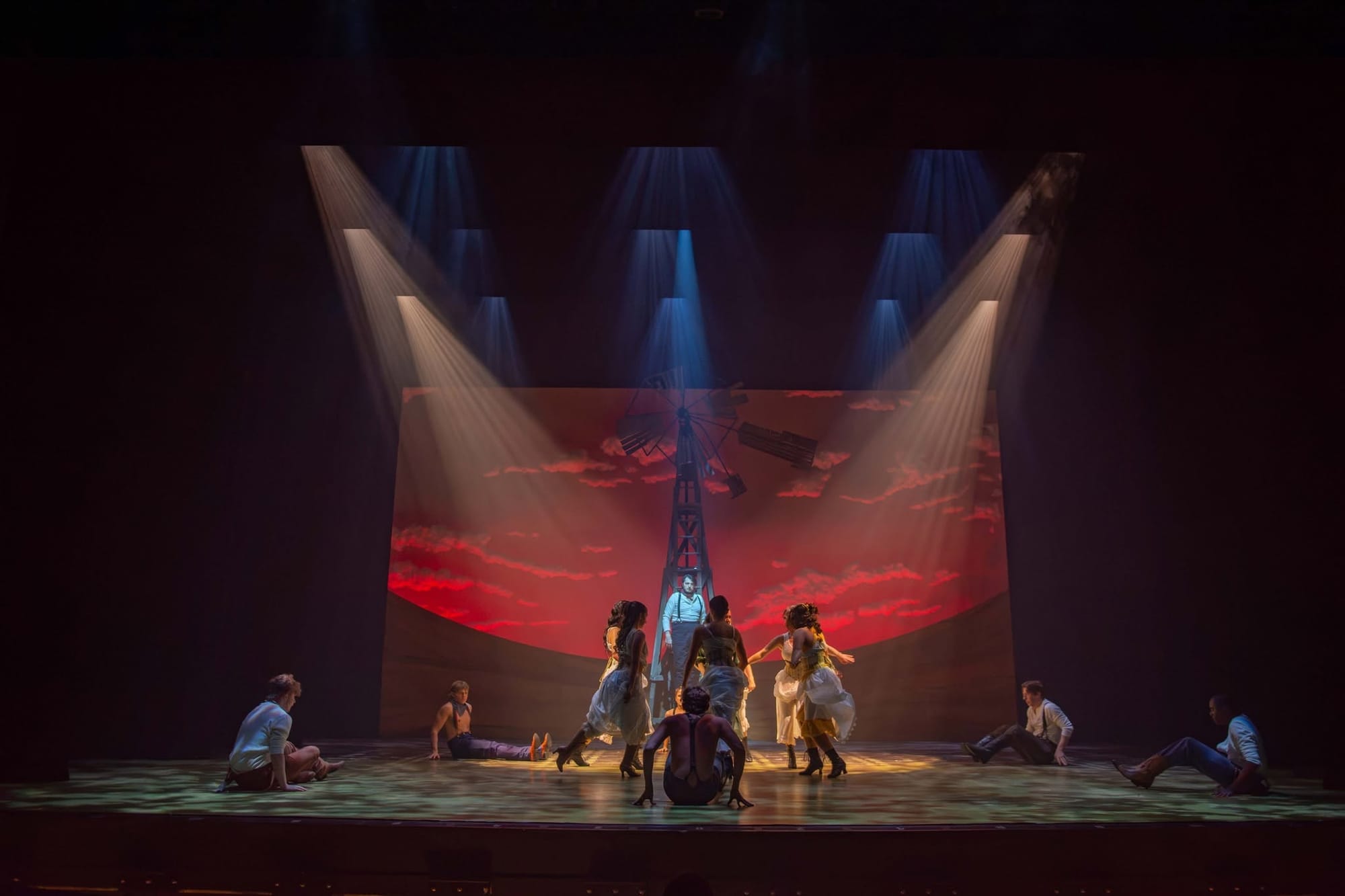
Photos by C. Andrew Nichols
Spectacle aside, I did not expect to become so invested in the plot of this musical. As I watched the various storylines unfold, my mind filled with questions: Would Will get the money together to marry Ado Annie? Would Ado Annie really be personally satisfied with married life? Is Jud that bad or are we casting judgement because he’s quiet and likes risqué photos?
In fact, I was so wrapped up in these stories that watching them conclude made me unsatisfied. As expected, the tone was pulsatingly optimistic and everything wrapped up with a neat little bow, but Rodgers and Hammerstein’s sanitized ending almost felt like a disservice to the characters with their very real, complex, un-exclamation-pointed feelings. I couldn’t buy that this was entirely a happy ending.
But Otis’ direction is aware of this—in fact, he gently calls it out throughout the show by using technical elements to make the events unfolding on stage feel like they might actually all be part of a dream. Deanna Byford’s lighting design, specifically with the giant sky backdrop, doesn’t document the passing of time, but rather uses color and movement to guide the audience through the characters’ different emotional states by darkening whenever a song begins. The back and forth between midday sun and bold cool colors is almost trance-inducing, giving an effect of nodding off and waking up from sleep.
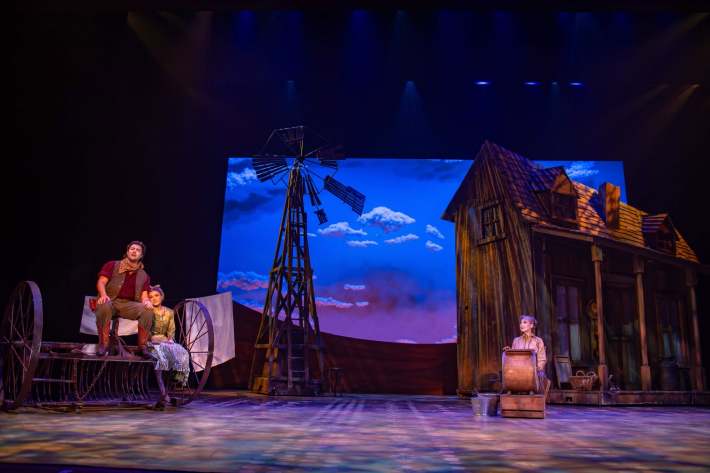
This surreality is enhanced by Crista Patrick’s costumes, which cleverly highlight the main characters in bold hues and dress the romantic leads in complementary colors (red and green for Curly and Laurey, purple and yellow for Annie and Will, some yellow embellishments on Ado Annie’s traditional Native American tear dress).1 In this world’s dreamscape, soulmates are predestined, obvious to the world around them even if the characters themselves are oblivious.
These subtle but clever design and directing choices allow TPAC’s Oklahoma! to present a classical take on a classic production, while gently challenging the somewhat idyllic depiction of the Sooner State that Rodgers and Hammerstein present. In a poetic parallel to the content of the musical, Otis embraces Oklahoma! for what it is: not the reality of what was but the dream of what could have been, or even what could be.
You’ve got three more weekends to let this Oklahoma! flood your pleasure receptors, hit your nostalgia buttons, and maybe spark some new questions about what it means to “belong to the land.”


