
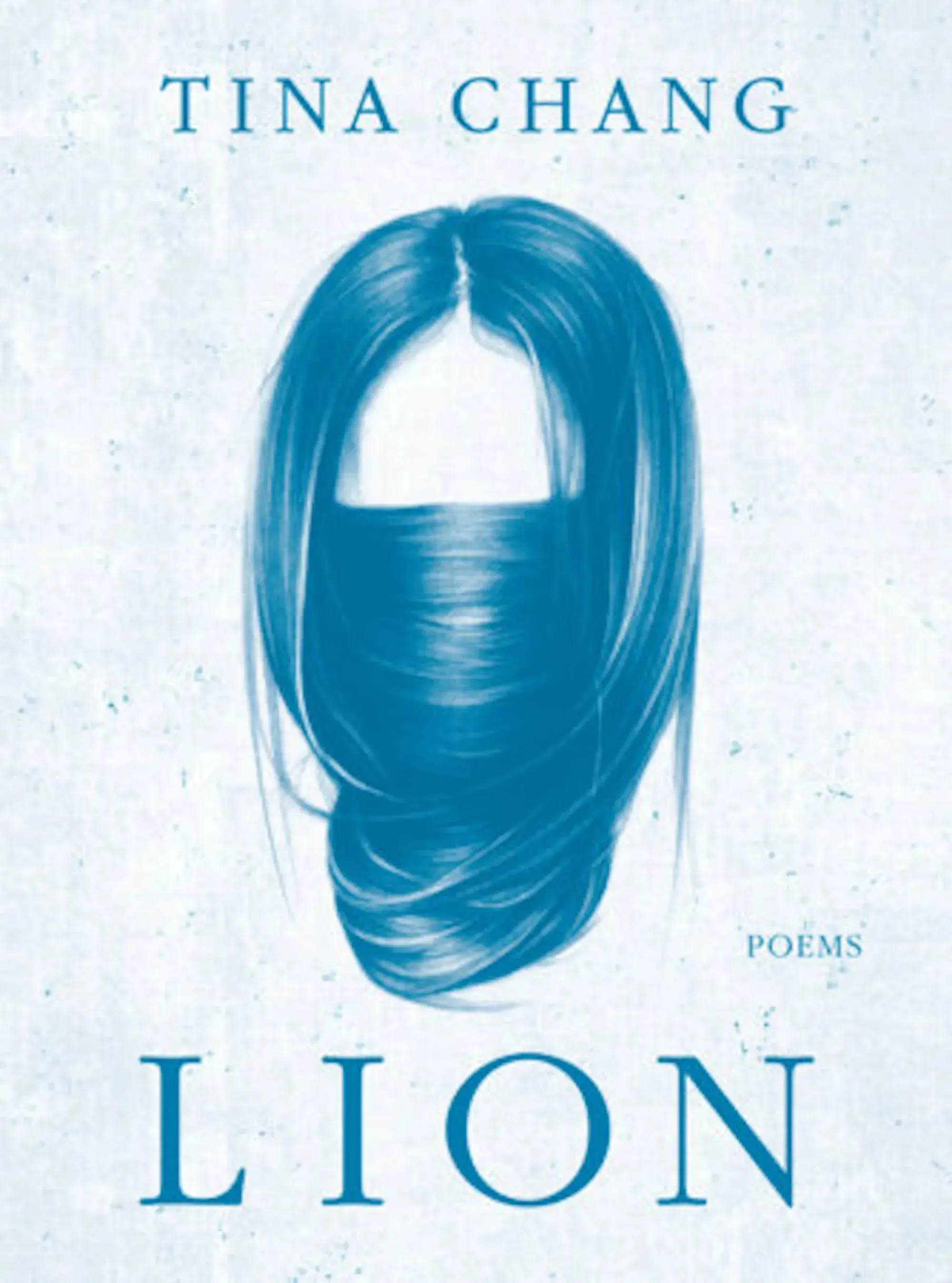
LION
By Tina Chang
W. W. Norton & Company
Releases Oct. 6, 2026
I picked up Tina Chang's LION after two years of rebuilding from a quarter-life crisis.
Tina Chang, the first female poet laureate of Brooklyn, is professor of English and creative writing at Binghamton University. After authoring three poetry collections, she returns with LION, a four-part collection of poems and responses to other women artists that result in complex dialogue about both visibility and invisibility for Asian American women.
I've been so busy erasing and rewriting myself for my career, that I'm almost ashamed to admit that I’ve tried to ignore my born-in identity as a Korean-American woman. I suppose I was afraid to give more language to an unforgiving reality, when I was already struggling. Reading LION, I realized that even in my often-lonely quest to rebuild, so much of my pain and endurance are shared.
LION is filled with collective accounts of disappearance. In the aptly-titled "Selective Seeing," Chang writes of the daily experience of an Asian American woman who has to touch her own hand to remember she exists, as she steps into a neighborhood that is not her community. Even her dog can't relate, instead "look[ing] on with unknowing compassion" on the many days where the "only interactions she might have had were with the mail carrier, a cashier at the local market, a neighbor she passed on her daily walk."
Amongst many accounts of a shared ache from being so forgotten, Chang interweaves details of her personal life. In a list of what she has inherited, she receives the abstract, like a "charge," "the energy;" and the physical, like a nurse's uniform, "folded in half and then again." She mentions her stepfather towards whom her "mother told me to stay silent," when she writes of violence in the home. There is an invitation to replace those identifiers with what I’ve inherited, and who I grew up with, both the nostalgic and cruel.
Chang also challenges the idea that disappearing is only a gradual fading into obscurity, by dissecting her own and public response to the 2022 murders of Michelle Alyssa Go and Christina Yuna Lee, and the 2021 Georgia Massage Parlor shootings. All of the victims were Asian American women.
Although there was a recognized surge in anti-Asian hate crimes during and after the pandemic, the more violent the crime, the more resistant law enforcement was to label it as a "hate crime." Chang cites headlines:
Asian American Woman Pushed Into Subway Tracks
Authorities Say it was Not Racially Motivated
Georgia Massage Parlor Shootings Leave 8 Dead
Authorities State it was Not Racially Motivated
In an act of resistance, after cobbling together public details of the victims' lives, Chang "keep[s] women safe from harm inside my notebook though the details of their true lives are unknowable to me."
On a good day, there was anger in my tears as I watched playback of vigils. On most others, I quietly planted my back against a wall to wait for the train.
Chang retreats within herself and isolates to feel safe, before realizing that she has also shut herself off from moments of genuine connection. I remember running away, too, trying to frame my choice to further disappear as empowering. We have both paused to pursue meaning elsewhere, outside of being seen: "I move inward, to safer rooms."
I appreciated that Chang spoke of the capacity to have rich inner lives in the face of ongoing threat, writing, "I often feel the most love for the world when I'm alone."
I interpreted it as retreat, when done intentionally, can be the rest needed to fuel our survival, which already defies the odds. But by having this rich inner life, when we introduce ourselves back into the world again, we are so overwhelmed by grief.


