
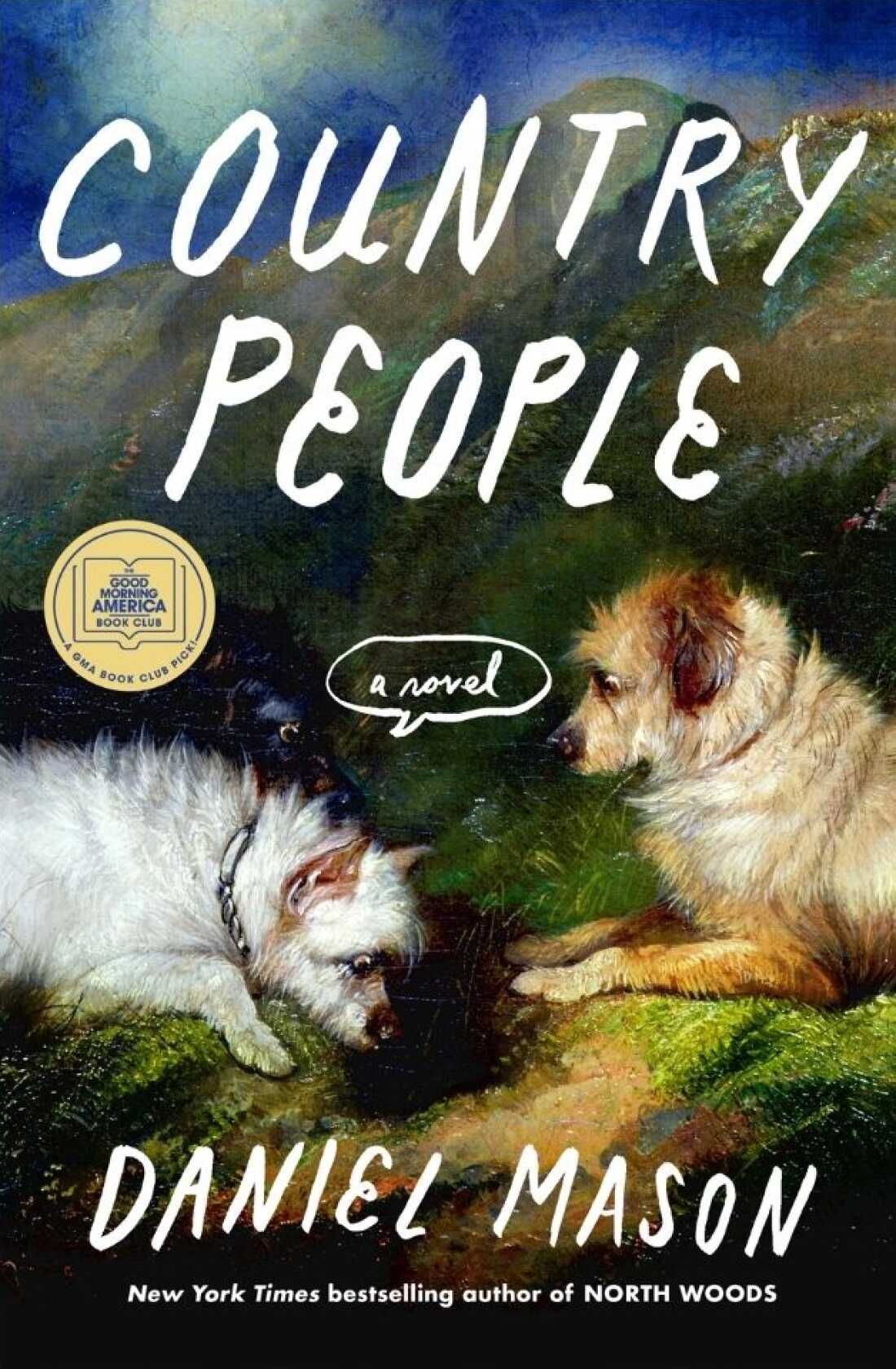
“Country People”
Daniel Mason
Penguin Random House
Published July 7, 2026
I’ll begin this review with a confession: Daniel Mason’s debut novel, “The Piano Tuner” (2002), was one of the first books I ever gave myself permission to not finish (long before Goodreads’ DNF shelf was such a flashpoint). Though it featured some lovely writing, it was a slog, so after a while, I simply threw up my hands and moved on.
More recently, Mason’s 2023 novel “North Woods” earned all kinds of praise and acclaim; and when I traveled in Northern Michigan this past summer, multiple booksellers in one of my go-to indie stores had Mason’s latest, “Country People,” atop their “staff favorites” piles. So I thought, “OK, I’ve changed a lot since 2002, and Mason’s written several books in the interim. Time to give him another go.”
While I finished “Country People,” and appreciated many of its moments of humor, whimsy, charm, and lyrical writing, I still found myself struggling to locate much in the way of a narrative engine. Admittedly, one reads literary fiction for character-driven stories rather than plot-driven ones. But is wanting both too much to ask?
Perhaps. But just because I didn’t love-love-love it doesn’t mean it might not be for you (see: booksellers at Petoskey’s McLean & Eakin). So here’s the skinny on Mason’s latest.
“Country People” begins with the (mouthful hyphenate) Krzelewski-Petrosian family — Milton scholar (and mom) Kate; adrift, all-but-dissertation dad Miles; 12-year-old son Wesley; third grader Olive; and truffle-hunting dog Giuseppe — making their way by car from California to Vermont, where Kate will be a visiting professor for the year. Kate hopes Miles might use the occasion to finally finish his 12-years-past-due dissertation on Russian peasant folktales, while Miles, not particularly inspired to do so, conjures idyllic daydreams of “country living.”
Throughout “Country,” Mason gently roasts academia and its adherents: Kate’s old grad school friend Miranda, who helped Kate get the visiting professorship, writes academic journal articles about everything happening in the town of Greensbury, using titles like “Little House in the Big Internet” and “My Forest is My Walmart”; and Kate is so dazzling in the classroom, we’re told, that she doesn’t need to offer comp lit classes that have been retitled from Russian Masters to “‘Look What You Made Me Do:’ Fyodor (Dostoyevsky) to Taylor (Swift),” as her peers do.
But Mason also wrings humor from the contrast between Miles’ cliched images of “country living” and the less-rustic reality. For example, when Miles visits another lapsed academic named Andrei, who’s lying on the ground, laboring to protect his orchard, Miles observes, “Deep down, he … knew that Andrei, quondam biochemist, was hardly a peasant. It was silly to pretend. … Other than his scythe and sundry artisan hoes, he bought most of his supplies online from Lowe’s. He scythed not for grain but to maintain a field in an arrested state of ecological succession, as a place where bobolinks might nest.”
Other local characters include a disabled Black man who believes himself to be the reincarnation of Wilson “Snowflake” Bentley, and who maintains an Inventory of Wrong Ideas inside an old ambulance; an online influencer who doesn’t know much about fixing or growing things, but succeeds nonetheless because of her cleavage; a former Olympian skier who inspires local moms to sign their kids up for lessons and go “Bjorning” every week in winter; a schoolteacher who helps monitor Vermont’s (supposedly contested) border with Massachusetts; a Shakespearean temptress (in period dress) who’s helming the annual third-grade production of “A Midsummer Night’s Dream”; and a secret group that believes local lore about the discovery, long ago, of a portal to a wondrous, underground world beneath Greensbury.
The narration spins on this idea for a while: “Did the tunnel bore straight down, and open up inside a sphere, like the inner surface of a giant tennis ball? … Or did the spinning of the sphere itself retain them against the surface, like some fun-park centrifuge? If so, was there, in going down, a moment of transition? A place of turning, where descent from one world became ascent into another? When a going-down became a going-up? Or was this all wrong? What if the earth was not a giant tennis ball, and more a sponge, riddled with wormholes, amphitheaters of different sizes, each holding its own kingdom, its own civilization?”
Needless to say, “Country People” is lacking in neither imagination nor quirky characters, and the prose is often gorgeous: “As the snow fell gently on the land, there occurred a transfer, imperceptible at first yet in its sum tremendous, of matter from sky to earth. Water droplets once suspended in the atmosphere settled on the branches of the trees, and with each falling flake, the weight of the boughs grew greater, and deep within the wood the fibers began to strain. And then, all over Greensbury, and across the border in Oakfield, the trees felt a twanging in the cords of their heartwood, and then their heartwood broke.”
But I can point to this same example as a reason why it took me twice as long to read this 300-page book as it normally would. The language is beautiful, for sure, but Mason’s tendency to wax poetic at times results in narrative stagnancy. Yes, there’s a plot point near “Country People”’s end that offers a bit of suspense (and thus some welcome momentum), but in this critic’s estimation, it takes more determination and stick-to-itiveness to get there than it should.
Follow Midbrow Detroit on social media:
Bluesky, Facebook, Instagram, Threads, TikTok, X.


