
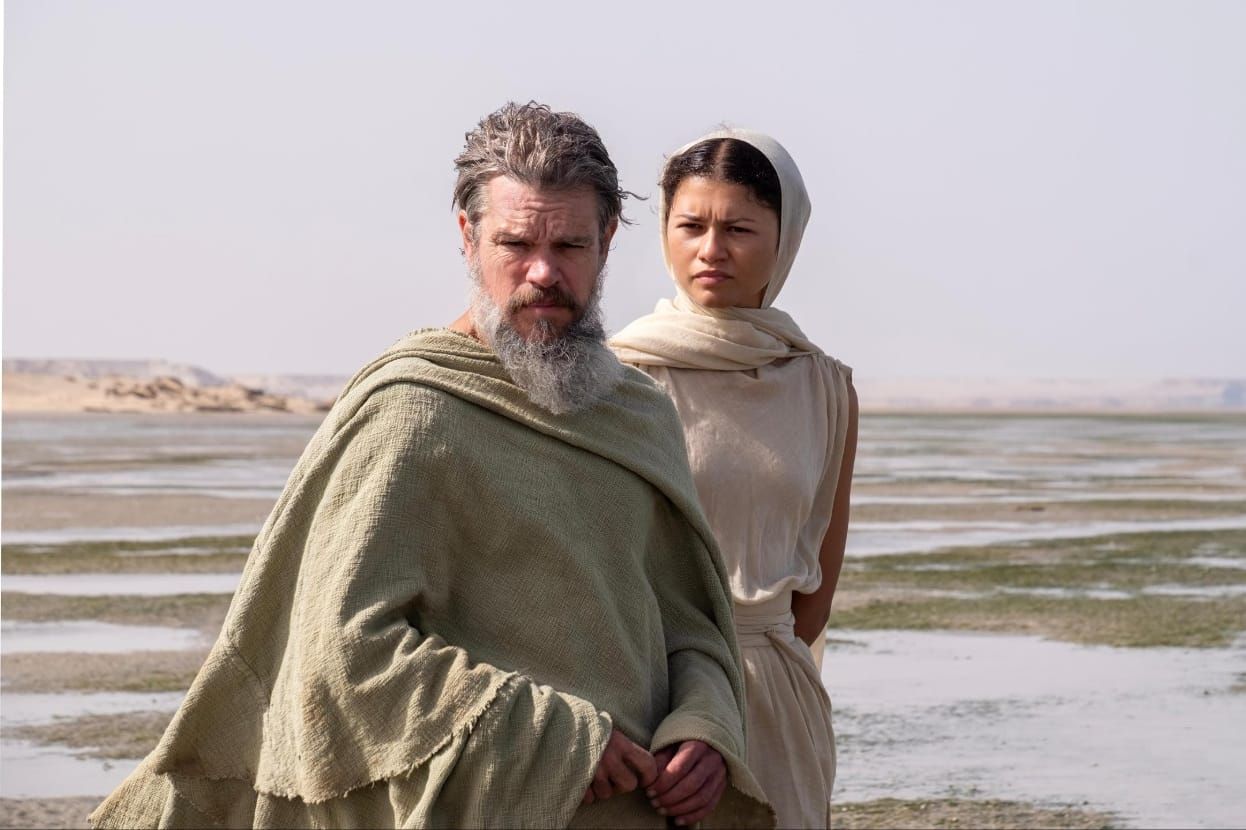
The Odyssey
Cinestudio
Hartford
July 17, 2026
WARNING: This review contains spoilers for a 3,000-year-old story.
If I had to sum up Christopher Nolan’s adaptation of Homer’s ancient Greek epic The Odyssey, in one word, that word would be restraint.
That might sound odd when describing one of the most anticipated movies of the year, a $250 million tentpole with a star-studded cast. Yet not only is that the message of Odysseus’ journey from the shores of Troy back to his home of Ithaca, but it also describes Nolan’s approach to film making.
The Odyssey follows Odysseus (Matt Damon) as he attempts to return after the successful conclusion of the ten-year Trojan War. Nolan has elected to tell the story in a nonlinear fashion, so the narrative jumps around to explain what’s happening. As Odysseus travels home, his wife Penelope (Anne Hathaway) and son Telemachus (Tom Holland) must fend off dozens of suitors who seek her hand, led by Antinous (Robert Pattinson, terrifically unlikeable here).
It goes without saying that the cast of The Odyssey delivered top-notch performances from beginning to end. With the likes of the top-billed cast as well as Lupita Nyong’o, Zendaya, Charlize Theron and more, the film is a study in how to squeeze the most emotional resonance out of every scene. It never feels like the characters are being outdone by the scenery, a condition that’s all too common in modern films thanks to the ubiquity of CGI. The actors are the main draw of the film,; the focus remains squarely on them.
My favorite performance was by John Leguizamo, who played Eumaeus, Odysseus’ most loyal servant. Leguizamo's role in the film allows him to show off his abilities with a wide range of emotions and different scenes to display them. Eumaeus is, in many ways, the heart of the story– the one person in perhaps all of Ithaca who has kept Zeus’ Law.
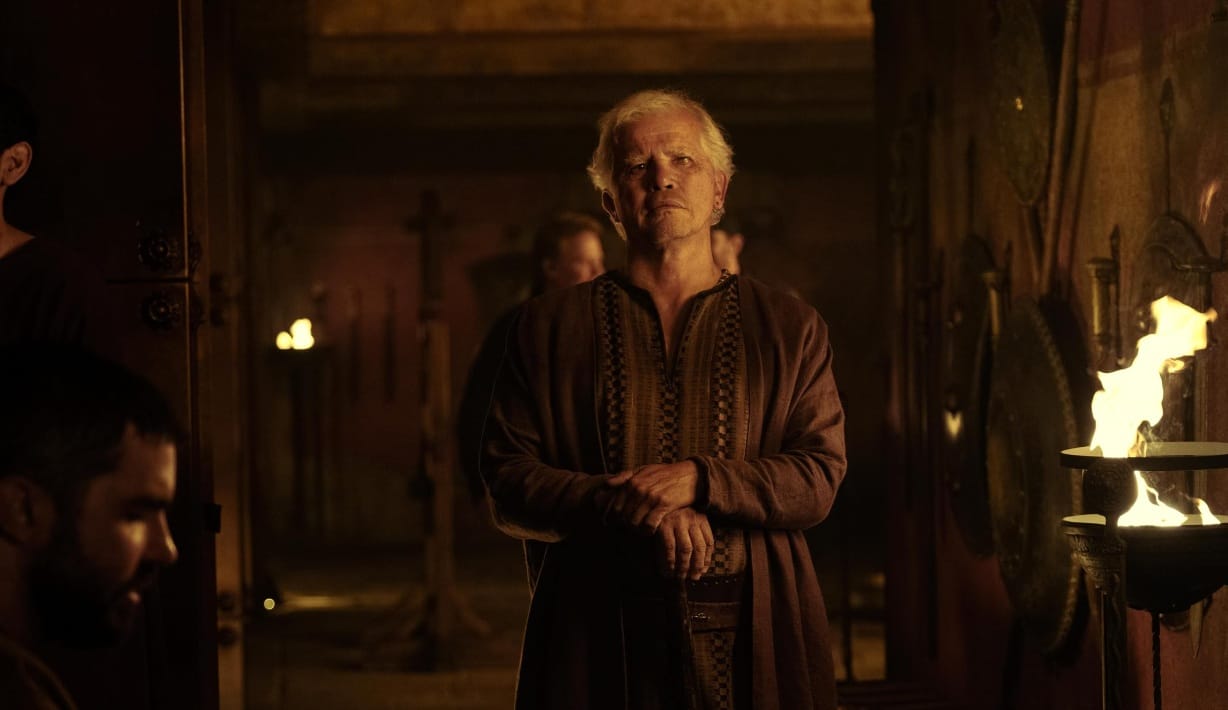
It’s an important distinction, because what Nolan’s take on The Odyssey is all about is adherence (or lack thereof) to Zeus’ Law, a set of guidelines that governs how Greeks are to interact with others. It boils down to being generous and kind, because you never know which person is actually a god in disguise.
Nolan’s decision to focus on Odysseus and his relationship with the gods and the law leads to interesting creative choices. Nolan deviates from the text of The Odyssey when necessary, but not without purpose. I won’t spoil those scenes because they do differ in important ways from the text, and deserve to be observed firsthand. But his framing gives the story a serious sense of action and consequence. Odysseus isn’t simply out having swashbuckling adventures; he’s reaping the harvest of what he has sown for failing to uphold Zeus’ law. That’s where restraint comes in for Odysseus. Just because something can be done, doesn’t mean it should be done. He learns this the hard way, of course.
I mentioned earlier that the scenery doesn’t overtake the actors, and that’s a result of Nolan’s restraint. There’s one scene in particular that stands out, where Odysseus and his crew are told they must go to a place where a river of fire and a river of ice converge. Ninety-nine percent of directors and art departments would have leapt at the opportunity to illustrate such an evocative image with millions of dollars worth of CGI. Nolan resists this urge, instead shrouding the area in mist and fog, as one might reasonably expect from a place where hot and cold water run into each other.
The decision may disappoint fans of visual spectacle, but it lets the meat of the scene – the conversation between Odysseus and those who died on his orders – take center stage. There are multiple moments like this one, small and large, where a less disciplined director would let tech run all over the people the story is about.
The restraint Odysseus learns, and the restraint Nolan exercises, serve to underline the main point of the film: the ends do not justify the means. When wrong has been done, consequences must ensue. It’s a humanistic message, because it’s saying that how we treat each other is the most important part of our civilization, and promises correction for those who fail to treat others well. Given the state of the world today, the idea that wrongdoers might actually face consequences is one of the most hopeful messages I’ve heard from a movie in many years.
NEXT
Jamil is taking the weekend off. See you next week!


