
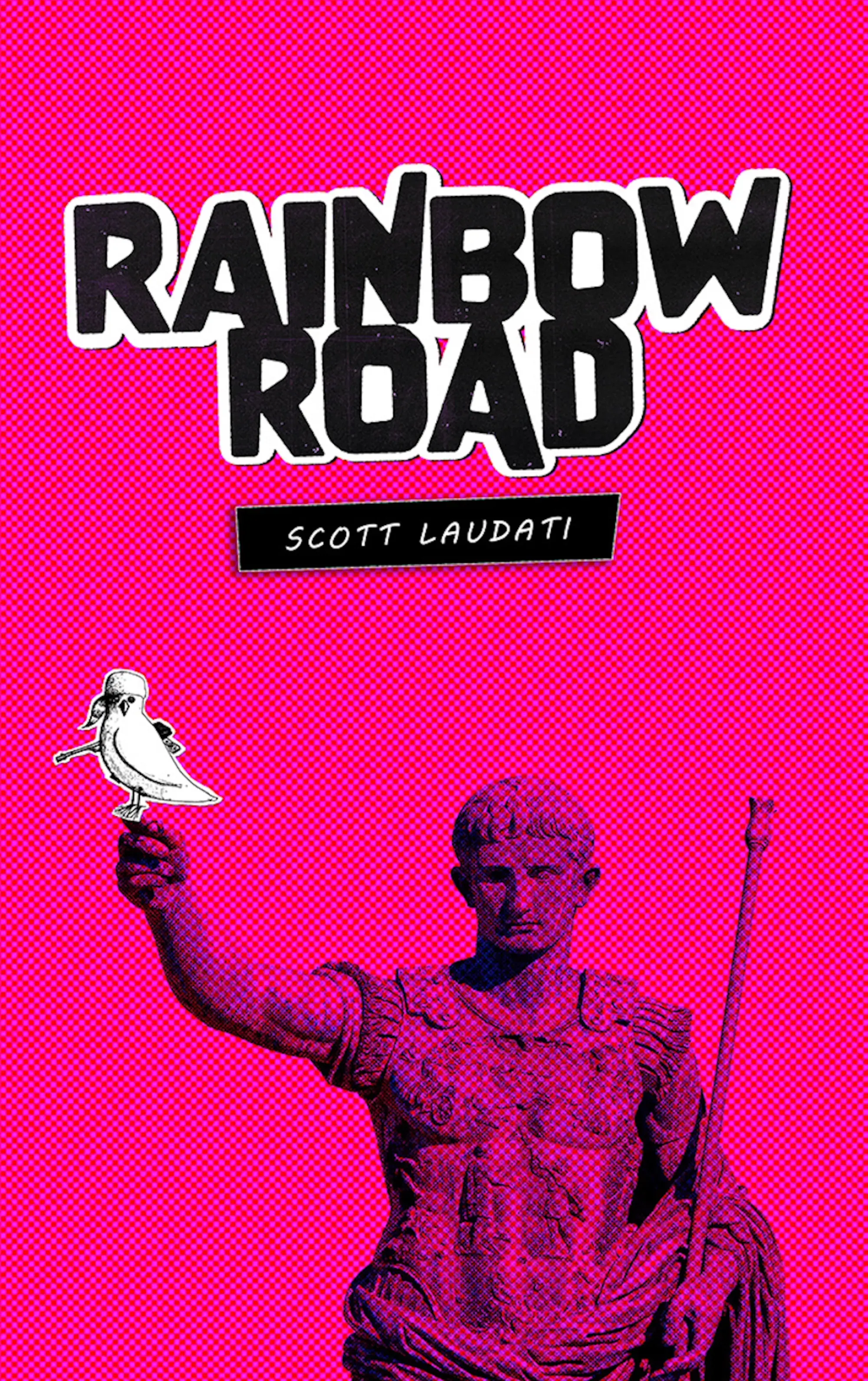
Rainbow Road
By Scott Laudati
Bone Machine, Inc.
Scott Laudati was feeling murderous the day he ran into Patti Smith on Thompson Street.
At the time, Laudati was on the precipice of getting his big break. He was working in a New York hotel and had been struggling for 10 years to make a living as a writer. Then he and a friend started a T-shirt company. Pop star Joe Jonas wore their “Daddy” T-shirt when announcing his relationship with model Gigi Hadid on Instagram. The money started rushing in.
Then his friend stole it all. Naturally, Laudati was going to kill him.
Somehow, Patti Smith managed to convince Laudati that his life was worth more than money.
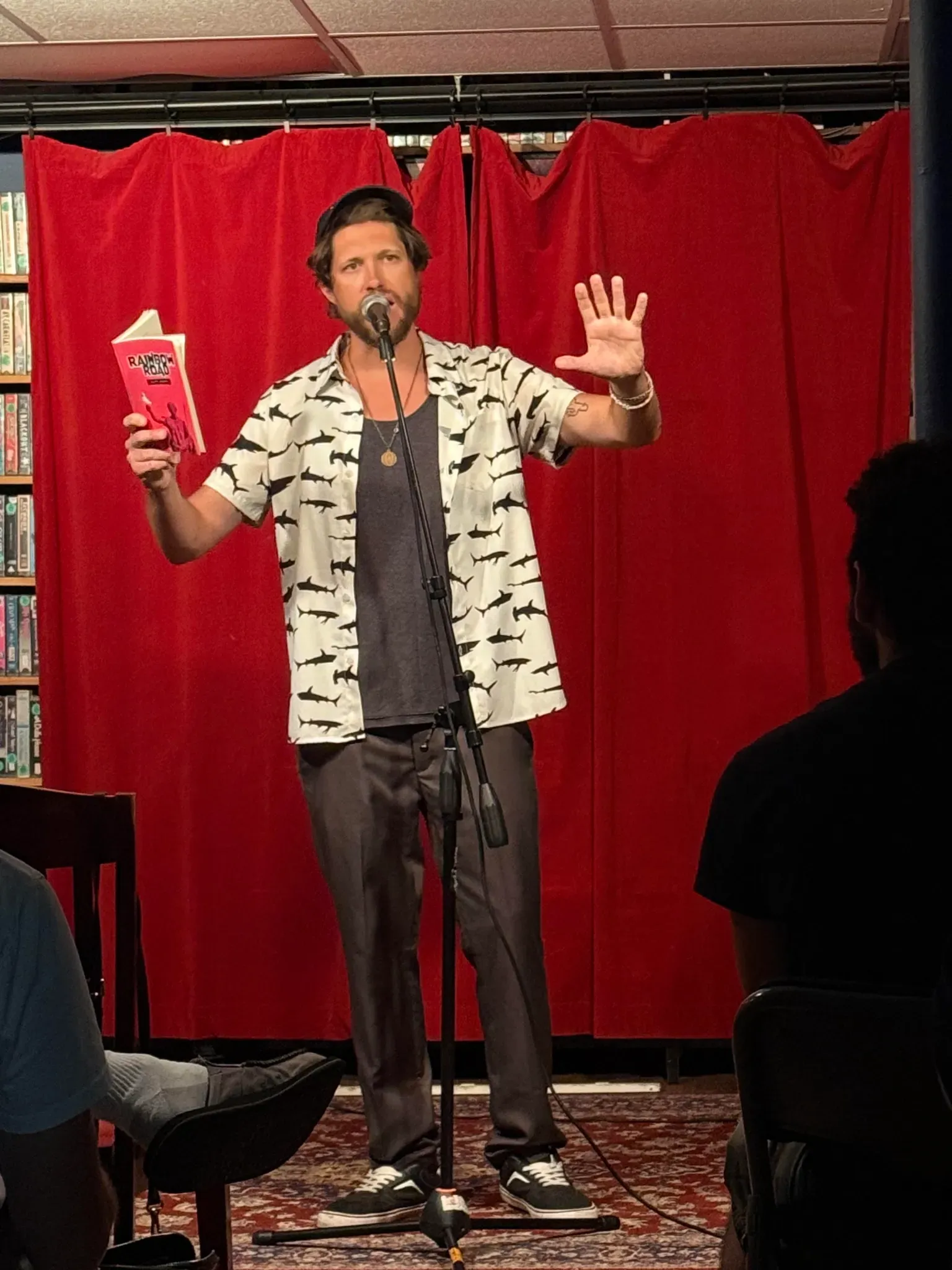
“And this is why you get to hear the story today,” Laudati told the incredulous crowd at a Best Video reading for his latest book of poetry, Rainbow Road.
The novelist and poet has lived a life. Two decades of writing have led to a book that deftly captures the anguish of artistic pursuit and the vagaries of living.
He named one of his favorite poems “In Front of the Closed Formosa Cafe,” after a bar he frequented when he was living in California. His book Pray the Devil had gotten optioned by Paramount, but after two years nothing came of the movie script and Laudati lost hope.
There are lines that will haunt any reader. From the middle: it’s the ones who say they love you/that’ll scare you the most,/they know something about you,/they’ll use it to hurt you. To close the poem, he states: fallen trees and most suicides/have marched quietly/into the silent night.
“My whole life, everybody was like, ‘You’re a loser. You need to get a job like a cop or in construction. Art is something that rich people get to do, and that’s not for you,’” he noted.
The poem conveys his shame and frustration at feeling unsuccessful and his attempts to fight the urge to quit the thing he lives to do. He said the poem is about owning your own life.
Rainbow Road is organized linearly across time and by the location of where the poems were written as he traveled all over the United States, sometimes on tour with up-and-coming pop-punk bands as a guitar technician, later, on tour to read his poetry. The book is grounded in some parts, while in others he takes the reader on linguistic adventures. There also is an emotional arc from hopeful (he was much younger as this was written over the course of a decade) to wistful. Laudati says he doesn’t even recognize the man who wrote the poems in the front of the book. That man was a bit more optimistic about his place in the world and the brightness of his future.
Not that that’s any indication of the quality of his work. Rainbow Road is deeply affecting and precisely crafted; Laudati generously lets the reader inhabit his world, exposing a life devoted to art. His poems are intimate without feeling self-indulgent, transforming private anguish into something immediate and recognizable.
The first poem, “My Bluest Valentine,” is in the Brooklyn section of the book. I imagine this was written at the beginning of the decline of Laudati’s optimism, some time after he first moved to New York with stars in his eyes. The poem is all young bravado, full of reminisces about youthful adventures but with a dose of bittersweet nostalgia. The first line is: Don’t bake me as birthday cake/this year. Instead, the poem’s narrator wants a carton of old cigarettes. The poem ends with, Let’s get married this time/like we swore we would at 17/when all we wanted/was to do drugs and fall in love/and we were still young enough/to be good at both. He wants to live with that bluster of yore but acknowledges that too much time has passed. The juxtaposition of love and drugs hints at a love that the narrator wishes he could get lost in again. But it also hints that that passion is dangerous. The poem portrays love as life itself – a reckless, all-consuming force that makes even the most ordinary experiences feel limitless.
“Thus Passes the Glory of the World,” “The Ohio Line” and “Portsmouth, Ohio” were written when Laudati was on tour from Jersey to Texas. “Glory” describes a long trip, driving through multiple seasons. The narrator and his fellow passengers are exhausted. There are embittered lines like, Every time I get into a car there’s a destination, and Will we sleep better tonight? “The Ohio Line” begins rather cynically with: This is a country of rivers fed by sewer mains,/and our grievances roll with them. “Portsmouth, Ohio” starts just as jaded with: There’s no place for wildlife/if animals like these roam the cities.
The poems suggest that to journey, literally and metaphorically, isn’t always pleasant and is often rather beleaguered. As they drive, they survey the land, witnessing brown rivers, lonely highway trailers, “eyes greyed by time,” towns turning back to jungle and a country “on the precipice of its next riot.” His dark emotional journey is set against the bleak backdrop of a collapsing empire.
The ending of “Glory” invites solemn stillness; it is so striking: We can sleep forever rubbed on this asphalt./We can dream in sentences buried beneath it. It speaks to the legacy he hopes to leave behind; even in death, the art continues to speak.
As bleak as the energy is in this part of the book, Laudati acknowledges in “Portsmouth, Ohio”: I’m a lucky man./I wrote a book and then I got to see the country. He even throws in some humor: I brush my teeth on a deserted street and/think about my father’s face when I told him/I’d quit my union job and was driving 400 miles/to read poems for six minutes in Ohio.
The last poem in the book, “Outer Sunset,” was written while he was in California; when dreams of a new life powered by the strength of his words were dashed and he realized he would have to go back to New Jersey and start over. The man in this poem is full of regret; always chasing something that takes and never gives. He says he’s selfish, the very opposite of his girlfriend who he describes as: a reef,/a million mouths could’ve fed from her. As he watches her playing in the surf, he laments that he’s taken so much from her and left her waiting while he vanishes for long periods of time pursing his dreams. The poem ends with: The last poem I’ll ever write,/never to begin again.
Never to begin again is a curious line because it uses the word “begin” though it’s referring to an ending; it seems to mourn the loss of possibility. He is disavowing the feeling of excitement and spark that leads to creation.
Such an existential way to end a book of poetry. It leaves the reader with so many questions. If this book is meant to be an artistic rendering of Laudati’s life, who will he be without his poetry? Where will all his feelings go if not transmuted into verse? Does he give up? Does he keep going?
The fact that Laudati stood before an audience at Best Video reading from Rainbow Roadoffers an answer. He did begin again. The despair in “Outer Sunset” was real, but it was not final; he survived it long enough to transform it into art that he could place in other people’s hands. Patti Smith once convinced him that his life was worth more than the money he had lost. Rainbow Road suggests that it is also worth more than every vanished opportunity and abandoned dream.
If Laudati can make language from what nearly destroys him, the last poem is never really the last.
Click here for more on Scott Laudati.


