
Boop! The Musical
Bushnell Center for the Performing Arts
Hartford
Nov. 11, 2026
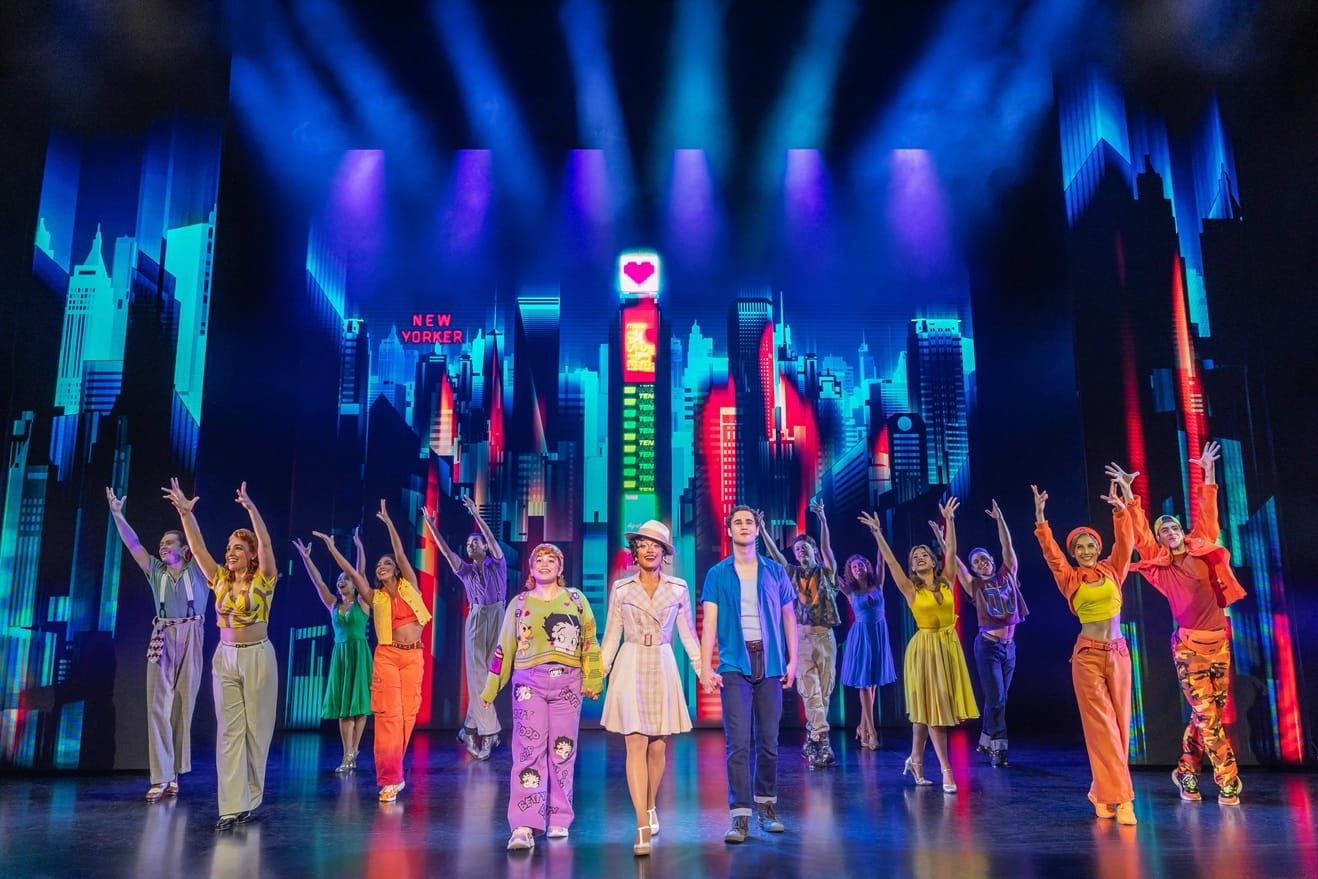
Boop! is one of the most creative Broadway musicals I’ve seen at Hartford’s Bushnell Center. It tells the story of Betty Boop (Aliya Grace), who has become tired of the fame and pressure of her life in Toon Town. Using Grampy’s (Dan Mason) special device, Boop transports herself to the real world, where she meets adopted brother and sister Dwayne (Mason Ballard) and Trisha (Ashley Calderon). While she’s falling in love with Dwayne, Toon Town is falling apart, because without its star it has no reason to exist.
The stage design makes Toon Town a black-and-white fantasy while the real world is a technicolor dream for Betty. The set transitions from monochrome to color seamlessly. My favorite musical number has Betty emerge from Toon Town right in the middle of New York Comic Con, leading to cosplayers dressed as Cyclops, Scarlet Witch, the Teenage Mutant Ninja Turtles and others singing about the wonders of color.
The real-world stage and costume design present an impressive pastiche of American culture. There are hints of the roaring '20s in the speakeasy Betty and Dwayne visit, while Dwayne himself is dressed like an extra right out of West Side Story. Trisha recalls the playful youth attire of the '90s, and other characters like Raymond and Carol evoke a Dick Tracyesque vibe with their large business suits. Despite the many influences, it’s a coherent approach that gives each character their own visual persona as soon as they hit the stage.
Of course, the best outfits and moments are reserved for the star of the show herself, Betty Boop. Aliya Grace truly is Betty Boop come to life, having mastered her voice, mannerisms and style. But Grace doesn’t just rely on established characterization, and fills out the rest of Betty as we see the character in new settings and situations. Grace brings a curiosity and shyness to the role that’s as appealing as the sexiness and charm she channels from Betty Boop.
Several scenes are reserved for tap dancing, a personal favorite. The one place Boop! falters is its story. The ultimate resolution of the play’s central problem – that the cartoon world will collapse unless Betty returns – is solved as soon as it becomes an issue: they have an interdimensional portal. That eventually the human characters would cross over into the cartoon world was a forgone conclusion.
That leaves the characters and their arcs to propel the story forward, and there’s not much growth there either. At the beginning of the play, a reporter in Toon Town asks, “Who is the real Betty Boop?” I don’t think we have an answer to that question by the play’s end. Betty has fallen in love and inspired her new friends, but is any of that what Betty wanted? Her return to Toon Town felt like an acquiescence to duty, not an affirmation of her importance.
Which, I suppose, is its own message: the rest of the world gets a say in who you are too. We all have our role to play, and our best chance is to find someone who loves us to help shoulder those burdens. Who is Betty Boop? She’s Betty Boop, for better or for worse.
NEXT
Boop! continues at the Bushnell through Nov. 15.
Jamil goes to the Connecticut Museum to learn about a generational connection through tools.


