
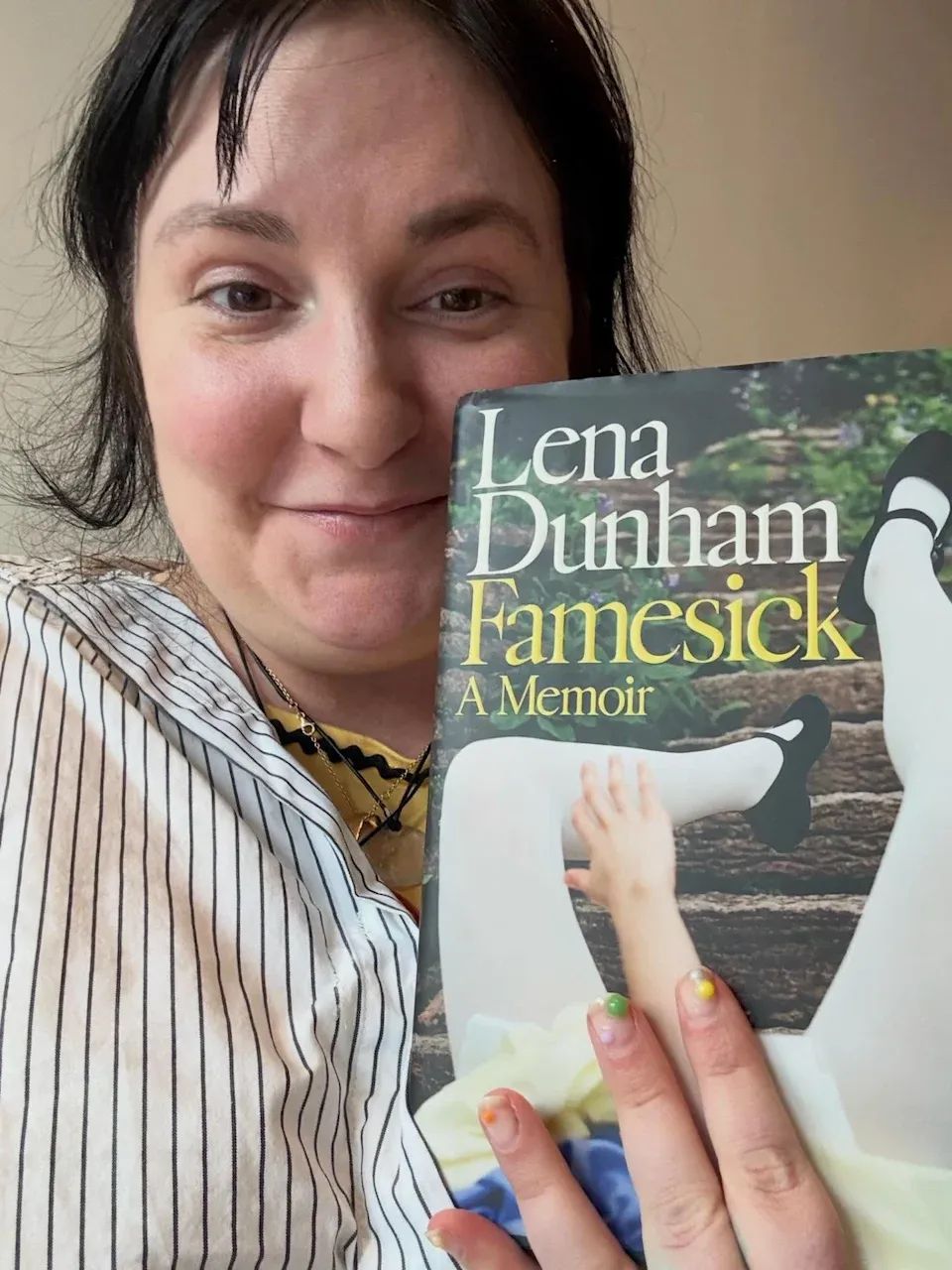
Famesick
Written by Lena Dunham
Penguin Random House
“Guys, I don’t want to freak you out,” a 24-year-old Lena Dunham confesses to her parents in the first episode of her HBO sitcom hit Girls, “but I think that I may be the voice of my generation — or, at least, a voice of a generation.”
While Dunham was actively becoming the hit writer and director of a defining television series centered on millennials back in 2012, her onscreen caricature Hannah Horvath was the opposite: a spoiled, aspiring artist who leverages her professional hunger for rent money from mom and dad.
Famesick, the second memoir Dunham has authored before turning 40, is a failed punchline to that early joke, which cemented her youthful ascent into the limelight. What could’ve been an insightful retrospective on the common struggles Dunham experienced in the decade after Girls went off air in 2017 instead reads as a Gossip Girl-style press release of Dunham’s sustained existence and personal woes.
In chapter seven, “Hard Being Easy,” Dunham confesses: “My obsession with mortality has always defined me. I spent a lot of my time wondering why we try when we’re all just going the way of the dinosaurs. There was something tidy about visible success that had at least the temporary effect of eliminating these questions. People remembered the dinosaurs, and they would remember me.”
The culture is not forgetting Lena Dunham; the debate has always been how we will remember her. Whereas Hannah Horvath was a messy hipster trawling the streets of Brooklyn for unsuccessful, self-focused short story material, in Famesick Dunham describes herself as a bed-ridden workaholic catering to the needs of those surrounding her. Dunham has long attempted to distance herself from the character of Hannah Horvath, whom she designed to mock narcissistic and privileged millennials, but whom social media deemed an autobiographical snapshot of Dunham and her privileged art world friends.
With this latest book, Dunham had the chance to rewrite how some view her legacy. She could have shaken off her status of solipsistic nepo baby by using her talents to wax universal about specific experiences, or at least to speak more intentionally to certain societal realities: confronting reproductive health, struggling through addiction, discerning mental illness, existing online. Since creating Girls, Dunham has undergone a total hysterectomy while struggling with chronic endometriosis, recovered from a pills addiction, and battled psychological pressures of fame during the internet age. But her insights into identity (“I wondered when I would stop feeling like a bad purchase, like a faulty doll that needed to be sent, again and again to the American Girl Doll Hospital,” or, “I wanted to have my cake and eat it too — and be liked by everyone in the process,”) serve as transitions between superficial victimizations of big-life events, like toxic relationships and breakups, on-set drama with celebrity actors, and internet bullying.
Dunham has endured nightmarish stuff on an amplified level. But it’s hard to feel sympathy for her when some of the case studies she uses for literary flair include a missed opportunity to meet Oprah due to her deteriorating physical health. (“But did I regret not meeting Oprah? Not for a second. Because you know what’s worse than not meeting Oprah? Faking it for Oprah. I would never fucking dare.") Or an article headlined “I saw Lena Dunham serve her dog salmon on a china plate,” brought up as a means of discussing online “hatred.”
These anecdotes, of course, exemplify Dunham’s sense of humor. But her inability to go deep even as she tells all is preceded by her subtle insistence on always being the butt of the joke. She herself has admitted to relying on her thighs' cellulite too often to crack some comedy into a scene. But even if those televised moments were framed as funny, it was always innately meaningful to see not just Dunham, but the whole cast of women on Girls appearing naked in unfiltered ways, not just literally but metaphorically, baring their embarrassing personality traits like proud pockmarks. In Famesick, however, Dunham ditches the camera and uses the shield of language to defend more than actually reveal.
If Lena Dunham got so sick of fame, I wonder why she wouldn’t spend her time and $12 million net worth making the kinds of experimental and independent projects that earned her a name in the first place. Her last film project, another (surprise) autobiographical Netflix series titled Too Much, lacked all the life that Girls contained. Her latest book tells the story of a girl boss somersaulting around the entertainment world as opposed to that of alternative media artist finding her way home.
It’s sad to think that Dunham’s soul was stolen by the masses, but Famesick suggests her spirit suffocated itself. My favorite part of rewatching Girls is still Lena Dunham’s underwear. It’s a shame she’s felt compelled to button up and beg her case by marketing a celebrity memoir on The Drew Barrymore Show. But nobody's to say she can't still be a voice of a generation; in spite of some of the stuff she says, I hope she never shuts up.


