
By Allan Appel
It’s not every United States poet laureate who has her own band.
Yet Joy Harjo does. She sings, plays jazz-infused tunes on saxophone and flute, and incorporates poetry in performance with her group — whose name is, yes indeed, Poetic Justice.
Yet even without musical accompaniment, the 23rd national poet laureate, who served between 2019 and 2022, takes you places far and deep.
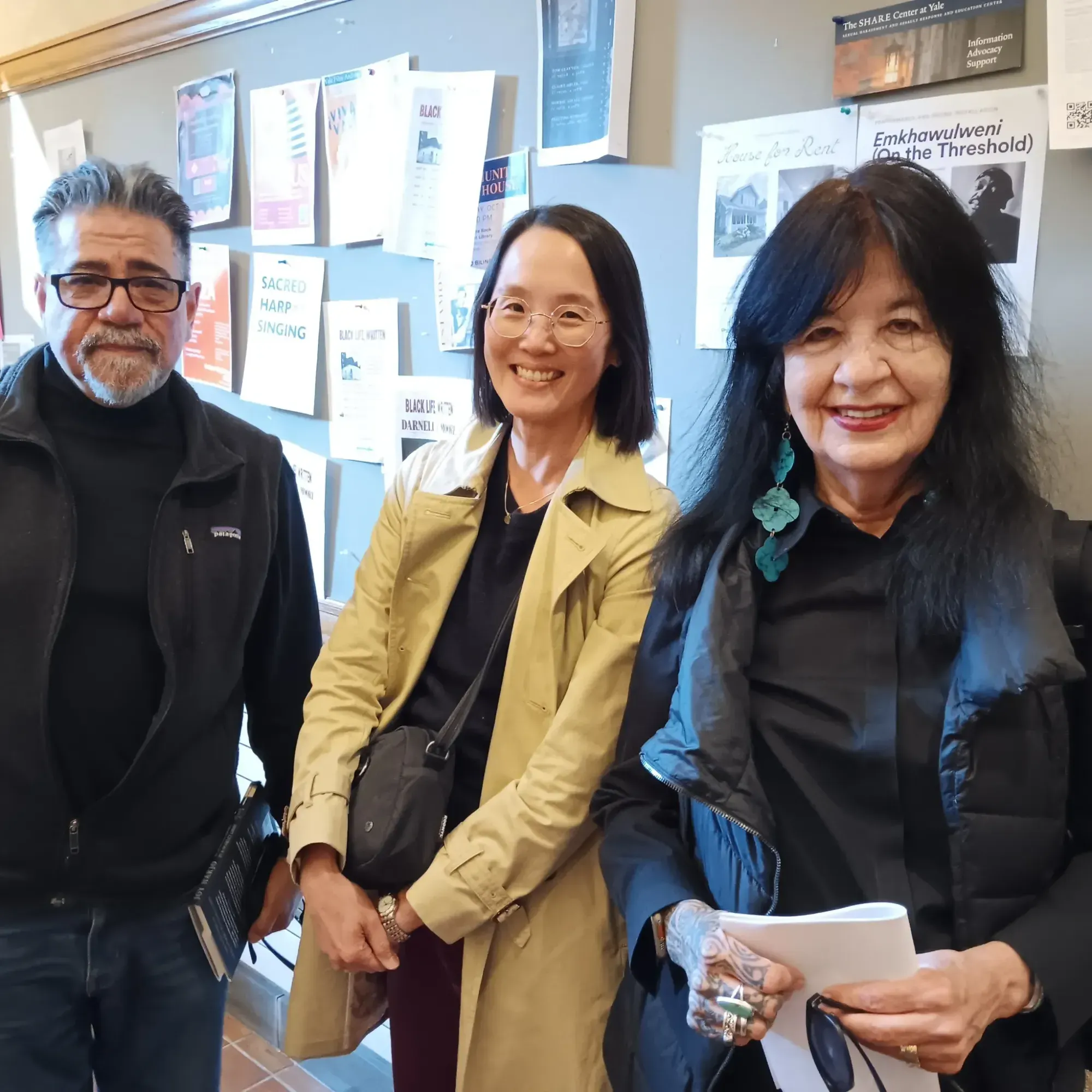
That’s likely why on late Wednesday afternoon, Yale’s Linsly-Chittenden’s lecture hall — the largest classroom in the English Department’s corner of the campus, on High Street — was filled with more than 100 admirers.
They were Yale students along with many members of the public. Her loyal following, unusual for a poet in America, has for years of performances, records, and 11 prize-winning volumes of poetry, resonated with Harjo’s work.
Over a long career, that work is drawn from her deep Muscogee/Creek Native American heritage, her evocations of a hardscrabble spirituality, along with themes of historic social injustices that rarely sound like preachiness because they are embodied in carefully observed and lived experience, along with a kind of stoic joy (she is well named), and much humor.
That’s why one New Havener attending the reading, Stirling Davenport, a perspicacious writer herself and unabashed fan of Harjo, described the reading of Harjo as we all entered the lecture hall, along with the poet: “She tells the truth in a way that makes you stop and you recognize, within yourself, something you may have forgotten.”
And then Davenport wanted to be sure the press really understood what she meant, the essence of power in Harjo’s work: “She has a way of putting you in a scene. But you are not watching her; you are in it. I’m inspired.”
Over about 45 minutes Harjo read selections from some of her greatest hits. Click here for some of those. And here for her reading of the poem “Cloud Runner,” the eponymous work in her new book released this week and based, in part, on grief for her younger brother who recently died.
In many ways the quiet spell Harjo casts — not a single poem generated applause, and yet the rustling quiet after each seemed to grow into a silent intensity of attention by the end –has an effect as if you have traveled somewhere far away, and not quite fully returned yet; maybe that’s what it means to be moved.
In addition to being a low-keyed but incantatory performer of her own words, Harjo is a writer’s writer.
In many of her works she speaks about the process of writing, admits to mistakes, inadequacies, and even a fatal limitation of language to deal with the human and cosmic situation, especially historic and gender injustices, that we find ourselves wrapped up in whenever we take time to notice.
Harjo read some brief lines and selections from essays in Why I Write and Catching the Light, including this simple but heart-breakingly true declaration: “Every poem is a prayer, a supplication in the cacophony of humanity.”
In other selections from Cloud Runner she referenced our Indian fighter president Andrew Jackson but hardly in the heroic way he’s taken by many Americans, especially today’s president.
“Lots of times native people are seen as shadow creatures,” she said, “moving in the trees. But we’re like everyone else, regular people, including some who own race tracks.”
And such properties, she added, were precisely among those that Jackson was after when, through the Indian Removal Act of 1830, he drove the Five Tribes, including Harjo’s Muscogee/Creek nation, out of the southeastern U.S. to reservations in Oklahoma. That’s where Harjo, generations later, was born, loved, and yet, she said, had to escape from in order “to save my life.”
From her 2017 verses “How To Write A Poem In Time of War,” she read this sobering selection:
No. Not here.
You can’t begin here.
This is memory shredded because it is impossible to hold by words, even poetry.
These memories were left here with the trees:
The torn pocket of your daughter’s hand-sewn dress,
The sash, the lace.
The baby’s delicately beaded moccasin still connected to the foot,
A young man’s note of promise to his beloved —
No! This is not the best place to begin.
Everyone was asleep, despite the distant bombs. Terror had become the familiar stranger.
Our beloved twin girls curled up in their nightgowns, next to their father and me.
If we begin here, none of us will make it to the end
Of the poem.
And from her poem “Bird,” for the jazz saxophonist Charlie Parker, Harjo peppered her talk with these lines:
All poets understand the final uselessness of words . . . inside this poem I can’t play a horn, or hijack an airplane . . . the fingers of saints are still hot from miracles, but can they save themselves.
In the brief Q & A following the reading a young student asked Harjo as she, the poet, practiced so many art forms, “When you get an idea, how do you know with what form to pursue it?”
Harjo’s answer was, “I think it’s all poetry.”
Yale’s English Department’s head of the creative writing program, Derek Green, who had introduced Harjo, described the cumulative effect of Harjo’s work as “a literature rooted in an obligation to honor one’s tribe, one’s self, and work of jazzy stillness.”
Harjo’s lecture was sponsored by the John Christophe Schlesinger Reading Series, one of the most prestigious of the English Department’s reading programs, and always open to the public.
The next writer in the series is novelist Susan Choi, who reads at the same venue, Linsly-Chittenden Hall, on Oct. 28 at 5 p.m.


