
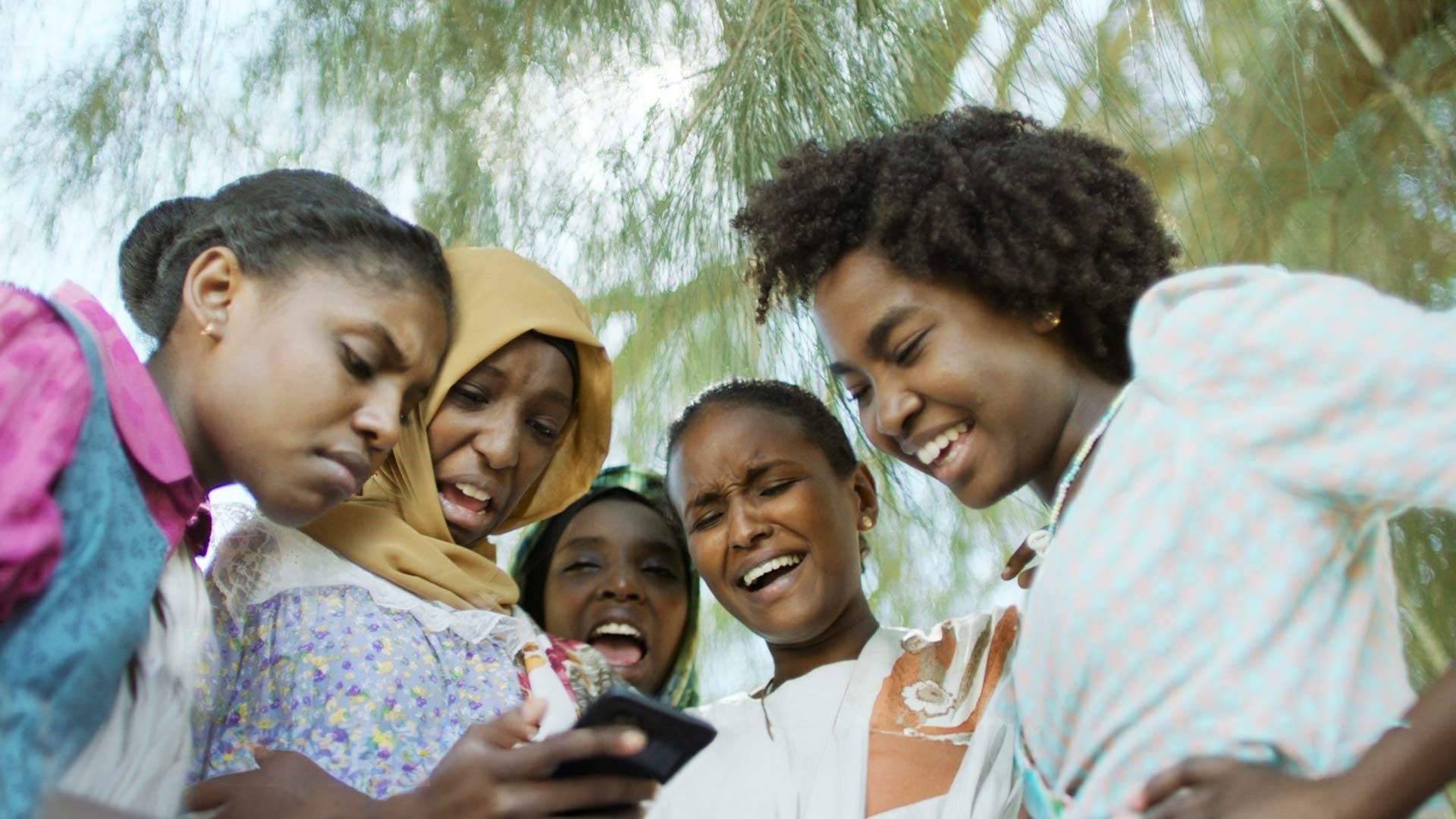
Cotton Queen
Dir. Suzannah Mirghani
National Asian Culture Center (ACC)
15th Arab Film Festival
Aug. 29, 2026
(Jisu Sheen recently moved from New Haven to Gwangju, South Korea, where she’s covering local arts and culture for the New Haven Independent and Midbrow.)
Watching Sudanese 2025 feature Cotton Queen at the National Asian Culture Center's Arab Film Festival in Gwangju this weekend, I was struck by the poetry of the magical realist, historical fiction form.
Not only is there poetry in the decisions of the girl at the center of the film, Nafisa; she carries a notebook full of introspective verses on life and love.
Before those poems hit Nafisa's on-screen notebook pages, they were written into the script by Cotton Queen's filmmaker, Suzannah Mirghani.
"Listen, we've all done it," Mirghani told me in a phone call a few days after the screening. I had asked her if she'd always been a poet.
"Every teenage girl in the world has been a poet at some point in their life," Mirghani said.
Her film opens with laughter and birds under a blue sky. Girls are singing in a cotton field. In this world, where they're alone with each other, the future is in their hands.
They are holding pure white cotton. It's the pride of their community, reigned over by Nafisa's grandmother, Al-Sit.
Al-Sit is also the name of a short film Mirghani made before Cotton Queen. It has the same characters, setting, and most of the same actors.
Mirghani wrote the script for Al-Sit and sat on it for a while. It's a project that asks to be made in the place it's about, and Mirghani had left Sudan at age 16. Omar al-Bashir's dictatorial regime, with its restrictions on the freedom of women, had made it difficult to return.
In 2019, when a popular revolution upended the dictatorship, Mirghani thought, "I need to go back to Sudan." She got a grant and traveled to Sudan to bring her script to the screen.
For every actor in Mirghani's cast, Al-Sit was their screen debut. The adults had acted in plays, and the youth were new to the field.
In about a month, Mirghani and her team had created a dreamy short film in their homeland.
Then came COVID-19 and a military coup. "I'm coming back," Mirghani said to her cast and crew. She wanted to work with them again, this time to make a feature.
By 2023, war in Sudan—a "horrible, very, very violent war"—had broken out, and most of Mirghani's actors had fled to Egypt.
"So we took the film to them," Mirghani said. The team recreated the Al-Sit set, a replica of Sudan, on Egyptian farmland.
It was a hard pill to swallow. "This film is about the land, literally," Mirghani said. She resisted the thought of shooting the feature anywhere but Sudan. As the political situation devolved, it became clear she had no choice.
Cotton Queen's set took on multiple meanings for the team. They were building a facsimile of a setting actively being destroyed by military and paramilitary violence. The actors didn't have other jobs at the time. They weren't going to school. They had been displaced, among millions in the growing Sudanese diaspora.
Working on the film together made Mirghani's team part of a collective hope for Sudanese cinema that had taken hold before the war.
In Cotton Queen, a secret name on a paper can spark romance, and a swallowed breath can do the same. When Nafisa thinks she sees Cupid, the angel in question asks, "Are you stupid? Cupid is banned in Sudan." Local and invented mythologies provide the surreal space for Nafisa, Al-Sit, and their community to deal with mysteries that may never be unearthed in full.
In Sudan, Mirghani explained, "the metaphysical world" is part of everyday life.
Every region has its own folkloric elements. Some traditions come from pockets as small as scattered groups of girls. Mirghani remembers audiences asking about the origin of a ritual in Cotton Queen where the girls draw blood on the face of a friend who's just gotten her period.
"Well, we did it when we were kids," Mirghani said.
Cotton Queen details the lasting effects of colonization as Nafisa navigates endless schemes being orchestrated around her—including plans surrounding a businessman trying to sell cotton seeds that don't breed.
Al-Sit, meanwhile, protects Nafisa in troubled ways. She is a self-made legend, but as Nafisa learns, following in Al-Sit's footsteps does not have to mean following her.
Likewise, what a movie is—and what a new movie can be—cannot be predicted by what came before. A film can be a way to find community in the midst of devastation. It can be a recreation of home. A feature-length movie can be one part of a larger poem.
These days, Mirghani is adding to the discourse on Sudanese cinema and other art forms at her 9-to-5, a research position at Georgetown University in Qatar.
She's also working on her next movie. As in Cotton Queen, the idea comes from her research, with an artistic vision to "take a giant industry and put a young girl at the heart of that industry."
"My hope," she said, "is that it will be shot in Sudan."
Sign up here to get Gwangju Midbrow email updates delivered straight to your inbox.


