
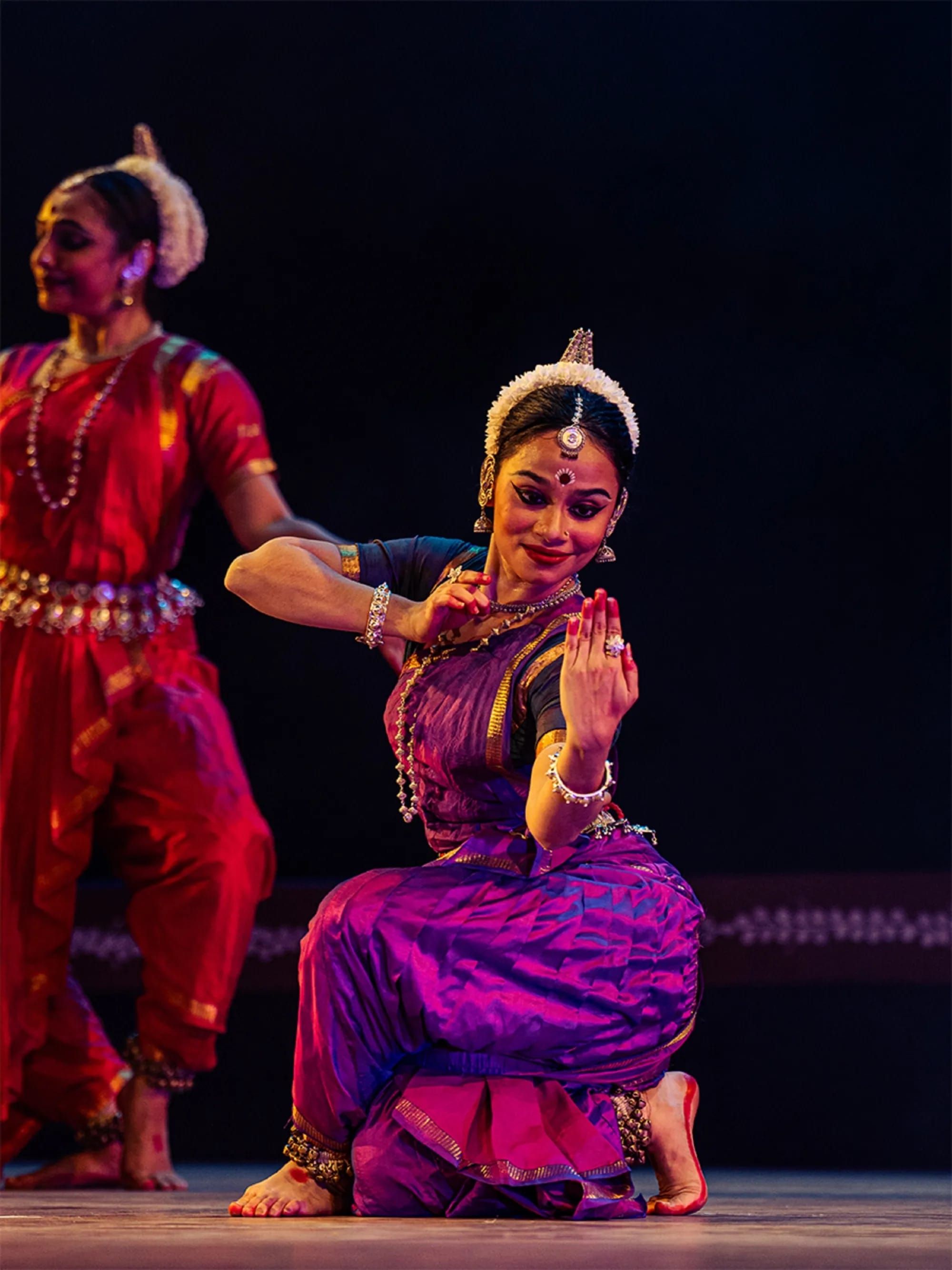
The Nrityagram Dance Ensemble
Khaṅkhaṇā: the sound of dancing feet
Shubert Theatre
Oct. 10, 2026
A turn of a wrist, a twist of a hip, stomping feet that slide precisely heel to toe across the stage to change position. Each movement and posture held by a dancer in a performance of “Khaṅkhaṇā: the sound of dancing feet” created and relayed a moment in time as body and story became one.
The performance, presented by the Nrityagram Dance Ensemble at the Shubert Theatre on Saturday, brought Odissi dance to New Haven, mesmerizing the audience with its dialogue between body, story, music, and the divine, evoking a deep history conveyed in absolute presence.
Odissi harkens from the land of Odisha in India, where dance has been an important part of the culture for centuries. It is known for its sculpture-like movements that, while precise, also flow along with music and story. According to the evening’s program, Nrityagram means “dance village” and is also “India’s renowned Gurukula for Odissi dance.”
The ensemble is currently under the direction of Surupa Sen, who in addition to being its artistic director is also its choreographer and principal soloist. Sen — along with Pavithra Reddy, Anoushka Rahman, Namaha Mazoomdar, and Daquil Miriyala — brought Khaṅkhaṇā to life via five different performance pieces: Sankirtnam, a prayer; Priye Charusheele, Divine Surrender; Aakriti, a dance that explores the “abstract and geometric vocabulary” of Odissi; Sridevi, Invocation to the Mother Goddess; and Smiritiranga, dancing again in moments want to live in.
The performance included a live original score played by musicians who sat on the left side of the stage. They included Jatin Sahu on lead vocals and harmonium, Rohna Dahale on chants and percussion, Parshuram Das on bamboo flute, Anup Kulthe on violin, and Sophie Gaur on vocals.
Each performance piece was introduced by a narrator who set its tone. Before “Sankirtnam” began, she spoke of “wandering minstrels” who “sing of love and compassion.” As the music started, one dancer under one single spotlight blossomed from utter stillness to fluidity and exquisite form, and she was soon joined by four more.
This initial performance felt like watching tree buds bloom in real time. Hands raised, folding and unfolding, while their stomping feet and the ghungroo anklets – adorned with bells that created their own unique sound – added another layer of percussion to the music. Every movement and change of position – a head shift, a shoulder roll, or a meticulous 360 degree turn from a single leg stance — evoked emotion, whether they performed synchronically or in their own unique patterns.
Every performance added another chapter to the story, another experience of wonder, of joy, spirits uplifted. “Aakriti,” for example, which the narrator called an abstract piece “that allows shapes to form and gravity to develop,” began as almost more of a sequence of prayer-like poses, but as the music layered and built up so did the movements, reminding this reporter of feeling the music as a way to let your body go and move and learn to dance yourself. The sound and fullness built even more, and it took everything in me to not move myself except that what I was witnessing was so transfixing.
Watching the performances also encouraged me to find out more about this art form, not just for this article but to satisfy my own interests as a dance enthusiast. Perusing the Nrityagram Dance Ensemble website and watching videos of past performances after the show was over kept my spirit alight. Peruse them yourself, and get ready to get lost, and then to find yourself again, in the spirit of the dance.
Another highlight of the show was the performance of “Sridevi” after the intermission. “We ask the presence of the mother goddess to light our way on our journey,” said the narrator. “From you comes all life and to you we must all return.” One dancer to the rear of the stage twirled under a spotlight while another carried a small sconce of lights and set it down near the front of the stage. Both lifted their hands to the sky. The praise and honor they offered emanated through their postures and movements and out to us all. The connections were felt and accepted with gratitude.
By the time the final piece – “Smritiranga” – was performed, there was no doubt that this would be an experience I would carry with me for a long time. The narrator told us before this performance that “memories play deep inside us,” that they are “an awareness of longing for someone, something, somewhere.”
“Dancing again in moments we want to live in,” she added, before the dancers came back and along with the musicians and vocalists ended with a showstopper full of bold and fluid movements, both solo and in unison, including embracing and dancing in a circle with arms joined. It was a reminder that memory can be a singular event or a shared one, but that we all come from the same earth, live under the same sky, look up at the same stars. As my own feet hit the ground while we walked across the city after the show, that connection remained.


