
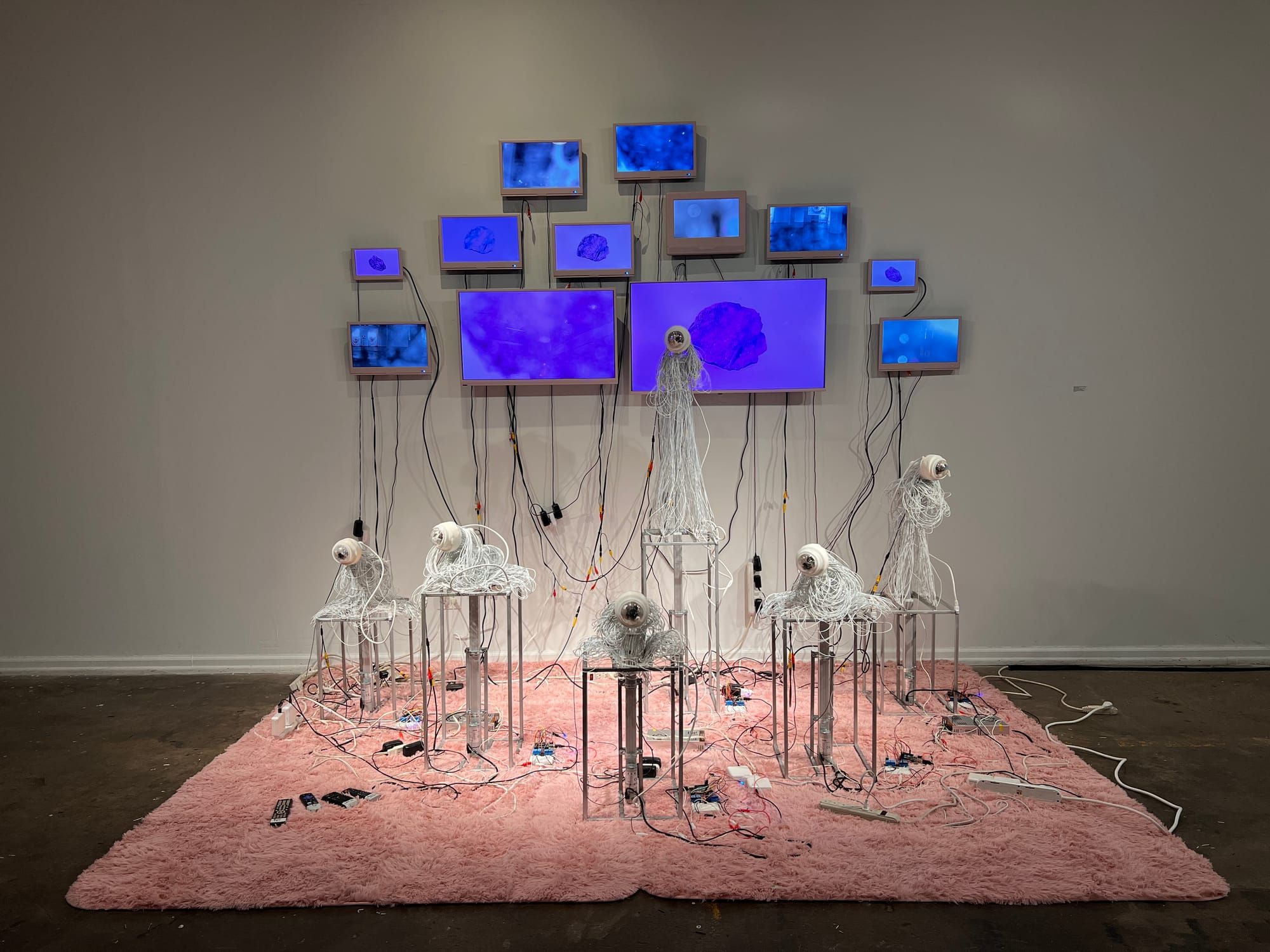
"Scut Work" by Jordan Vinyard
Living Arts of Tulsa
through October 10, 2026
The machines want you to notice them, but they also notice each other.
It’s hard to imagine a better news cycle during which to view Jordan Vinyard’s Scut Work than one where the human harbingers of artificial intelligence are admitting that control of the technology is slipping out of their grasp. Fun and games, automation, recursive self-improvement … and then what? The current trend of recreational, “creative” AI usage is just the Industrial Revolution for losers, but the business and government uses of AI—and AI’s unexpected uses of government and business—are something more sinister than we’re able to imagine.
In her artist statement for Scut Work, Vinyard writes: “As we evolve alongside our machines, we continue to redefine the governance of our bodies, actions, and experiences. This exhibition interrogates the developing boundaries of labor stratification in an era increasingly mediated by intelligent machines.”
Who carries out the dirty work in this “fractured anthropology,” she asks? And who is the benefactor? The questions posed by Vinyard’s work remind me of Michael Pollan’s treatise in The Omnivore’s Dilemma on how corn actually domesticated humans, not the other way around. Is this going the way we as humans think it is? Is humanness necessary for human acts? Do humans even get to decide that anymore?
photos by Becky Carman
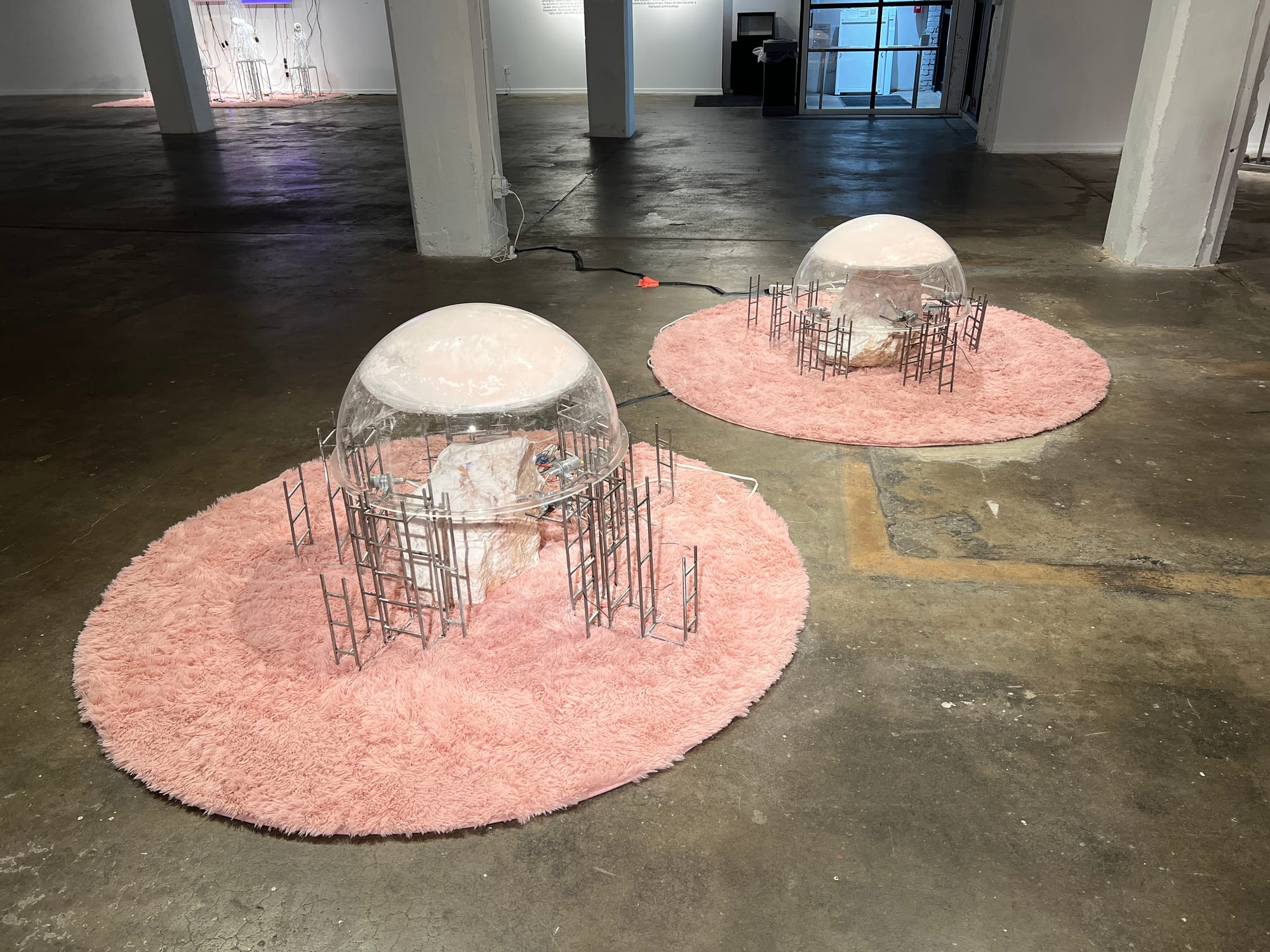
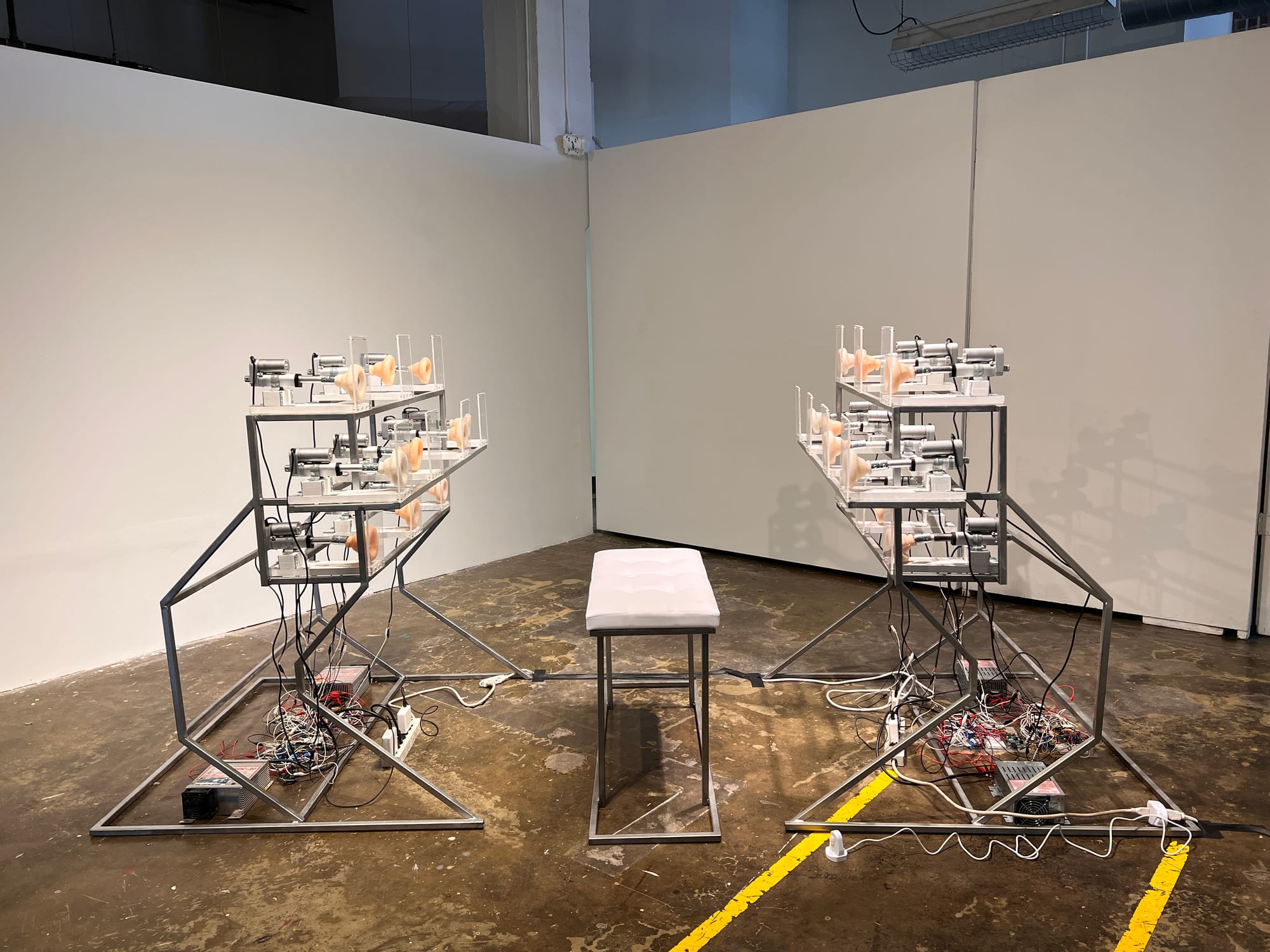
In the open space of the entirety of Living Arts, Scut Work gets the breathing room these kinetic sculptures deserve two years after Z.B. Reeves reviewed Vinyard’s Command + C, Command + C, Command + C at a too-small space. This new exhibition is a vast uncanny valley of massive robots—for lack of a better word—emitting abrupt, mechanical whirs, many of them triggered to move via small motion detectors by viewers walking by. That isn’t awareness, exactly … or is it?
Vinyard leans into that question with a palette of pink, peach, and other light skin tones across the soft materials, including prosthetic silicon, giving the impression of human skin stitched together as costumes. Some of the pieces are repeats from that 2024 show, including All the King’s Horses and Kissing Booth, two of the artist’s most successful interpretations of distilling humanity out of habitual human movement.
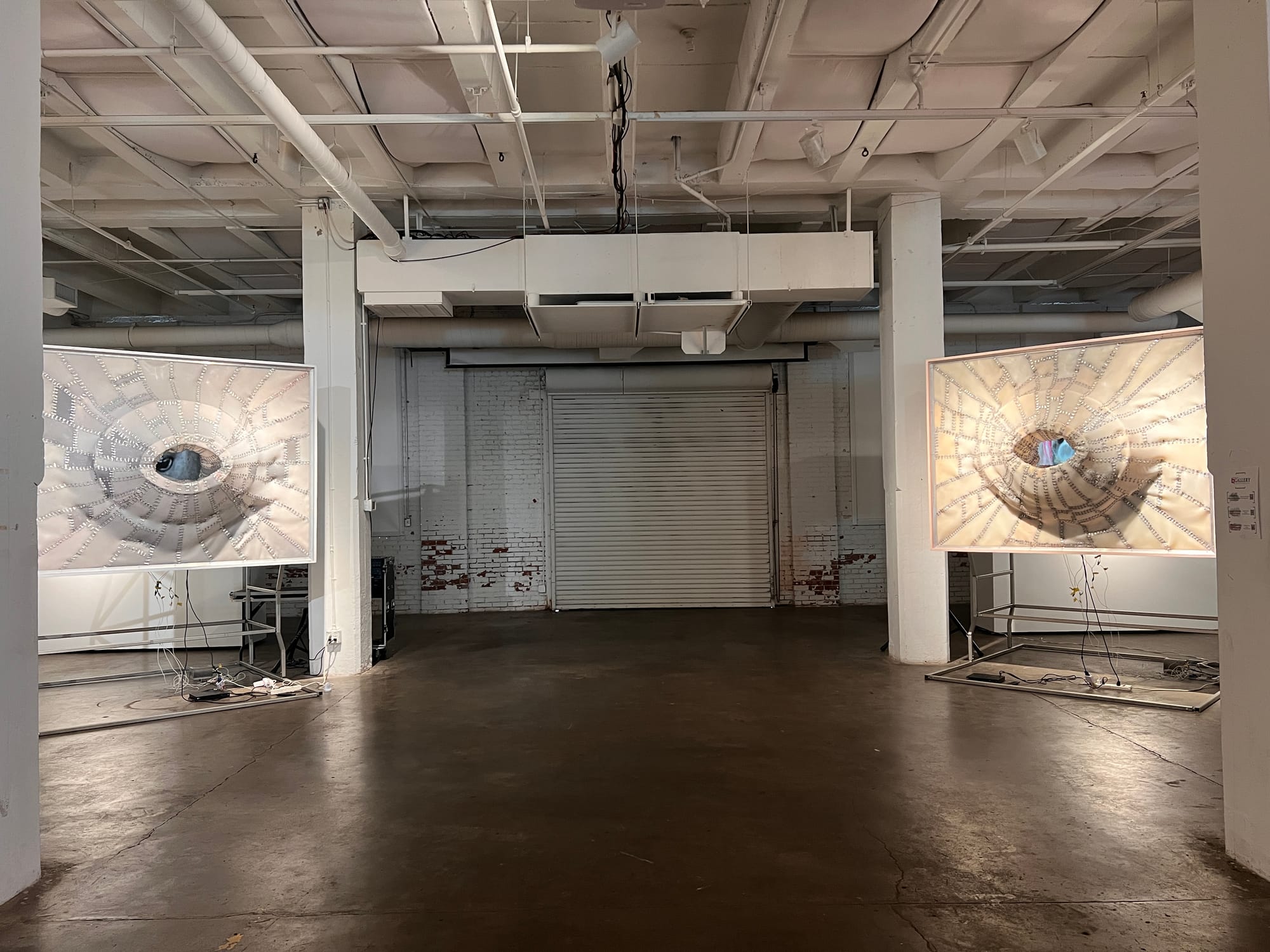
photos by Becky Carman
A cluster of nervous, shifting cameras greets entrants into the gallery; closer attention to the screens displaying their points of view reveals what they are and aren’t catching in the room around them. Skin-toned silicon-draped trusses encase miniscule LED screens, some displaying self-identification messages, others countdowns. A bright pink bomb emblazoned with HB 3278 is also tipped with a tiny flag reading “HIGHER ED.” (Vinyard is a professor at the University of Science and Arts of Oklahoma in Chickasha.)
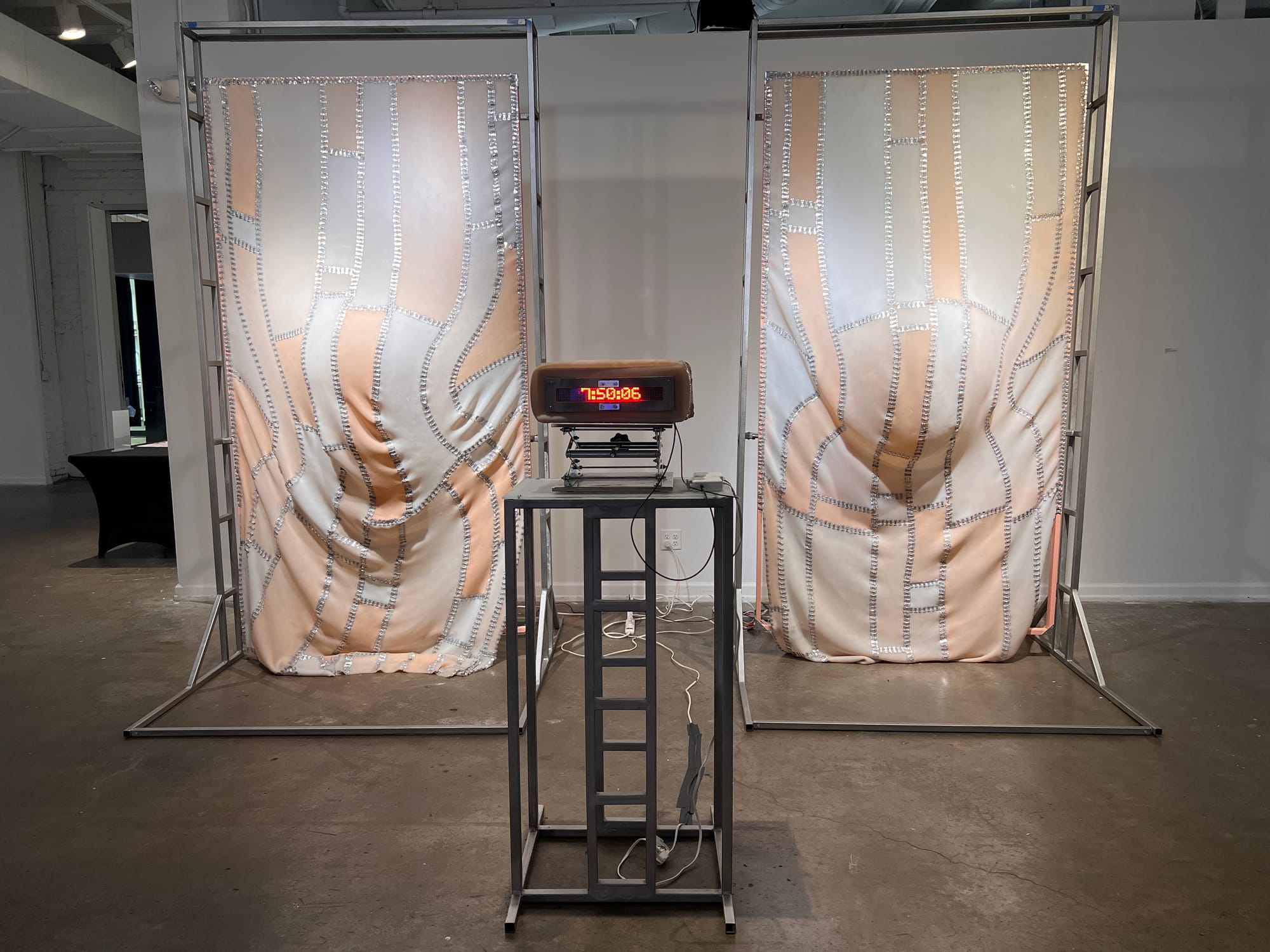
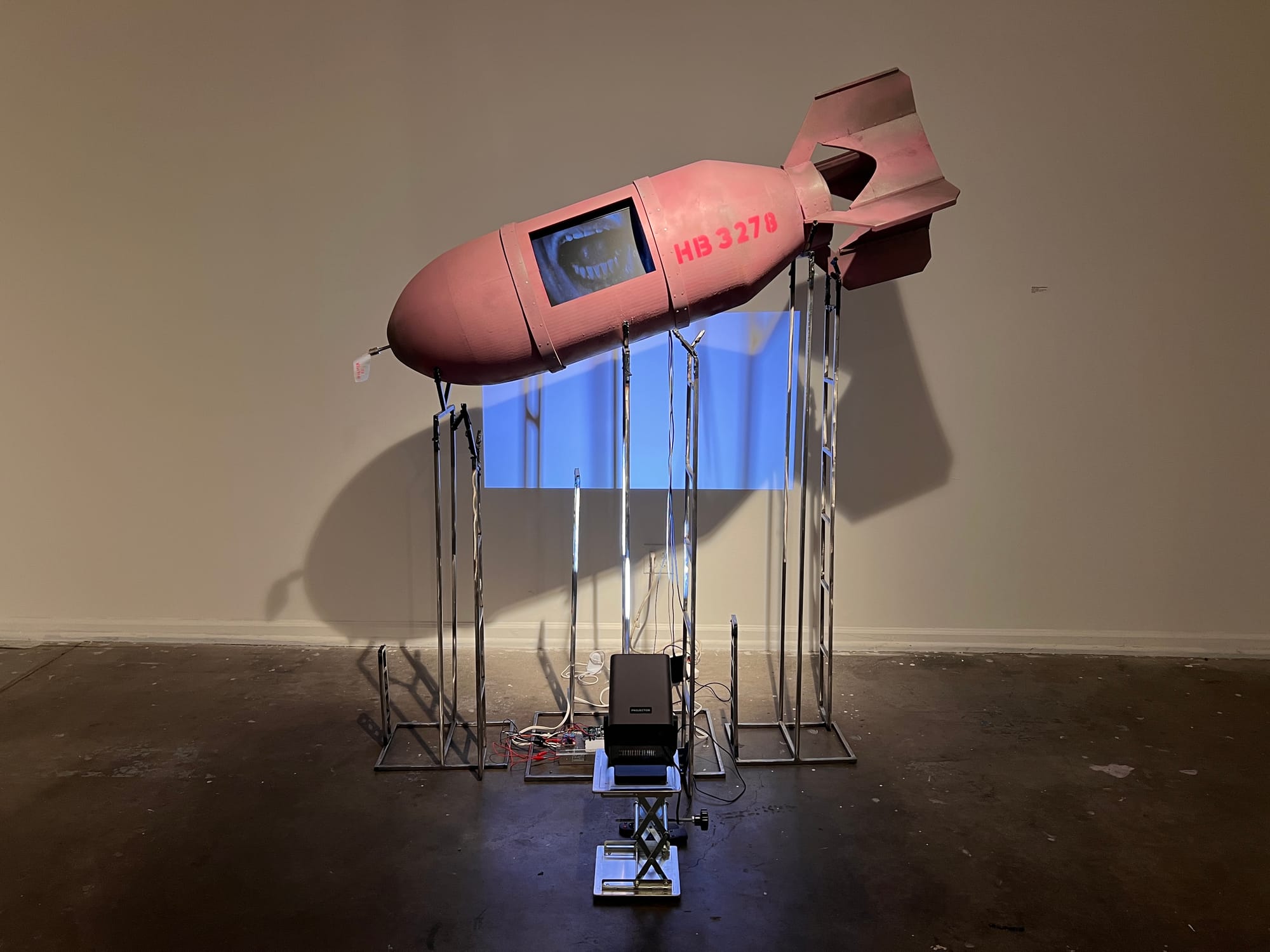
photos by Becky Carman
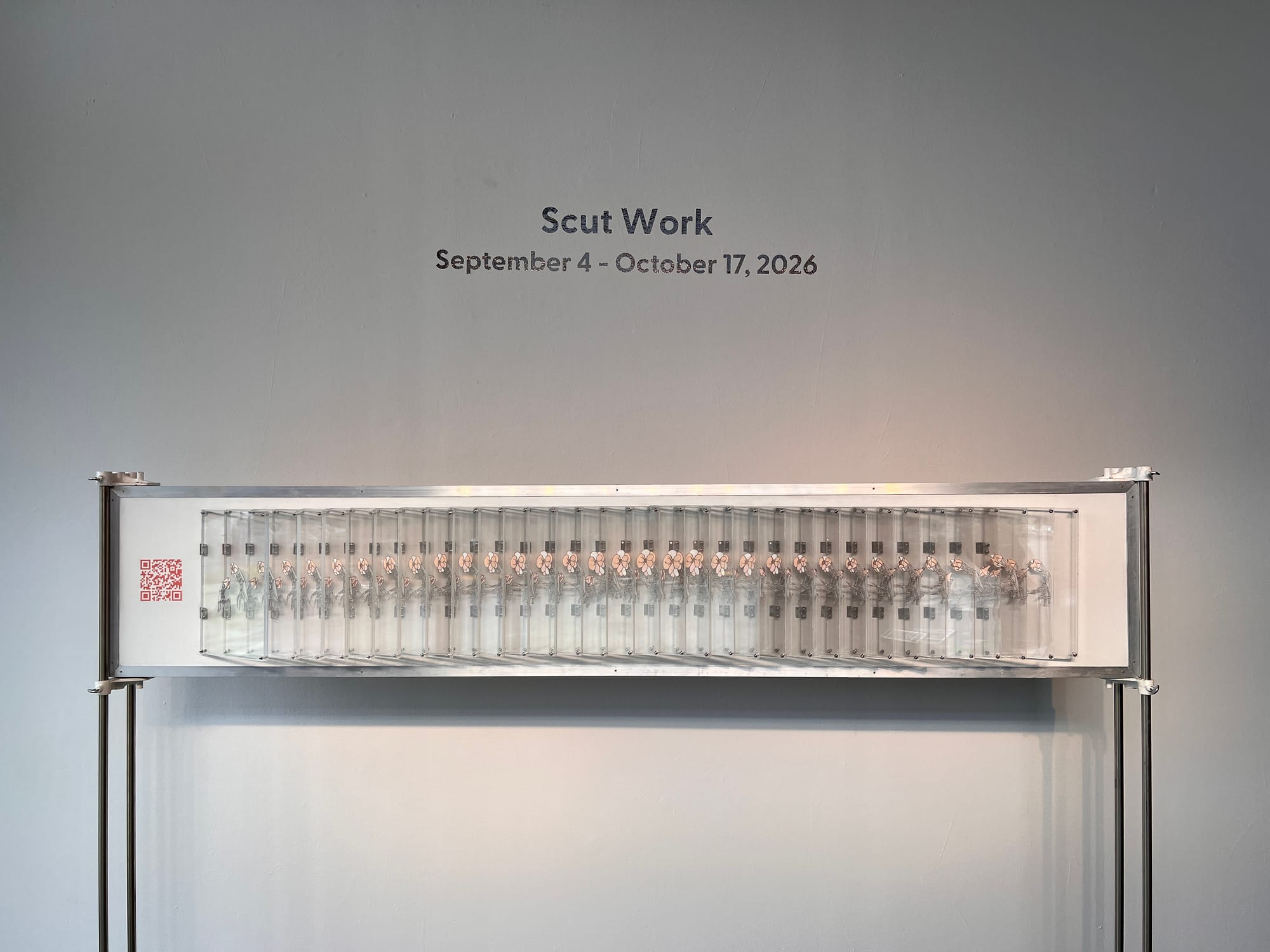
My cell reception in this strip of downtown buildings is historically bad, so when I scanned the accompanying QR code to Suspended Animation, it took several minutes to buffer and view the streaming video component of the animation frames. The hitch delivered a wonderful layer of irony: a machine I rely on for everyday tasks failed me while trying to learn more about a machine trying to do everyday tasks.
“Scut work” is labor that is routine and menial but generally necessary, and that makes Vinyard’s Influencer piece all the more poignant, smashing another layer of artificiality into a job that is already steeped with it. The constellation of artificial animatronic sheep mouths moving and saying nothing, mounted on sheep wool, contains layers of questions about whether or not work matters just because you call it work. The sheep heads are, of course, accompanied by an equally bleak Instagram account.
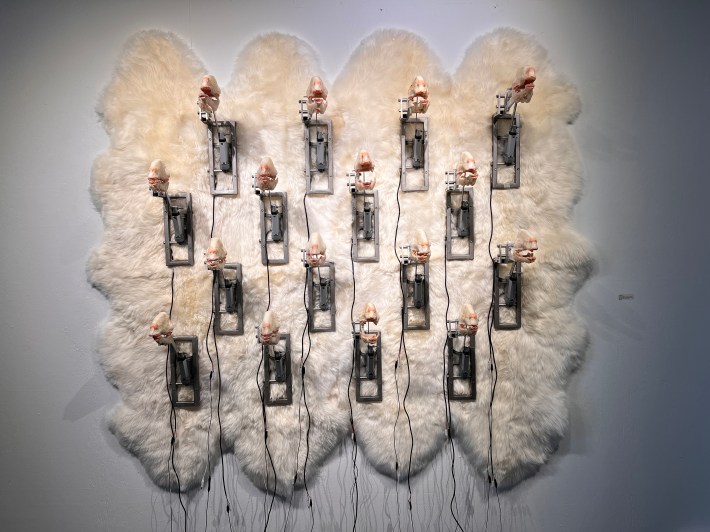
Scut Work will make you question the nature of yearning and who (or what) is capable of it. It’s whimsy that makes you feel bad. And it’s a compelling reminder that maybe the point of doing something lies outside of the mechanical doing. That’s a place we think robots can’t reach. But we still aren’t sure if they know that, or if they want to.


