
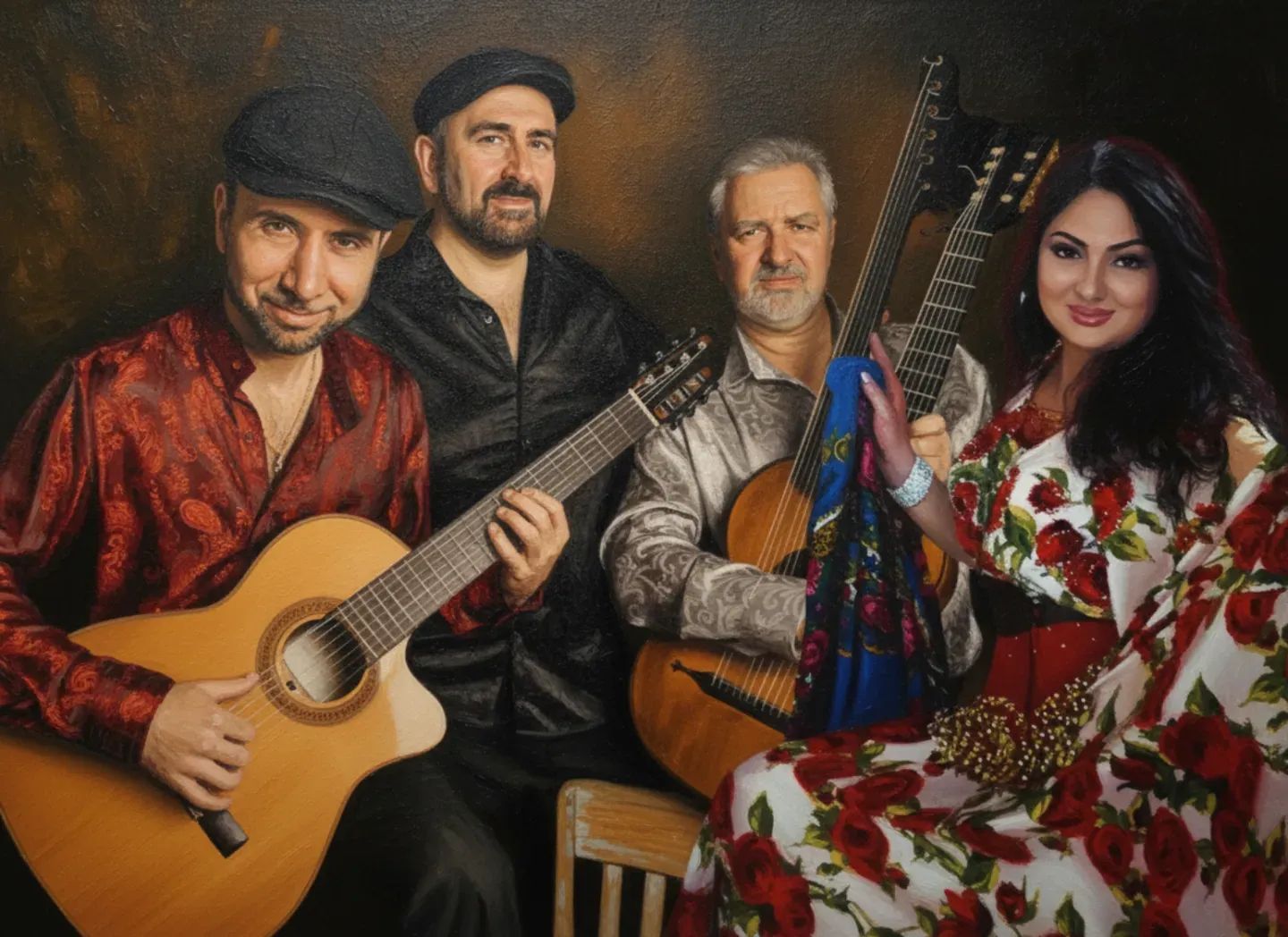
Zingaresca Ensemble
Henry R. Luce Hall
New Haven
April 14
Vadim Kolpakov, seated in the auditorium inside Henry R. Luce Hall on Hillhouse Avenue on Tuesday night, began with one crystalline note plucked from his guitar. He chased it with a flourish from the fingerboard, another, another, letting waterfalls of music flow from the strings, yet somehow the melody stayed clear, floating above it. He executed one delicate, intricate passage after another, energetic and effortless. And through it all, time after time, he looked up from his instrument, made eye contact with the audience, and smiled. He traveled far, and never left anyone behind.
Kolpakov is the musical anchor for the Zingaresca Ensemble, a trio and sometimes quartet that specializes in Romani, Jewish, and other Eastern European music. As the his bio on the ensemble's website states, Kolpakov "is one of the most prominent and renowned Roma seven-string guitarists in the world. He was a lead musician of the famous Theatre Romen in Moscow, where he performed as a guitarist, composer, vocalist, dancer and dramatic actor. To this day, his original guitar compositions are performed in many prominent plays at the theater as part of the vibrant oral tradition of the Russian Roma culture. Hailing from Saratov, Russia, Vadim graduated from the Roma performing arts school Gilori and studied guitar with his uncle Alexander Kolpakov, the virtuoso Russian seven-string guitarist who served as the musical director of the Romen Gypsy Theatre for over a quarter of a century. At the age of 15, Vadim began work at the Romen Gypsy Theatre, where he worked for eight years and was the leading guitarist for seven years."
The full extent of the bio is worth quoting: "In 2008, Vadim, as a member of the Kolpakov Trio, went on the world tour 'Sticky & Sweet' with Madonna. They performed in many European and South American countries, as well as in North America and Mexico, including venues such as Wembley Stadium in London, Madison Square Garden in NYC, and Maracana stadium in Rio de Janeiro."
The rest of the ensemble has similar accolades. Second guitarist Oleg Timofeyev is a celebrated ethnomusicologist and documentary filmmaker. Singer Anton Belov is a Juillard-trained baritone who has performed at Carnegie Hall. And singer Alina Nazarevich, from Kyiv, Ukraine, is the founder of her own Roma ensemble.
Which is why the ensemble had spent a two-day residency at Yale, of which Tuesday's performance was the grand finale. April 13 featured a screening of Romany Vengerka, a documentary Timofeyev made about Kolpakov and his uncle. Earlier in the day, the ensemble gave a lecture about the history of the Romani people and their migratory pattern across Europe, along with musical demonstrations. The concert was a chance for the ensemble members to put all of their knowledge into practice.
The music they played — most of which, they explained, came from their Romani repertoire — to the American ear often feels drenched in nostalgia and history, but the Zingaresca ensemble's nimble playing kept it grounded in the present, as living, evolving music. Kolpakov explained that the first piece he played was written by his uncle, and that he plays it at every concert. From there, the rest of the ensemble joined him.
To a number, the ground's sung pieces were exercises in big voices and big emotions. Belov's powerful baritone didn't need the microphone he was using, while Nazarevich served up melody after melody with sharp delivery. Blended together in harmony, their voices were rich counterpoint and complement. In those pieces, Kolpakov and Timofeyev played strutting, nimble accompaniment, supporting and embroidering the singers' melodies and harmonies.
Along the way, Belov often gave short, humorous summaries of what the songs were about: "A boy and a girl go into the woods and they have a fight, then get back together again"; "how brave a suitor needs to be to acquire a Roma heart—he has to be as brave as her brothers, and that's very brave"; "there are the mountains covered in snow, there I will lose myself, never to be found again." But then another one was about a horse. "A lot of the songs don't have a very deep meaning," Belov said, chuckling.
Many in the audience were fluent in the languages the ensemble sang in. Even without that level of understanding, the ensemble always conveyed the meaning in the music, communicating well enough that the crowd broke into rhythmic clapping spontaneously several times, sang along on occasion, and met every song with hearty applause. Throughout, Kolpakov's playing shone through. Whether he was playing in lush, emotive style or shredding at high speed and volume, his deep technique served emotional expression every time, and the rest of the ensemble knew it.
"How many people here play guitar?" he asked after a particularly virtuosic piece.
"Everyone plays guitar," Belov said in response. "But not like you, my friend."


