

Theatre Tulsa x Margaret Stall: Witch
Theatre Tulsa Studios
September 25, 2026
This past weekend, local artist Margaret Stall kicked off a new season of self-produced works in Theatre Tulsa’s Collaboration Series with Witch by Jen Silverman. Even with opening night serendipitously tucked between the autumn equinox and the weekend’s Harvest Moon, this play—a loose reimagining of the English Jacobean 1621 play The Witch of Edmonton—doesn’t deal with witchcraft in the way you would expect.
In Silverman’s version, a sweet-talking salesman of a devil named Scratch visits the small town of Edmonton and tempts the residents by granting their deepest desires in exchange for their souls. Scratch finds quick success with his initial targets. Cuddy, Sir Arthur’s artistic son, harbors suppressed lust for castle resident Frank, a condition that punctuates his gentle nature with violent urges. Frank, a peasant to whom Sir Arthur has taken a liking, has his desires set higher, wanting to persuade Sir Arthur into giving him his title. Even Winnifred, Frank’s secret wife who works as a servant in Sir Arthur’s castle, ends up striking a bargain with Scratch in her moment of despair.
The one person he can’t convince, a societal outcast named Elizabeth, is the one the town calls a witch, a title she decries. What’s advertised as a play about desires becomes a poetic examination of power and the avenues we take to grasp it, even if the world deems we cannot have it.

While the characters and their arcs felt familiar, these actors crafted genuine performances that made the twists and turns, the betrayals, and the reveals strike an emotional chord, particularly in the conflict triangle between Cuddy (Charles Davis), Frank (Aaron Seale), and Winnifred (Nicole Billups). In particular, Davis and Seale handled the swelling tension between Cuddy and Frank quite well, making for some true “holding your breath in anticipation” moments and culminating in a joyful yet devastating resolution set to Florence + the Machine’s “Shake It Out.”
In an inspired casting decision, Kathleen Hope brought out the comedy as well as the deep humanity within Sir Arthur. Hope said as much in her bumbles and grumbles as she did in the clearly delivered monologue in which Sir Arthur relays his fears and struggles concerning his son Cuddy. She had me hanging onto every word. The audience was into it as well: her first exit received applause well before the scene even ended.


Stall stepped into the role of Elizabeth, playing the world-wearied woman with a blunt deadpan that humorously accentuated Jasper Hammer’s happy-go-lucky Scratch. Hammer’s performance naturally found the wit in Silverman’s dialogue, creating such a likable character that you appropriately forget he’s technically a devil.
While this juxtaposition was enjoyable at first, later scenes between these two hit a plateau. Stall kept Elizabeth's deeper feelings a little too hidden. While this might be a natural response given the character’s circumstances, I didn’t get a strong taste of the character or her emotional arc, which felt necessary to counterbalance the second story line. Additionally, from my seat on the opposite side of the stage, the moment Elizabeth’s budding kinship with Scratch passed the platonic threshold came as a surprise, as I couldn’t ascertain how Elizabeth really felt about him and his advances up until that point.
This muddled energy carried from the penultimate scene, where Elizabeth finally takes up Scratch on a deal for her soul, into the final one, where Scratch talks to his “boss” in a monologue that carried the necessary grave emotion but needed a little more shaping to give the overall piece a sense of finality.

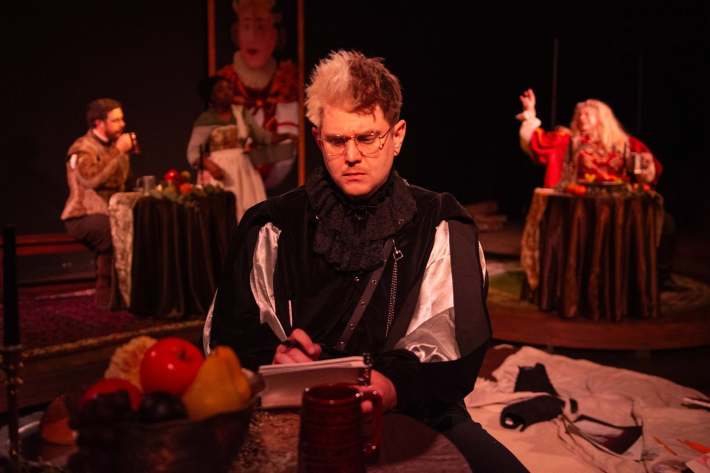
As he’s done in previous productions, director Jason Sirois shone once again when it came to production design. His ornate reconfiguration of the set into a thrust stage created a symbolic and immersive playing space that expertly highlighted the play’s themes. Four platforms marked the domains of four characters: Frank, Cuddy, Sir Arthur, and Elizabeth. Each looked deliciously lived in and foreshadowed a few of the characters we were about to meet: a frequently-used wood chopping station, a pair of shoes in the exact position that indicates a character slid them off with their heels, a jar of paint brushes on the floor.
This design placed Sir Arthur quite literally in the middle of everything, signalling his indisputable power and influence on everyone’s lives. I found myself hyper aware of where everyone was at any given time, of who had a space and who didn’t, and of how the power dynamic shifted in the room with every move.
Add in the ornate embellishments (props by Sirois and Jessica Teruki), lush lighting (Mallory Lindsay), stunning costume design (Adam Farman and Paulette Record), and a warm but zesty cinnamon scent throughout the space to welcome the audience into the world, and you have a show that, on a technical level, became a smart, rich tapestry that expertly brought Silverman’s world and themes to life.
Like any true fable, Witch comes with a moral lesson. How well do we actually know our own desires, and by extension ourselves? How does our proximity to power alter what we desire? Silverman’s text and Stall’s production are united in their timely warning about the corruptive yet necessary nature of power, with a sober reminder that it doesn't take a demonic supernatural force for humans to go down that path.


