
Nick Cave: Mammoth
Smithsonian American Art Museum
Washington, DC
Through January 3, 2027
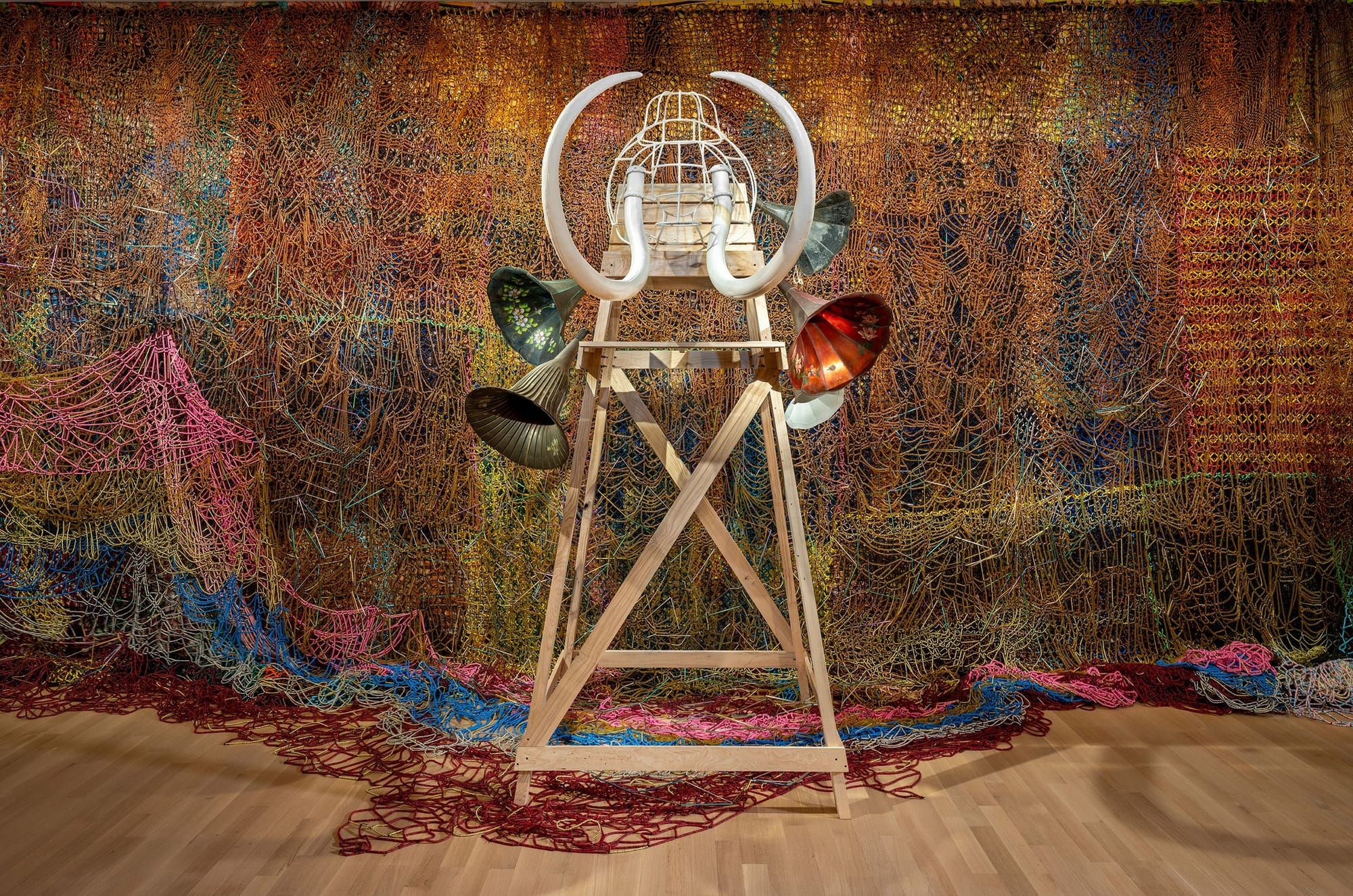
An entire wall of the special exhibition gallery of the Smithsonian American Art Museum vibrates with scintillating, undulating color. Closer inspection reveals it to be a woven wall covering, but from even a few steps back, all we get is the complex visual effect: dazzling, enlivening, disorienting. This is in part because of what's installed in front of it: what looks like an old lifeguard chair, a circular cage oriented to resemble the outline of a skull, a pair of curling tusks. An array of Victrola horns emerges more or less from the place where the creature's mouth might be. What would its voice sound like? What message might it try to communicate? And would we be able to understand it?
The arresting piece is one part of the exhibit Nick Cave: Mammoth, which is enjoying a run at the Smithsonian American Art Museum through Jan. 3, 2027. Cave (born in 1959 and not to be confused with the leader of the rock group The Bad Seeds) is a truly multidisciplinary artist: a painter, sculptor, dancer, and performance artist, in additional to being a professor. He has had major shows at the Museum of Contemporary Art in Chicago and the Solomon R. Guggenheim Museum in Chicago, and his work has often incorporated found objects. In Mammoth, Cave offers a sense as to why: "History is something that is made, as are our selves and our ties to one another. Each marker, memory, and connector might be described as small, special, and specific, but collectively they are mammoth," he is quoted as saying.
The accompanying notes to the installation can feel almost cheery, which is of a piece with the bright colors Cave often deploys. "In Mammoth, Nick Cave invites us into a world built from memory, imagination, and the materials of everyday life," a sign on the wall reads. The project is "deeply personal. It traces back to Cave's childhood on his grandparents' farm in Chariton County, Missouri, where creativity was woven into daily life. Inspired by family members who pieced quilts from scraps, repaired tools for new uses, and coaxed beauty from whatever was at hand, Cave learned early how to transform the ordinary and overlooked into something magical," evoking "both loss and renewal. Mammoth asks us to consider the stories embedded in our surroundings — and to reflect on how we live with the things we inherit, as well as on the traditions and knowledge we may have lost. Collected here at a time of profound change, Cave's art forms a kind of monument: not only to the past but to the everyday acts of making, preserving, and imagining that carry us forward."
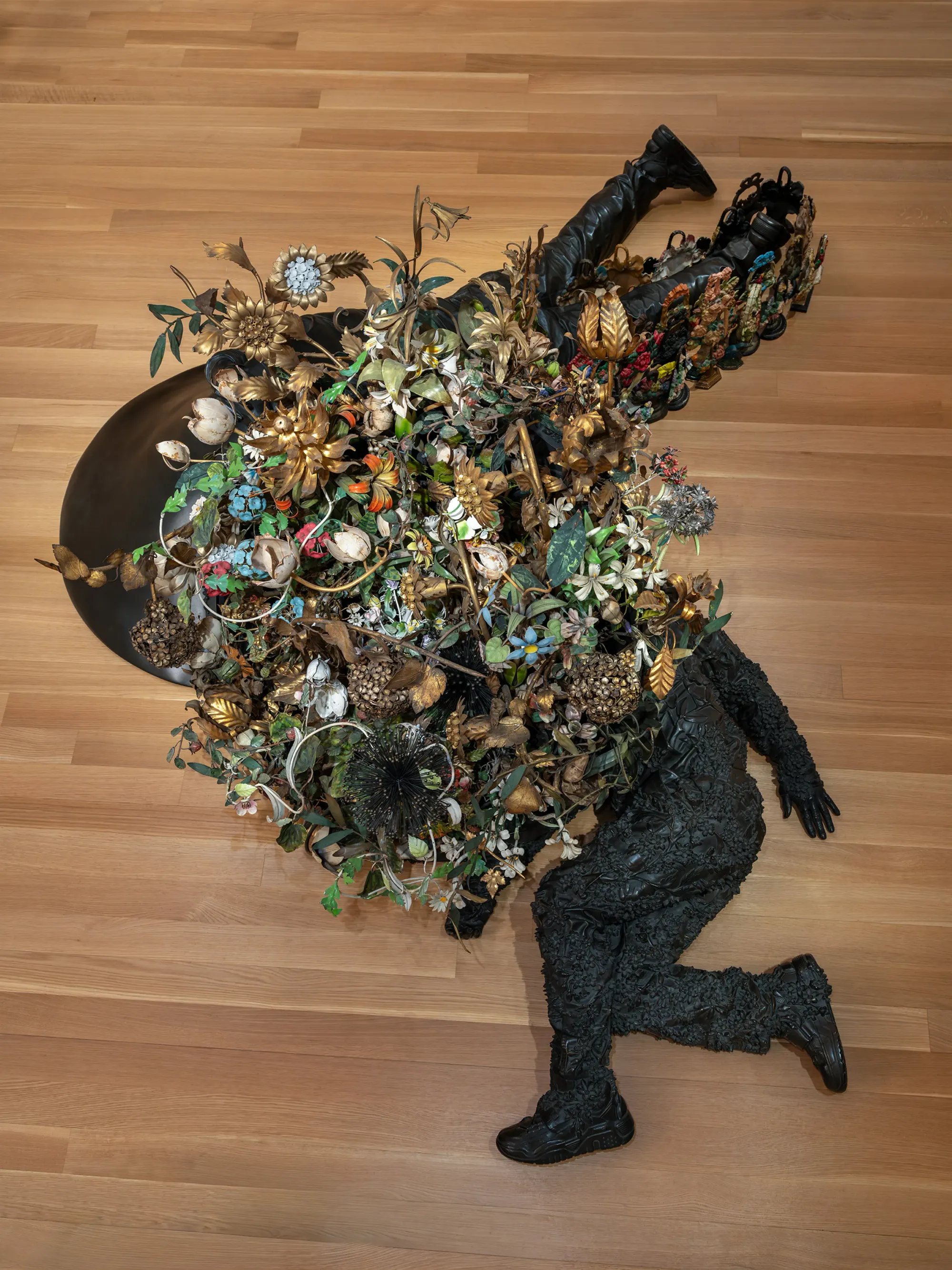
Where the accompanying texts accentuates the positive, parts of the show suggest that something more complex is afoot, and that darker elements lurk beneath the surface. In Amalgam, the first thing that draws the eye is the explosive bloom of color and texture at its center. The flowers are all sculptural, but they look ready to flutter in a slight breeze. The soil for the flowers, however, appears to be the heads and torsos of two people lying prone on the floor at unnatural angles. The first association may be that plants usually only grow from dead bodies, not living ones, though Cave's depiction of the two forms suggests the relationship isn't just about growth from decay. They could be sleeping, and the flowers could be manifestations of their dreams. There is also a way that the growth is bringing the two people together, making them one, perhaps making them whole. All the interpretations are possible, but the sense of death and decay can't be overlooked.
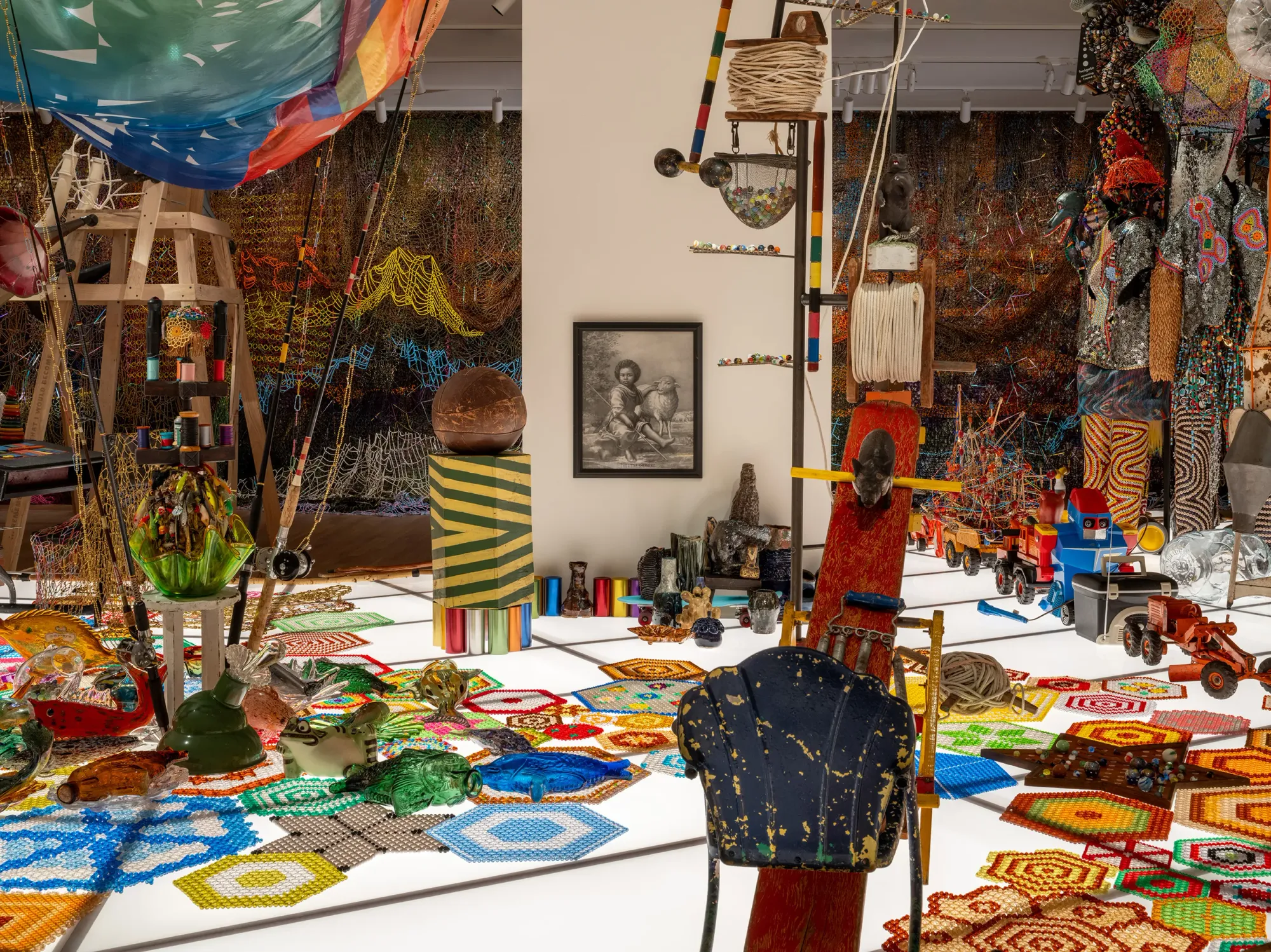
Amalgam puts an unspoken edge on the rest of the show, the centerpiece of which, as the accompanying notes state, is a "massive glowing light table" on which Cave "has placed thousands of objects: from vintage juggling balls to pie plates to a set of his grandmother's thimbles. Some of these objects remain recognizable; others have been transformed into creatures and contraptions that seem to hum with spirit and intention. Nearby are the imagined tusks and hides of long-extinct mammoths — Cave's ancestral witnesses, watching quietly from deep time."
The table — which photos don't do a great job of capturing — is the most mesmerizing part of the show: part junk shop, part unfathomable Rube Goldberg machine, and part something else entirely, which the notes hint at. "Mammoth is built from the craftsmanship and imagination of countless unnamed individuals. The tools and trinkets that make up this installation were created, used, mended, and treasured by hands other than the artist's, many of them now lost to time. In gathering and transforming these objects, Nick Cave enters into conversation with generations of makers," making Mammoth "a testament to shared histories and deep knowledge held in things made by hand."
But it is also a testament to the ways in which those histories and knowledge aren't always shared. They don't always get passed down. Sometimes they get left behind, or fall by the wayside, unnoticed. Sometimes, try as we might to hold them, they slip between our fingers.
That puts a sting on one of the accompanying note's final statements: "As you explore this space, we invite you to look closely. You may recognize something: a walking stick like your grandfather's, a toy from your own childhood, a fabric pattern that once lined a kitchen drawer. Cave's work asks you to remember and consider how your own stories live on in the things we share, use, and pass along." Mammoth is also, beneath that comforting message, a monumental work about the frenzied process of understanding history, which is another way to say making meaning of our present.
The notes allude to the fact that we live in a time "of profound change." That change has been unsettling, at best, for a lot of people, and some may turn to ask how it is that we got here. Cave arrives with complicated news. Part of understanding the path to the present involves tracing the threads of what we do know back in time, to see the warp and weft of the patterns that have shaped where we are now. But part of that involves keeping a keen eye out for the things we lost, maybe without even noticing when it happened. What were they? Can we reclaim them now? And what would that mean for the future?


