
Watching the sunset on Belle Isle is one of my favorite things to do in the summer. The sunset itself is not important. It’s the water. Watching the last rays of daylight shimmer on the Detroit River as the moon rises to watch over the city is a spiritual experience. When I was a kid, my mom would load my cousins and I in the car for a “midnight swim” on Belle Isle. That was before the Michigan Department of Natural Resources took over and began enforcing the strict 10 p.m. closing time. Everything changes. And change is the thing that stuck with me the most as I read Black Summers.
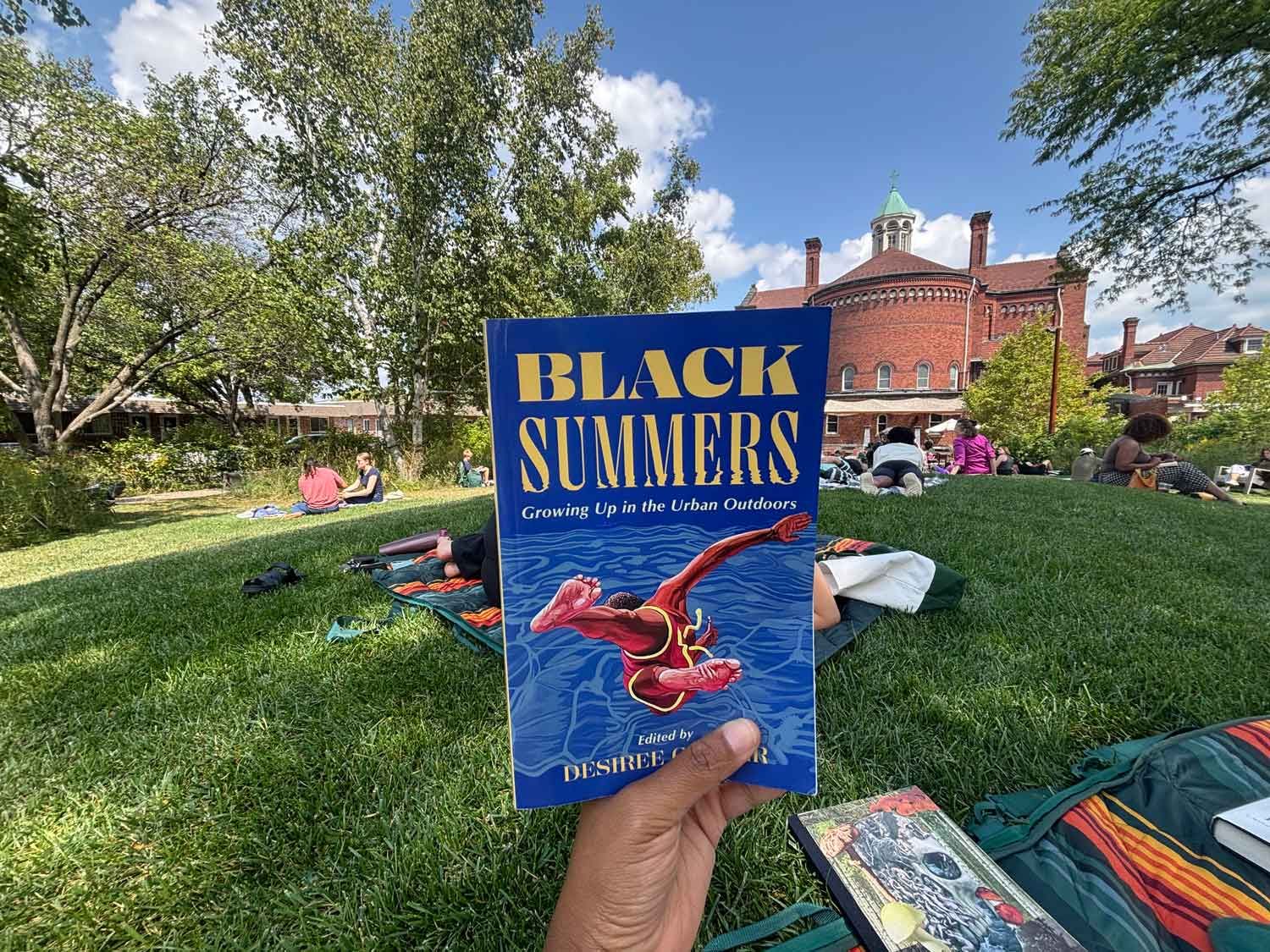
Black Summers: Growing Up in the Urban Outdoors is an anthology of Black Detroit writers, curated and edited by Desiree Cooper, and published by Wayne State University Press in April. It features essays, creative non-fiction, and poems by the likes of Brittany Rogers, Kahn Santori Davison, Nandi Comer, Zig Zag Claybourne, Angela Atabex Lugo-Thomas, MARS Marshall, Tommye Blount, shannon garth-rhodes, and Cooper herself, among others.
The anthology tells stories of joy, self-discovery, community, hardship, belonging, and grief. But this story starts with water.
It opens with Cooper recounting the story of Sarah Elizabeth Ray, also known as Liz Haskell, who integrated the Boblo Boats in 1948 after she was kicked off the boat for being Black. Ray had boarded the boat to celebrate her graduation from secretarial school with her fellow classmates. She sued the company for racial discrimination with the help of the Detroit NAACP who took her case all the way to the Supreme Court and won. Cooper’s essay positions Ray as an ancestral figure who, in many ways, paved the way for Black Detroiters to be able to indulge in their right to enjoy nature by forcing the integration of the Boblo Boats and her later work as a community activist.
The writing feels like a cool breeze off the riverwalk on a scorching hot day while young people zip by on roller blades and oldheads cruise along blasting R&B. It feels familiar to Black Detroiters like the writers and readers are speaking a shared language on our collective experience. It captures the feeling of Detroit summers so vividly that it’s impossible not to feel a sense of camaraderie.
Black Summers is full of life. Full of water. But also full of change, starting with Ray’s story. I saw myself, and my family in many of the pages, and most Black Detroiters will too. Bridget M. Davis writes about how her front porch was her place of solace until the National Guard rolled down her block in tanks, ordering everyone to stay inside, during the 1967 Rebellion. I read with a visceral familiarity and a sinking blow in my gut when she recounted how her father’s house was lost to time, eventually being forfeited to backtaxes, which happened to both my grandmother and my mother’s houses.
In “Detroit Boricua,” Angela Atabex Lugo-Thomas shares her story of moving, reluctantly, from Puerto Rico to Detroit as a child. The closest place she finds the sanctuary of the island’s womb waters is Belle Isle. I felt her story in reverse. The Detroit River has been my safe space since I was a child, and visiting Puerto Rico (my great grandmother’s homeland) feels like returning home as I swim in the Atlantic Ocean and waterfalls of El Yunque Rainforest.
Nandi Comer recounts camping in Port Huron to watch a meteor shower and running into a man writing “Trump” in the sand of the beach, a real fear for many of us who venture out of Detroit to enjoy the sprawling nature of our state.
I was struck by Zig Zag Claybourne dubbing the willow trees on Belle Isle as “witches,” and Keith A Owens’s description of Detroit as the “Blackest Big City in America.” While Owens found a mecca of Black culture in Detroit after growing up in majority-white Denver, I did not appreciate how Detroit beams as a glowing container of Black joy until I moved to Japan in 2016 and found myself a lonely Black face in a sea of homogenous culture.
The wheel of the year is turning to fall, and I’m savoring the last moments of summer and chances to swim on Belle Isle with it. I read the majority of Black Summers while sitting on the lawn of The Shepherd, during a silent reading party hosted by In Thicket bookstore. Both are newcomers to the eastside as part of Little Village, the three acre community that encompasses Library Street Collective’s The Shepherd, the Lantern building, and Cadillac Arts Center. Nothing stays the same. Everything changes.
No matter how much the city changes, Detroit will always be sacred land for Black people. The Detroit River is our church. It’s the final passageway that our enslaved ancestors crossed to freedom on the Underground Railroad. It’s the place that feels closest to God where we gather with family, friends, and lovers to savor the summer sun. The river hears our prayers, cries over heartbreak, and joyous laughter.
As Desiree Cooper says in Black Summers, “In Detroit, we water.”
Black Summers can be found via Wayne State University Press.
Follow Midbrow Detroit on social media:
Bluesky, Facebook, Instagram, Threads, TikTok, X.


