
“Equus”
Ringwald Theatre
Ferndale, Mich.
Until Nov. 2, 2026
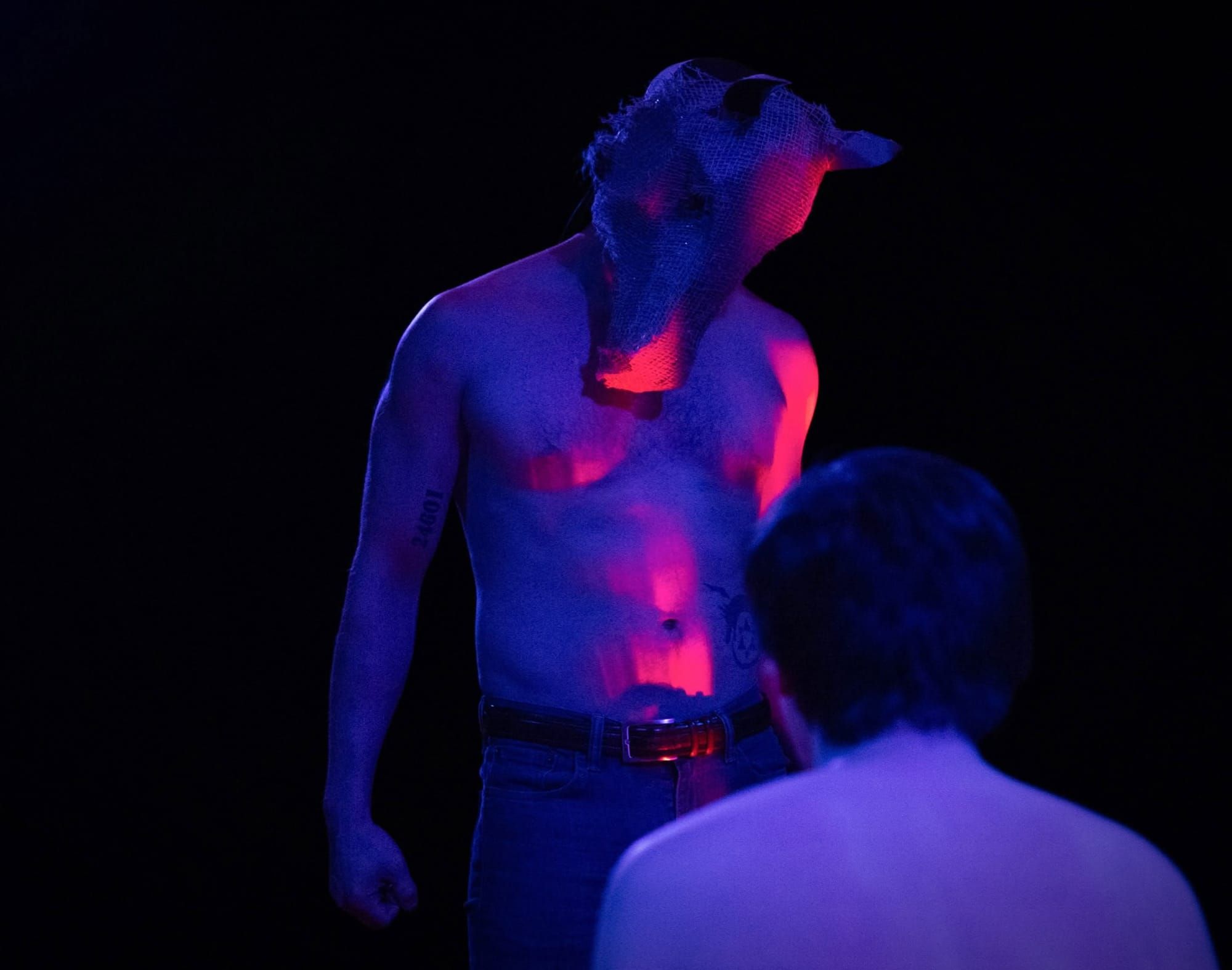
From the minute the lights went up to reveal a young man sensually nuzzling an actor wearing a horse hood, I knew I was in for an uncomfortable evening. And I was right. The Ringwald Theatre’s production of “Equus” was one of the most deliciously disturbing nights of theater I can remember, and it was glorious. The 1973 play by Peter Shaffer is a psychological thriller about a teenage boy who looks at horses in a way horses should not be looked at — examining passion, religion, sexuality, and conformity along the way.
The play, directed by Jamie Warrow, mostly takes place inside a psychiatric hospital, where child psychiatrist Dr. Dysart tries to understand his latest patient Alan, a tormented 17-year-old boy brought to him after blinding six horses. Through tiny breakthroughs and glimpses of Alan’s past, we learn of his early fascination with horses as a young child, drawn by their strength, their power, and yet their ability to be controlled by humans. The bridle bit — which Alan’s first horse “told” him was quite painful to wear — becomes a recurring theme of the show representing the ability to control that power. Alan’s sheltered upbringing with a controlling father and a religious mother transforms his obsession with horses into something spiritual, a discovery of a Christ-like horse-god “Equus” — the Latin term for horse — which presides in each horse and is a being to be worshipped.
Dysart, meanwhile, is battling his own demons, questioning if his work “fixing” troubled children is stripping them of what makes them individuals.
The six-person cast, led by Brady Jacot as Alan and Joe Bailey as Dysart, is excellent. Jacot is convincing as the disturbed teen, capturing his fear, anguish, shame, and confusion as he tries to understand himself and the world disgusted by him. His Act 1 and Act 2 finales are powerful, with Jacot releasing both his jubilation of fulfilling his desires and the subsequent self-destruction.
Bailey’s anguish is more tempered, coming from a man no longer fazed by psychological abnormalities and a near-boredom that leads to a tormented envy of his patients.
Amy Schumacher, Sean Sabo, Hosanna Phillips, and Garett Michael Harris round out the cast. They expertly take on various roles that are largely reactive characters expressing the disgust, anger, and frustration of Alan and Dysart — and with multiple convincing British accents and the occasional horse sounds.
Warrow’s direction fully utilizes the intimate, in-the-round theater and leans into the disturbing nature of the story with background characters wearing creepy white masks when not in a scene and frequently chanting. Jake Turner’s set features a rough, wooden, stable-like structure with walkways and piano benches that allow audience members from all sides of the room to have close proximity to the actors for at least a few scenes throughout the nearly three-hour show. Brandy Joe Plambeck’s lighting design alternates bright white lighting for the present psychiatry scenes and interactions and moody, blue-and-red lighting that amplifies the story’s passionate, hellish flashbacks.
At first glance, “Equus” is an extreme exploration of self-identity versus conformity, of power and control, and the blurry line between passion and worship. It can also be interpreted as an exploration of the desire to express one’s sexuality openly without public condemnation or religious shame, and how fundamental sexuality is to our self-identity — which feels particularly resonant for a play written by a gay man in 1970s England. But as a woman watching the play in 2026, my first thought was that Dysart’s sympathy and envy of Alan’s obsession — which resulted in six blinded horses — could be used to justify sexual assault. It is certainly a case where one’s individual passions should be bridled.
“Equus” was one of the most thought-provoking, unsettling and exciting shows I’ve seen this year, brought to life by an excellent cast and creative team who weren’t afraid to take us to the dark places we needed to go. And while I wish I had time to see it again, I’m confident it will haunt me for years to come.
Follow Midbrow Detroit on social media:
Bluesky, Facebook, Instagram, Threads, TikTok, X.


