
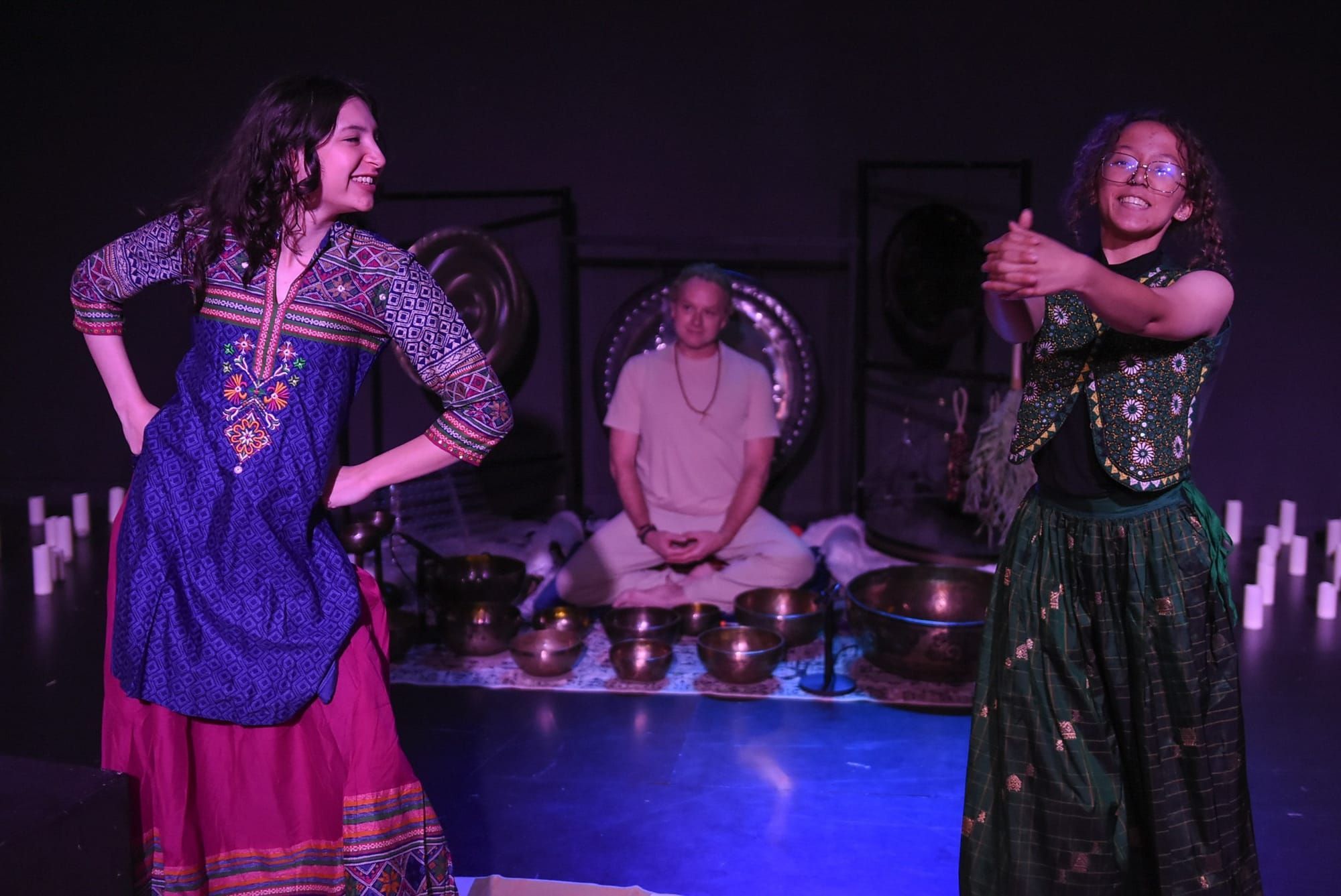
Heller Theatre Company: Radiant One
Theatre Tulsa Studios
May 28, 2026
In her debut as Heller Theatre Company’s playwright in residence, Carlyn Flint presented Tulsa with a piece from her graduate school days: an adaptation of a spiritual text called The Vijnana Bhairava Tantra. Believed to be written in 800 C.E. Kashmir, this text details 112 yogic meditations to help a person find oneness.
We know very little about this text, as Flint explains in her program note—not even its author. Flint’s play explores a fictional origin story, inspired by the mediations themselves. The plot follows a character called Reva, or more accurately her spirit, from the end of her previous life and through the one she is reincarnated into. As a child, she gravitates towards meditative practices and expresses a brave curiosity, asking those simple “why” questions that make adults uncomfortable.
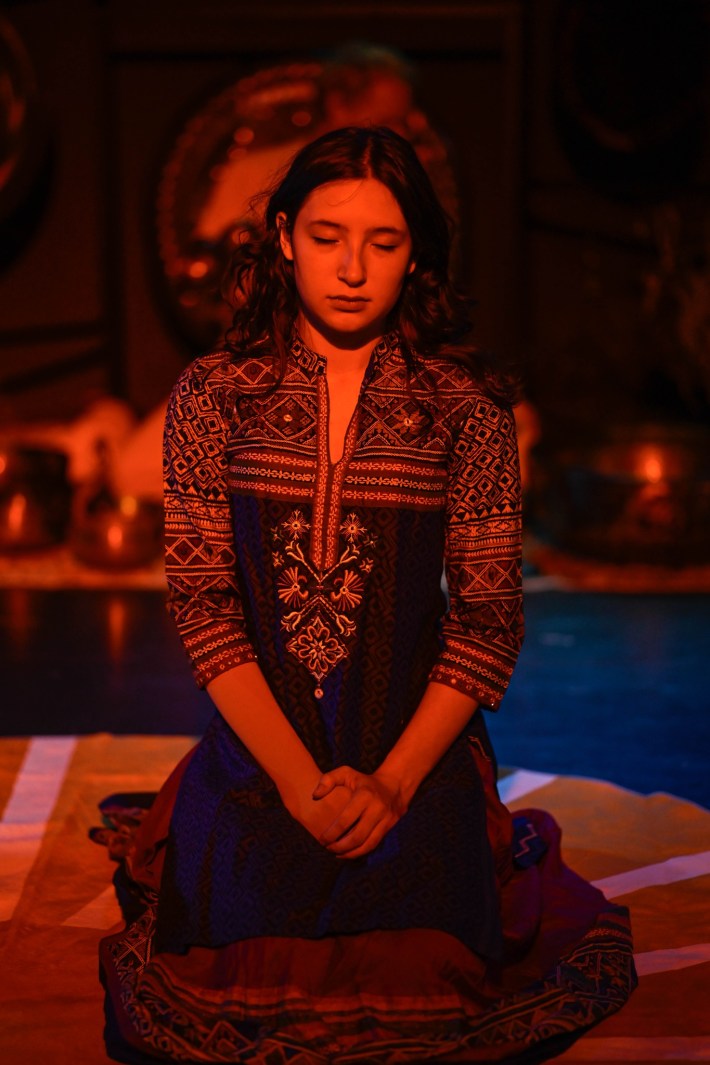
As she matures, so does this inquisitive spirit, and Reva finds herself distanced from her peers. A fateful meeting with a young boy, Kheertan, which moves through flirtation and later heartbreak, sends Reva into a deep depression, resulting in a lung infection that eventually ends her life. In her final days she writes the poems that eventually become The Vijnana Bhairava Tantra. Through it all, her mother Anya, who is carrying her own emotional baggage, stays by her side, offering counsel and necessary side eyes when needed.
I went into this play with no real knowledge of Hinduism, the history of southeast Asia, or the foundational text itself. Aside from the program note, there was little in the way of formal introduction to The Vijnana Bhairava Tantra in Radiant One. Instead, Flint dropped us directly into the piece with an opening monologue from the show’s drummer, one of a handful of live musicians in this production.
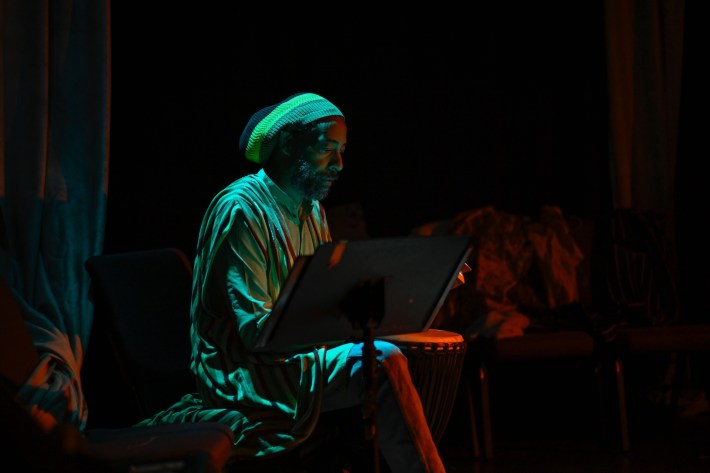
From his position in line with the audience and facing the stage, Chuck C. Fluker presented his drum and talked about the cyclical nature of stories—that the story we were about to hear has been told over and over again, just as a circle never ends. Then with a commanding beat, a lighting change, and a gut-wrenching wail from George Romero, who played Reva’s previous incarnation at the moment of her death, we were thrust into the story of Radiant One.
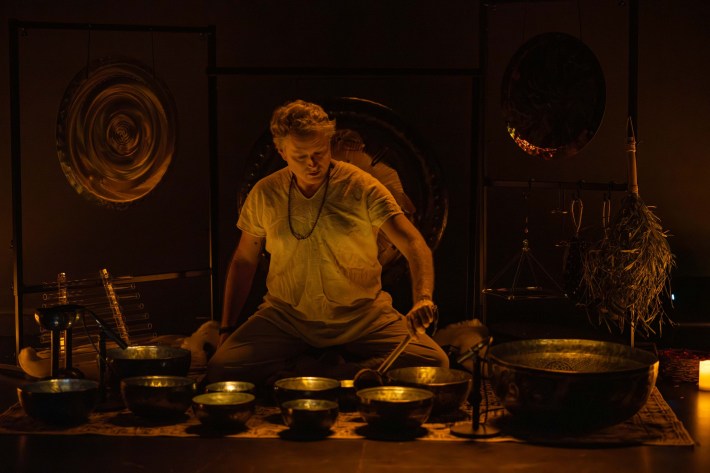
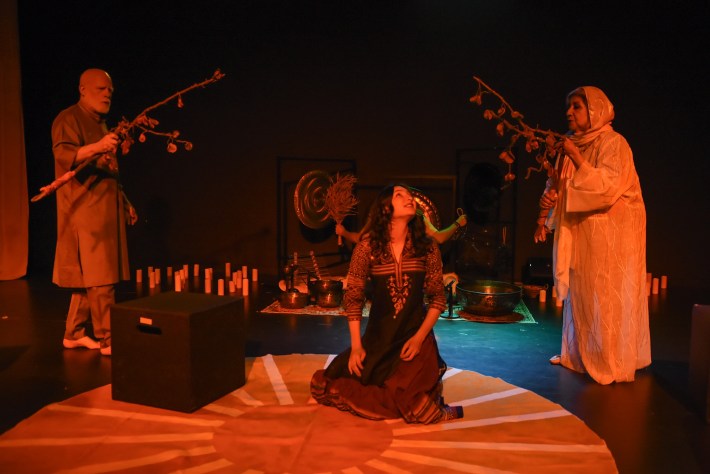
That was the first of many examples of the technical feats that continued to pull me into the piece. Playing into the motif of the circle, director Deborah J. Hunter blocked the play in the round. While most of the audience sat in front of the playing area, about 10 seats wrapped around the slides of the stage, creating an intimate and cozy atmosphere. Add Radar Bishop’s simple but effective set design of drapes and floor candles, meditation music, and an ethereal lighting design by production manager Anna Puhl that played heavily in warm oranges and eerie blues, and Theatre Tulsa Studios felt completely new.
An encompassing live score composed by Somesh Yatham accentuated this piece. Joining Fluker in the audience was Eric Strauss on the banjo/sitar, while Zavian Jamerson (Kheertan) played a flute live during his scenes. From his position at the back of the stage, Nic Bradford rounded out the soundscape with practical sound effects and a powerful live sound bath at intermission. His gentle acknowledgement of the actors’ performances, happening right in front of him, made the piece feel spiritual, as if the gods were watching Reva’s life unfold before her.
A multicultural cast brought this story to life, some playing two roles that presented delightful duality. For example, Daniel Ghoziel brought strong range to the enthusiastic Val in act one and the reserved and terse Shayak in act two. Jordan Wright performed in distinct voices for their two characters: a gravelly but menacing whisper for Orange Eyes (a puppet with a striking light effect designed by Puhl) and a clear-toned directness for Abrir.
Recent Charles Page High School graduate Esme Davis brought bright energy to Reva, fully embracing the simplicity, silliness, and earnest focus of a child; through the show, Reva ages from infancy to 18 years old. The joy in her act one dance with Leela (played by D’mi Johnson) was absolutely infectious. Even after Kheertan broke Reva’s heart in act two, and she plummeted into depression, Davis continued to command the stage.
Oly Mistry played Anya with an honesty that stole my heart. In every scene, my eyes always found her to see the way her confident motherly facade cracked and peeled under the pressure of the situation. At the play’s climax, when she’s allowed to fully grieve the impending loss of her daughter, her guttural cry broke me.
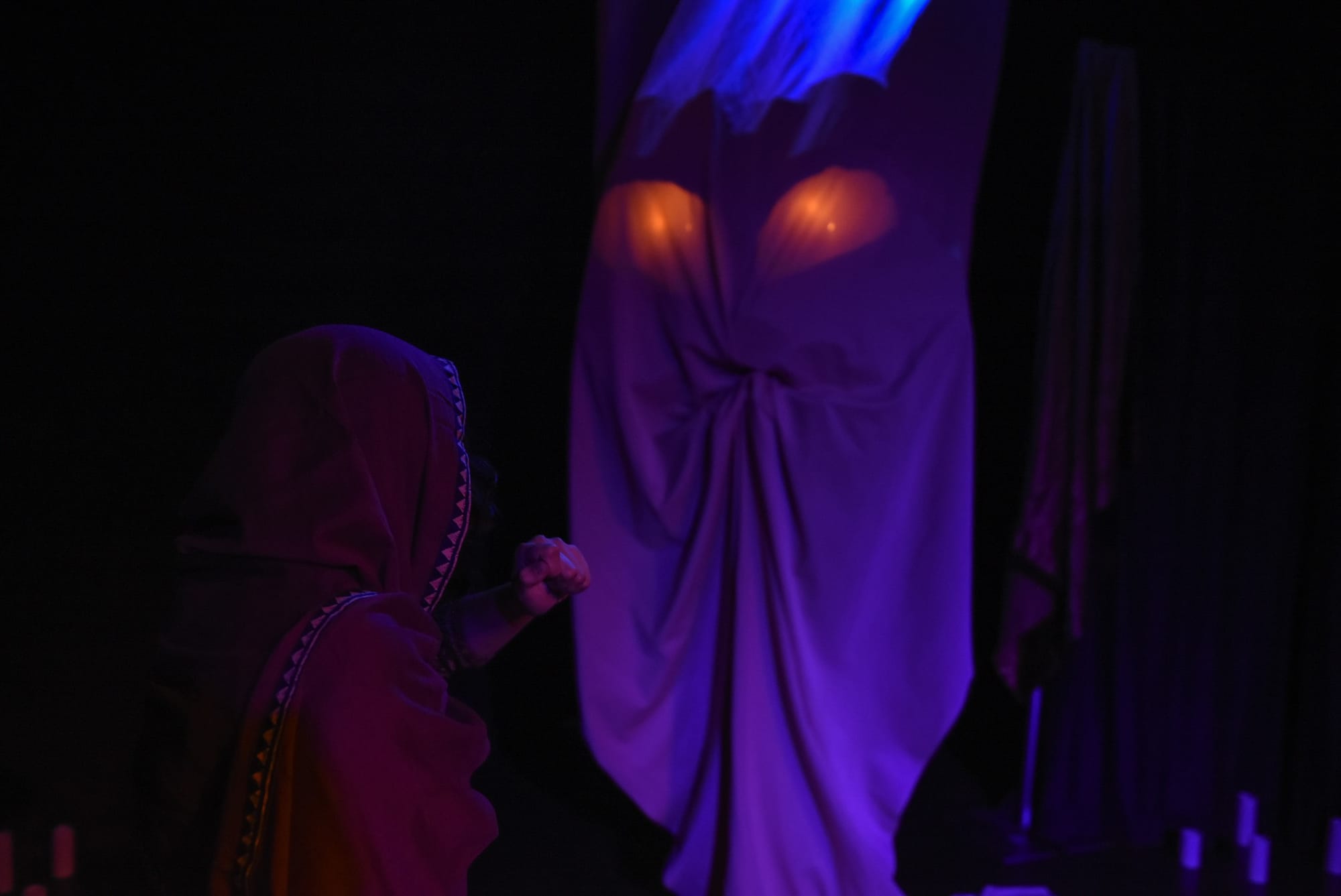
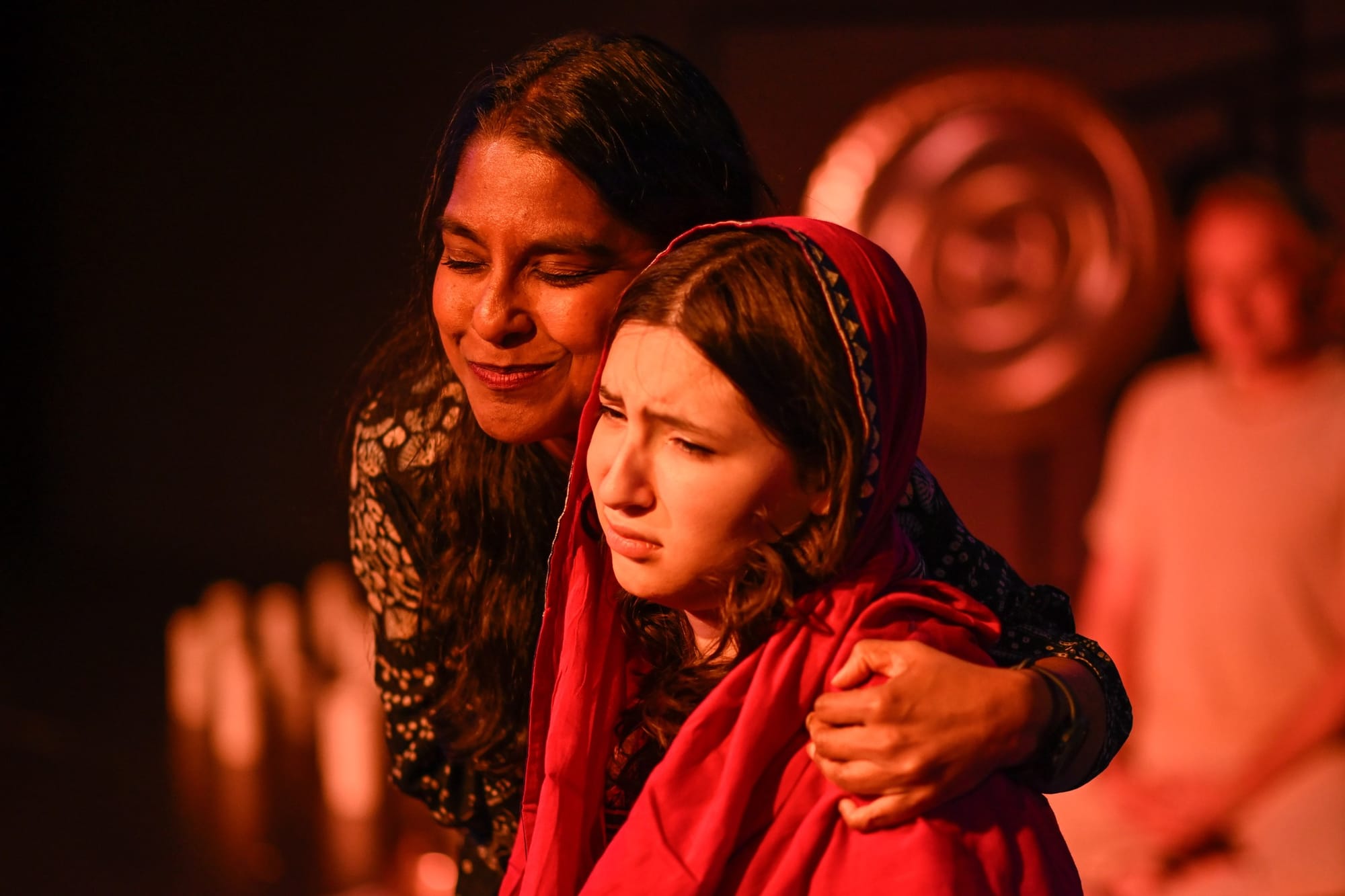
Jordan Wright as Orange Eyes; Oly Mistry as Anya with Esme Davis as Reva | photos by C. Andrew Nichols
I drove away from Theatre Tulsa Studios bubbling with energy, the show’s technical execution and delightful performances dancing in my mind. But the more time I spent away from the show, the harder it was to hold onto anything except those elements. I was almost tempted to go back for the Sunday matinee, in part because I enjoyed being in that space so much—but also because the more I thought about Radiant One, the more little fissures emerged.
The play’s overarching tone and the drummer’s monologue at the beginning suggests we are in an ethereal world, where the events we are seeing are universal in a fable-like way. Reva’s “ahead of her time” mentality seems to confirm this, as do the magical forest scenes where she encounters the gods Devi and Bhairava (Russell Mills and Shadia Dahlal), along with Orange Eyes. But the script itself is quite insular, focusing on Reva’s personal journey and one-on-one relationships that allude to the realities of societal norms in ancient Kashmir (realities that would also contribute to the creation of a text like The Vijnana Bhairava Tantra).
While I got glimpses of this specificity, mainly through the character Leela and how her path veers from Reva’s, a few elements went over my head, like the fact Reva could not actually have married Kheertan because he is in a higher caste. With a stronger union of mystical imagination and historical context in the direction of the actors, the piece could’ve created a stronger lasting message.
Additionally, the duality between act one and act two that I enjoyed when it came to character construction and casting made the plot feel muddied. By intermission, I wasn’t entirely sure what the plot was building towards. When Reva began writing toward the end of act two, it took me a minute to realize it wasn’t a song or a diary entry, but the text that would eventually become The Vijnana Bhairava Tantra. Because the whole writing process felt crammed in at the end, the spiritual importance of the text felt less impactful. Upon reflection, I can see the throughline Flint is drawing through Reva’s journey—how her love of being in her own body, her inquisitive mind, and her natural disposition toward meditation would’ve primed her to take her grief and transform it into yogic meditations—but it was lost on me in the moment.
After seeing Heller’s Radiant One, I do not think I could tell you what The Vijnana Bhairava Tantra is about. But maybe the true takeaway was more about a feeling—what it would be like to live a bit like Reva, settled into an embodied experience through which the circular magic and mystery of incarnation flows.


