
Power, Practice, Purpose: Contemporary Art and Civic Life
NXTHVN
New Haven
Oct. 4, 2026
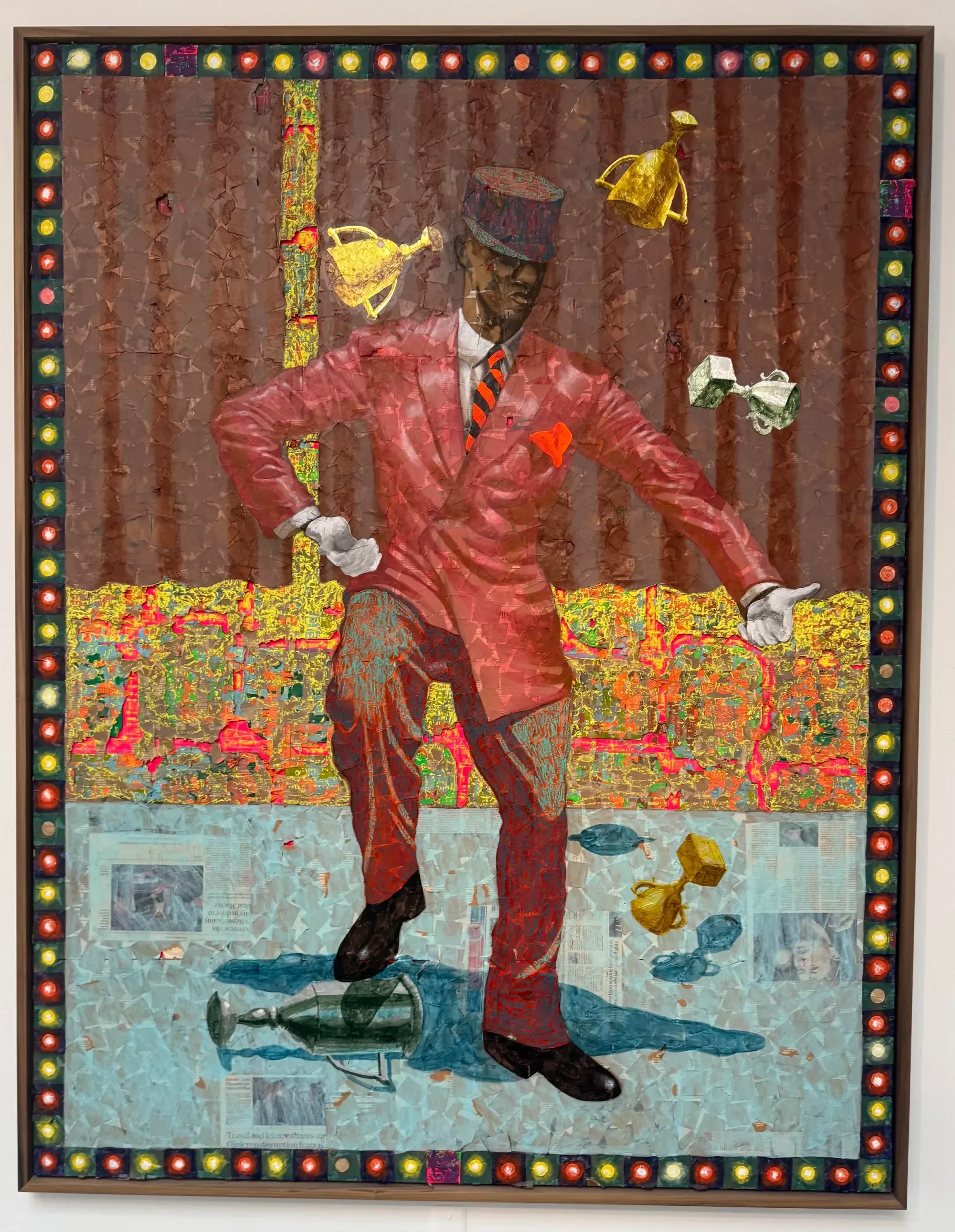
The collage features a Black man immaculately dressed in a red suit, complete with a red pocket square, top hat and white gloves. He appears to be amid a performance of some kind, looking vaudevillian. All around his head and figure are falling golden and silver trophies. Glowing red and yellow circles frame the piece, giving the impression of a sign for a carnival attraction.
Look closer at the piece and you can make out some of the newspaper images and headlines on which the suited man is standing. Elon Musk’s recalcitrant face hangs upside down in the right corner. There’s a Financial Times headline about travel and leisure stocks surging as fear faded over the Omicron variant of Covid. Another headline is about French conservative politician Valérie Pécresse’s mission to defeat French President Emmanuel Macron.
I wondered if the piece — entitled Highstep Fumble, and made of acrylic, charcoal, cardboard, oil pastel and foil on newspaper mounted on canvas — reflected the precarious balancing act that is the performance of living, all the more dangerous in a world full of bad actors and uncontrollable circumstances.
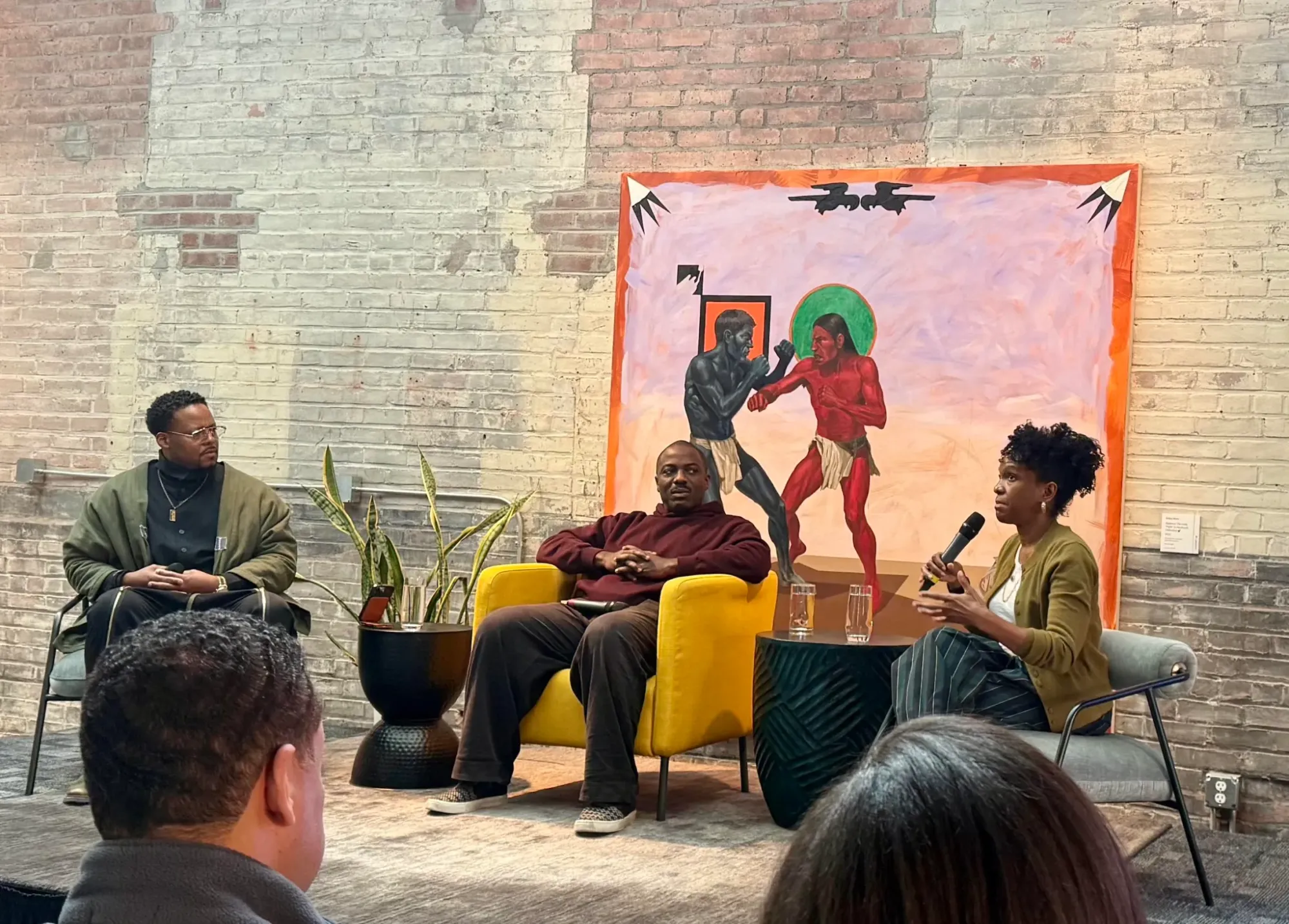
Those musing over Derek Fordjour’s engaging work got the privilege of hearing directly from the internationally acclaimed artist in his talk with NXTHVN founder and artist Titus Kaphar and renowned interdisciplinary scholar and author Dr. Imani Perry on Sunday afternoon at the NXTHVN gallery at 169 Henry St.
The event was sponsored by the John D. and Catherine T. MacArthur Foundation; both Kaphar and Perry have been MacArthur Fellows, a fellowship that funds boundary-defying, society-shaping work.
Sunday’s conversation unfolded with the ease and curiosity that only exists between true friends.
“You can have an exhibition wherever you want. Let’s be real,” Kaphar said to Fordjour, NXTHVN’s 2026-2027 visiting artist. “You can show anywhere in the world, and you’re showing in our neighborhood.”
Indeed, the award-winning interdisciplinary artist Fordjour has shown at any major museum you can imagine, from The Metropolitan Museum of Art in New York to The Museum of Contemporary Art, Los Angeles, as well as internationally. He has done publicly commissioned work for the High Line and MTA’s Arts and Design program, among others. Global publisher Phaidon will publish a monograph of his work in 2027.
Now, he’s showing in New Haven’s Dixwell neighborhood.
Fumble, Fordjour’s solo show at NXTHVN (Sept. 23 – Nov. 22), is a nod to his work in The Big Game, a 2014 exhibition that analogized sportsmanship and artistry. Per Fumble’scuratorial statement: “Both art and sport offer no utility beyond spectatorship; however, the significance of their social value is well established. The artist and athlete wholly devote themselves to pursuing mastery, yet both are acutely vulnerable to calamity.”
At Sunday’s opening celebration at NXTHVN, guests mingled amongst Fordjour’s vibrant work presented as three distinct mediums: collage, video and sculpture. In all pieces, Black men are engaged in sport: rowing, dance, equestrianism and biking. Highstep Fumble (2022) was the outlier piece and the only one that featured the show’s title.
With Kaphar facilitating Sunday’s discussion, Perry and Fordjour discussed their work centered on Blackness and history and discovered intersections in their practices. The concept of archive was thoroughly examined as it resonates through all their work, particularly the vulnerability of archive within the Black community where so much has been lost (or stolen).
Fordjour shared that he steeps himself in scholarly research when coming up with a concept. Perry considers her writing to be more artistic and creative, not conforming to the bounds of classical scholarship.
I found fascinating their conversation about history, not always entirely precise though it is often presented as fact. Fordjour admitted to once making the mistake of putting inaccurate information on Black derby winners in an art piece. He had pulled information from one source and found out something else two years later. He doesn’t castigate himself for the error, though, because he views art’s subjectivity as a source of freedom. He mentioned Alex Haley’s work as being seminal despite not being wholly accurate.
Fordjour and Perry found another point of connection. Many of Fordjour’s pieces are frenetic, tactile collages, while Perry makes collages of people and environments as she writes to draw out her voice. “No one will ever see them,” she laughed.
Fordjour observed, “There’s something a little irreverent about collage. You’re taking things that don’t belong together, that kind of mash up. If you think about Black cultural production, collage is central.” He mentioned the collage sensibility inherent to hip hop, the youth’s flips and remixes of their parents’ records. He spoke about his own life being a collage: “I was born in Memphis, but my parents are immigrants.” Outside was America, inside was Ghana.
That sense of assembling something new from disparate parts extends beyond Fordjour’s artistic practice. As the conversation turned toward the institutions that determine who gets to make and profit from art, Fordjour and Kaphar spoke candidly about their responsibility to create opportunities for Black artists coming behind them. For both, success within the art world is insufficient if it does not also widen the door for someone else.
In pursuit of that goal, Fordjour created the youth arts organization Contemporary Arts Memphis.
“I really did not solely want to be a tool for wealth building,” he said.
Kaphar echoed his sentiments. “We know the miracle of our existence in this particular moment. So we want to make this more possible for the people that are behind us.”
“I’m thinking about NXTHVN in 40 years, in 60 years. This institution will persist. I am convinced,” declared Fordjour.
Perhaps that is what makes his decision to show at NXTHVN and serve as the organization’s visiting artist so meaningful. Fordjour can exhibit anywhere but he’s looking toward the longevity of a Black arts institution and the generations it might nurture long after him.
For more NXTHVN events, visit their website.


