
By Jeffrey Davitz
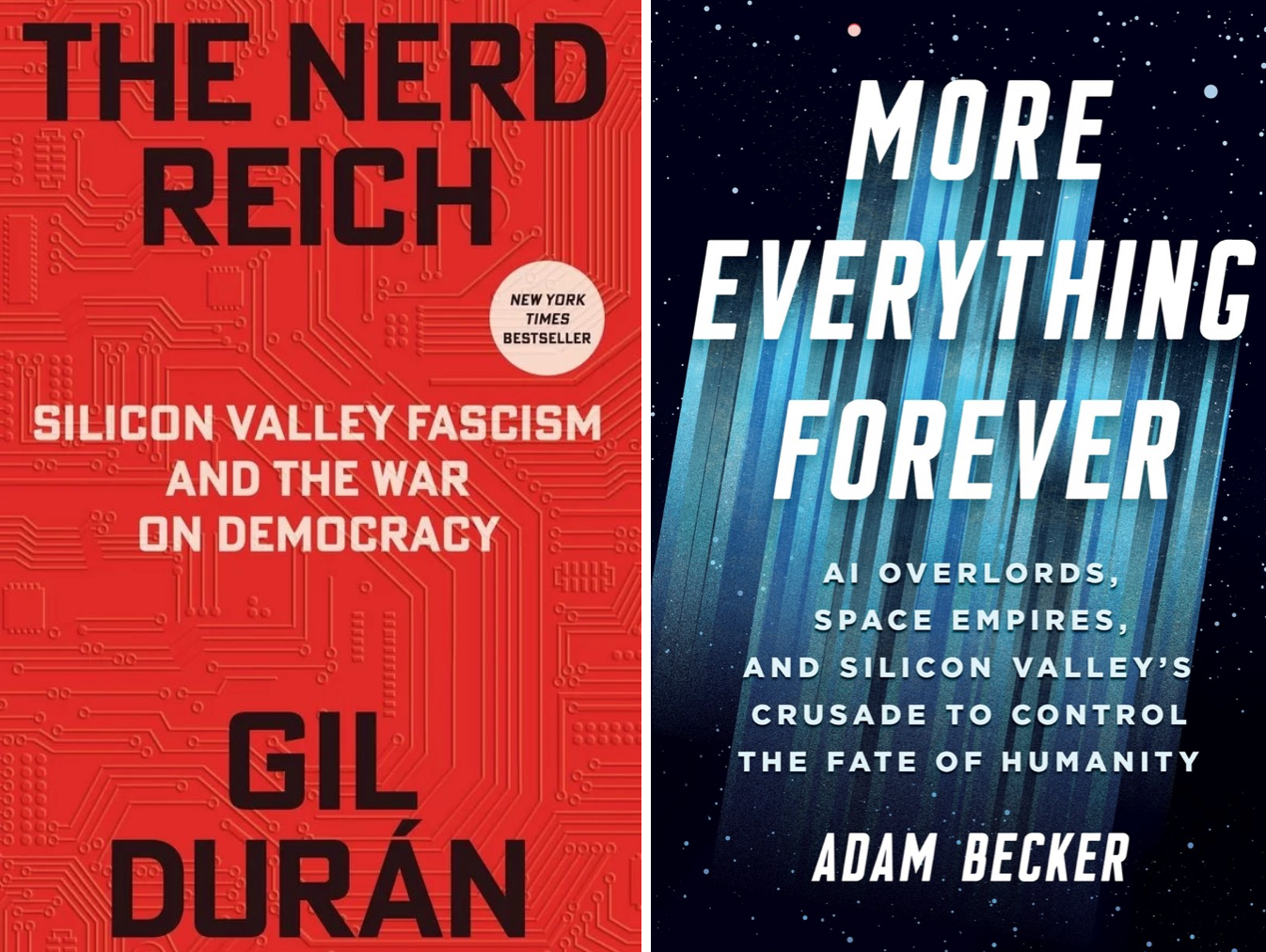
The Nerd Reich: Silicon Valley Fascism and the War on Democracy
By Gil Duran
Avid Reader Press/ Simon & Schuster
August 2026
More Everything Forever: AI Overlords, Space Empires, and Silicon Valley’s Crusade To Control the Fate Of Humanity
By Adam Becker
Basic Books UK
2025
When I started out in the Silicon Valley tech world, I knew that there was lots to learn. But I was most surprised by the strangeness of the culture. I was a technical person but of a different sort. I wasn’t prepared for lots of what I encountered. Mostly it was incredibly fun, but one particular thread of it was mysterious and irritating.
Outsiders often think that the world is filled with autism-spectrum types, and there is some of that. But the tech world is intensely social in its own way. I was introduced to that mostly at lunch. The boys (and they were almost all boys) in the “trenches” would often go out to lunch in packs and the discussions were often intense. Not about personal or cultural topics but about history and politics. That alone was surprising. What really got me was how assured and definitive they were. They just knew. Even more, they knew what should be done.
I began to realize that these people had been bathed in a completely different intellectual milieu. Many of them had become obsessed with computers from a young age; that had become their strongest formative experience. Computers are completely comprehensible. Maybe it takes effort, but ultimately there’s no ambiguity. There was of course a strong connection to gaming, and these fantasy worlds were also completely rule-bound. It was just a matter of figuring it out.
This was quite the opposite of my experience (and my friends in other technical subjects). One would aspire to clarity, but most of the time one felt lost and struggled. The best that could be done was some kind of slightly better approximation. The complexity of social and psychological phenomena were yet a whole other realm. The born and raised software people did not seem daunted. They brought their certainty when traveling to these other spheres.
But then tech took over the world. It now has a bizarrely powerful economic and cultural impact. Now the ideas and attitudes I first encountered at those lunches have a global impact. Those ideas have, of course, morphed and become ever more grandiose right along with rise in wealth and power. Some of it is funny, some nutty, and some really scary.
There has long been a hype literature describing some form of tech salvation. As risks and failures became increasingly apparent, there is a growing critical literature. Two books have been published in the last year that deal with important aspects of our new tech-drenched world.
The first is Adam Becker’s More Everything Forever: AI Overlords, Space Empires, and Silicon Valley's Crusade to Control the Fate of Humanity. Becker, a physicist, covers the grandiosity end of the spectrum. One of his goals is to take the ideas seriously as scientific proposals and then hand them the scrutiny they deserve. There is in a Spinal Tap sense a fine line between aspirational and off the wall.
For example, he looks closely at the realities of relocating to Mars. It sounds cool; what 14 year old nerd boy doesn’t fantasize about being on that rocket ship? But the destination packs a huge wallop of disappointment. Life on Mars would suck to the point of being wildly implausible. Vacuuming out all the crazy and fun diversity of earth-life and resigning myself to an austere bubble life in an incredibly hostile climate is profoundly unappealing.
Becker also looks at the individuals behind some of these aspirations. The star here is Ray Kurzweil, the apostle of the singularity. Kurzweil is clearly a brilliant and imaginative guy. He is also an exceptional promoter. Becker goes deeper and references the loss of his father at an early age. It’s a surprising and touching personal touch. Becker appreciates Kurzweil as a talent and a person even as he pulls apart the scientific grounding of his ideas.
The new book by journalist Gil Duran, The Nerd Reich: Silicon Valley Fascism and the War on Democracy, is strikingly different in tone and intent. Whereas Becker takes tech on its own terms and pokes pins in the balloon of excessive fantasy, Duran argues that the politics of the Valley have turned toxic and metastasized into the body politic.
There are lots of characters in the book and significant discussion of the shared ideological grounding, but there is a lot of focus on Peter Thiel. Like Kurzweil, Thiel is not a lightweight. He is extremely smart, persuasive and effective. He’s also extremely rich, partly because of that powerful-rich-get-richer dynamic in the Valley. After getting rich, he got other handy opportunities, like a meaningful stake in Facebook.
Thiel is the leading alchemist of a bunch of lines of thought that will be familiar to anybody who has followed the intellectual far right (e.g., Curtis Yarvin). The ideologues are serious, but Thiel also has serious cash, and he uses it to promote his views. His money and sponsorship have had real effects. In Duran’s view, our vice president, JD Vance, owes his career to him and might be reasonably called an acolyte.
The book will be helpful to those who have not encountered this brand of far right thinking. This brand takes Ayn Rand very seriously. It is stridently and explicitly anti-democracy. If it were a wine, one would detect notes of ubermensch, eugenics and neoliberalism. The genetics are not just intellectual. Patri Freedman, the grandson of the neoliberal icon Milton Freedman, makes an appearance.
Reading these two books is a very different experience. Becker is subjecting extreme Silicon Valley ideas to a sober analysis, sometimes with some sympathy for the characters involved. Duran’s book is a screed. He is angry and wants us to be scared. The last sentence even suggests that there is a risk our imagination will be taken away from us. For me, this bordered on the paranoid. Overall, the extreme style of his writing and his deep reliance on associations and connections felt conspiratorial-adjacent.
I do, though, agree with his basic point. The risks are real. There are extreme views whose impact is meaningfully accelerated by Valley wealth and power.
Both books are solid contributions. There is a lot more to do. Becker makes great points about the wilder Valley promises. But AI is a transformative technology of a sort that I don’t think humanity has faced. It’s more important than ever to think as clearly as we can (Becker) and pay attention to the way politics can turn evil in such turbulent times (Duran).
Jeffrey Davitz is a Human-centered AI scientist and entrepreneur. Read more of his work here.


