Noah Davis
Philadelphia Museum of Art
2600 Benjamin Franklin Pkwy.
Philadelphia
April 26, 2026
I visited the Philadelphia Museum of Art three times this month in search of refuge from an everyday life I’ve become jaded by.
On the first floor of the institution is a retrospective of artifacts from the private life of painter Noah Davis: photographs of him at home, of him in his studio, and in a video being interviewed by journalist Shelley Wade at his first solo exhibition in New York City.
Noah Davis, who was born in Seattle in 1983, and passed away in 2015, was an artist most beloved for his figurative paintings depicting Black ordinary life. Davis was asked about his artistic motivation by Dazed Digital in 2010: “If I’m making any statement, it’s to just show Black people in normal scenarios, where drugs and guns are nothing to do with it,” he said.
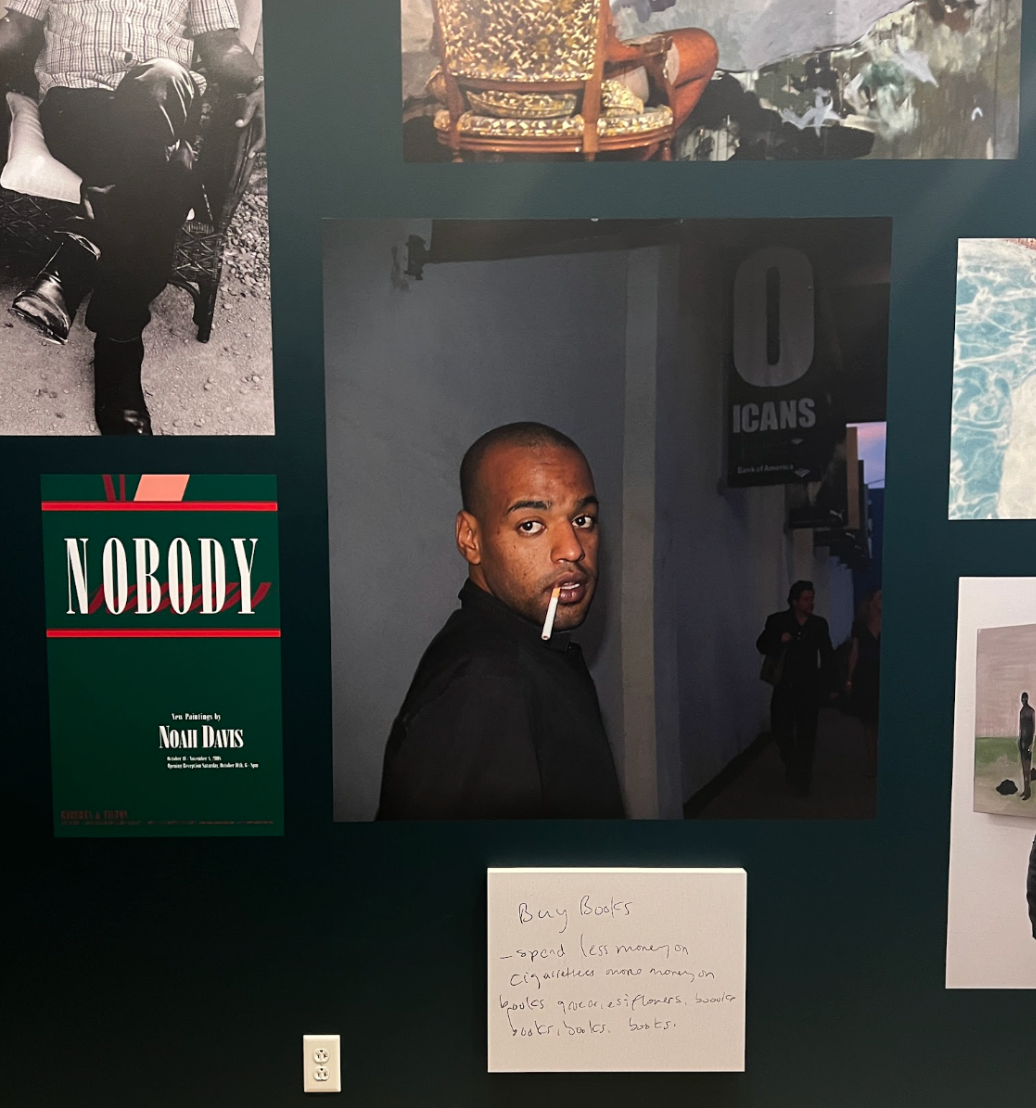
Noah’s dedication to representing mundane reality is considered through the documents that illustrated his own everyday: a portrait of the artist with a cigarette hanging out of his mouth, a note he once wrote to himself hanging below the image like a caption:
“Buy books, spend less money on cigarettes…”
“Yeah, same,” I thought to myself. There is always comfort in seeing someone’s proclivity towards vices that are familiar to you — and there’s just as much humanity in the aspirational attempts we all take to distance ourselves from these vices. Just as Davis was captivated by the “underside of our intimate and daily lives,” I am by this snippet of his.
This retrospective covers about a decade of Davis’ career, from 2007 to his death in 2015. I gravitated towards his portraitures of lone figures, as well as the many wide, open spaces he tended to survey.
A work titled LA Nights stands out: It’s one of few pieces that doesn’t include any humans in the picture, offering instead a sweeping view of Los Angeles at night, as seen from the Hollywood sign. When asked to commission a poster for the 2015 Los Angeles Film Festival, Davis presented this work as an option to consider. Director of the LA Film Festival at the time, Stephanie Allain, chose this as the final image for how it conveys "the glamour of L.A., the excitement of being in the dark with other people, the multicultural essence of L.A."
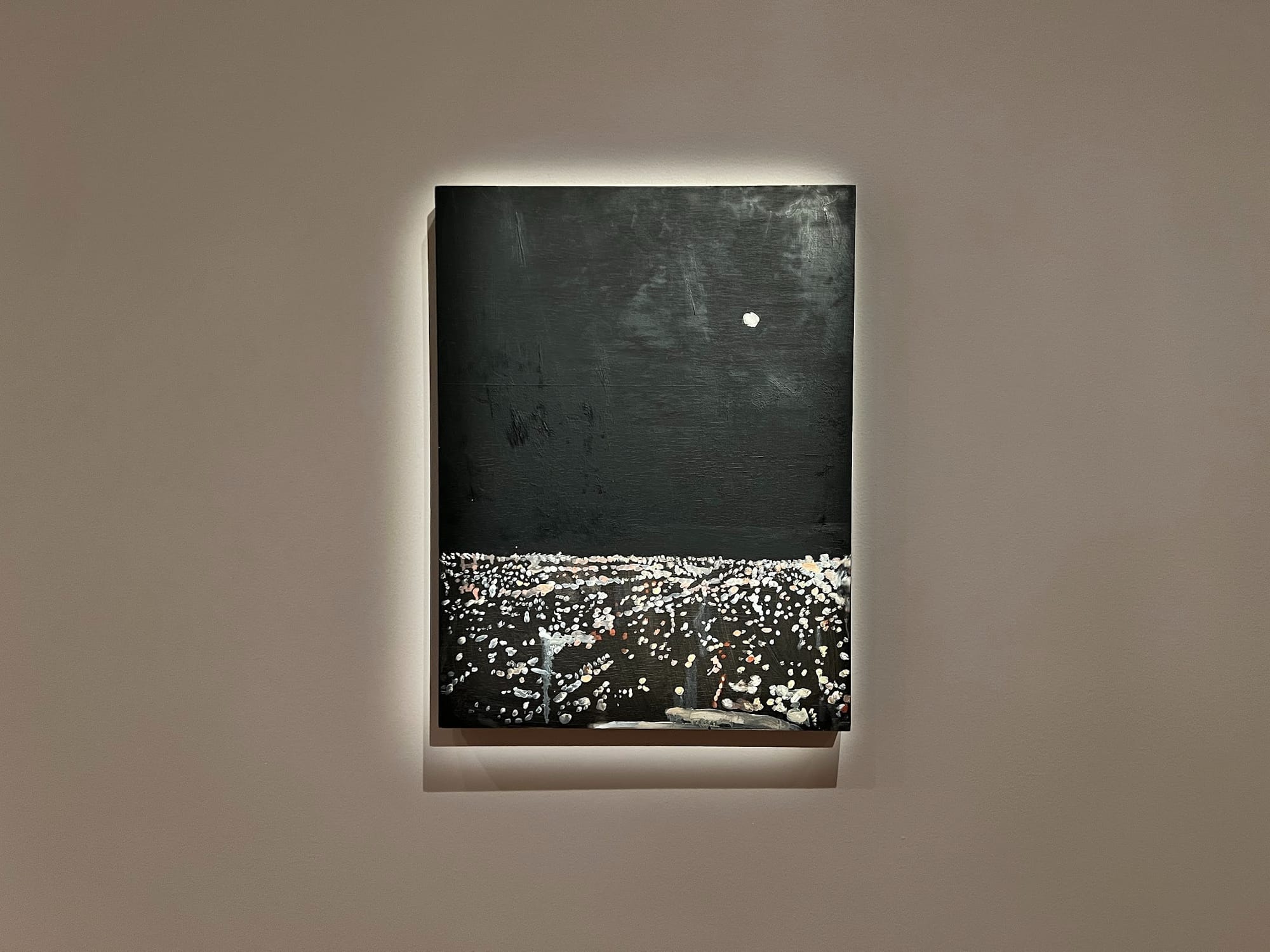
This is all true, and, to me, LA Nights further mirrors the specific isolation unveiled by sprawling cities. We know that this image represents millions of residents, and yet we can’t see a single person. We can’t reach them. I’m reminded of sitting in many a red-eye alone, looking out of the window as the plane descends, observing the expansiveness of it all; trying to imagine where these hundreds of thousands of people are, what they are doing and if they feel as I do in this kind of liminal zone, unsure and unclear. It’s not so dissimilar from the feeling I’m carrying into the exhibition today.
This past Saturday, the museum hosted a workshop titled “Tenderness with Others: breath and movement attuned to the group,” the last of the Portals into Tenderness series hosted by local yoga instructor & bodyworker, jean-jacques gabriel.
I was a bit nervous going in: I didn’t know what to expect and was timid about embodying tenderness in a group of strangers while stuck in a generally pessimistic mindset.
jean-jacques kindly checked in with every individual about how we were feeling physically before starting. Once we were settled, he sat with us and invited us to share our names and an example of tenderness we’d experienced within a collective: some spoke about their children or families, others talked about exchanges with friends or strangers. jean-jacques reminded us to consider our ancestors in this as well.
We were guided through a series of stretches in and around our chairs, arms reaching wide and up, going down, sitting to turn our torsos in tandem. I was keenly aware of my movement in comparison to those walking around outside of the workshop, but it faded as I closed my eyes and focused on my own breathing and the faint sounds of breath and motion around me. Our movements somewhat in sync, I leaned heavily into this communal activation and allowed for the release of anxiety I’d been holding, grounding myself into this moment.
Separated into groups of three, we each selected an artwork in the show to observe together (ideally) in silence. My group viewed 1975 (9), Seventy Works, and Congo – the last of which we spent much of the workshop poring over.
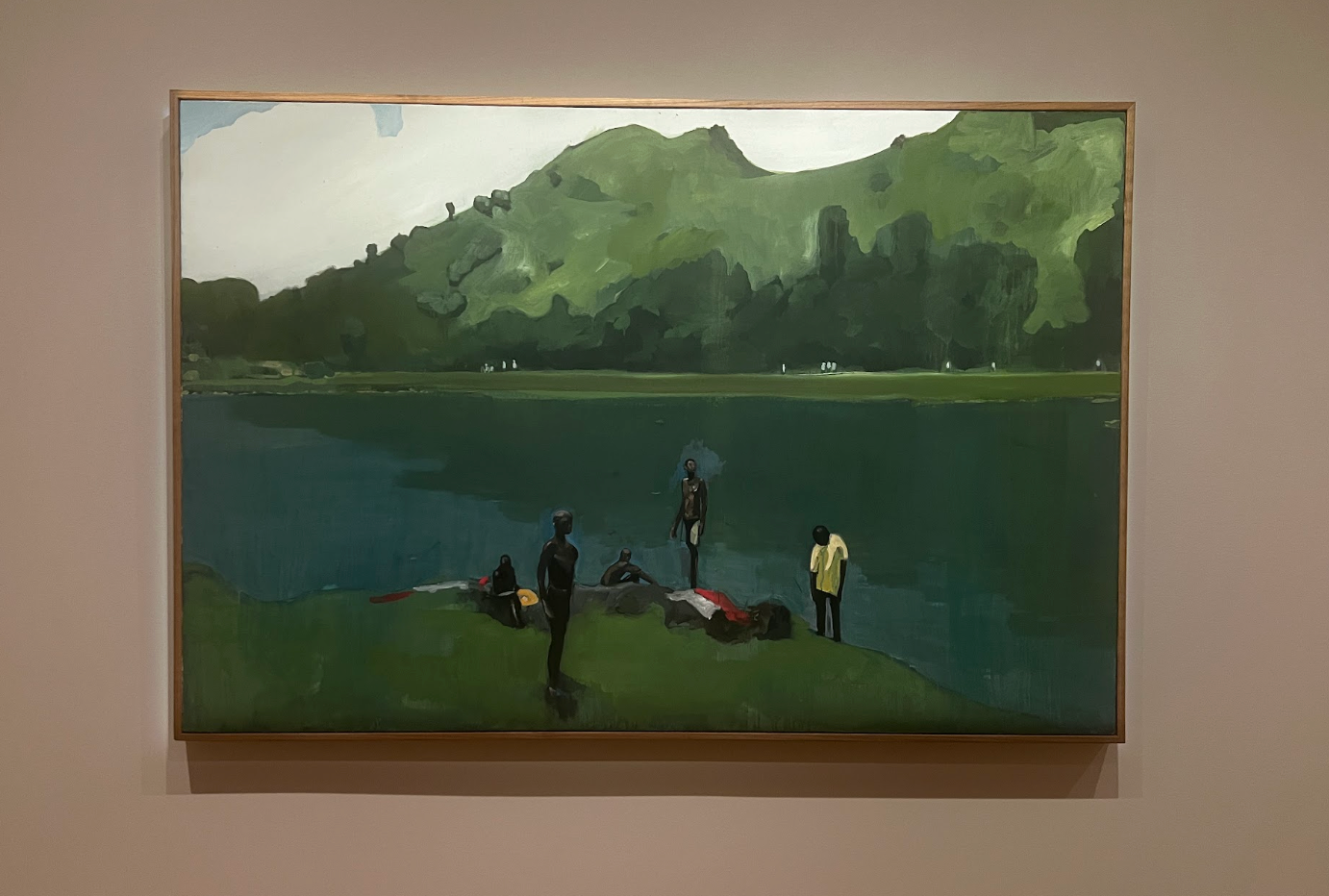
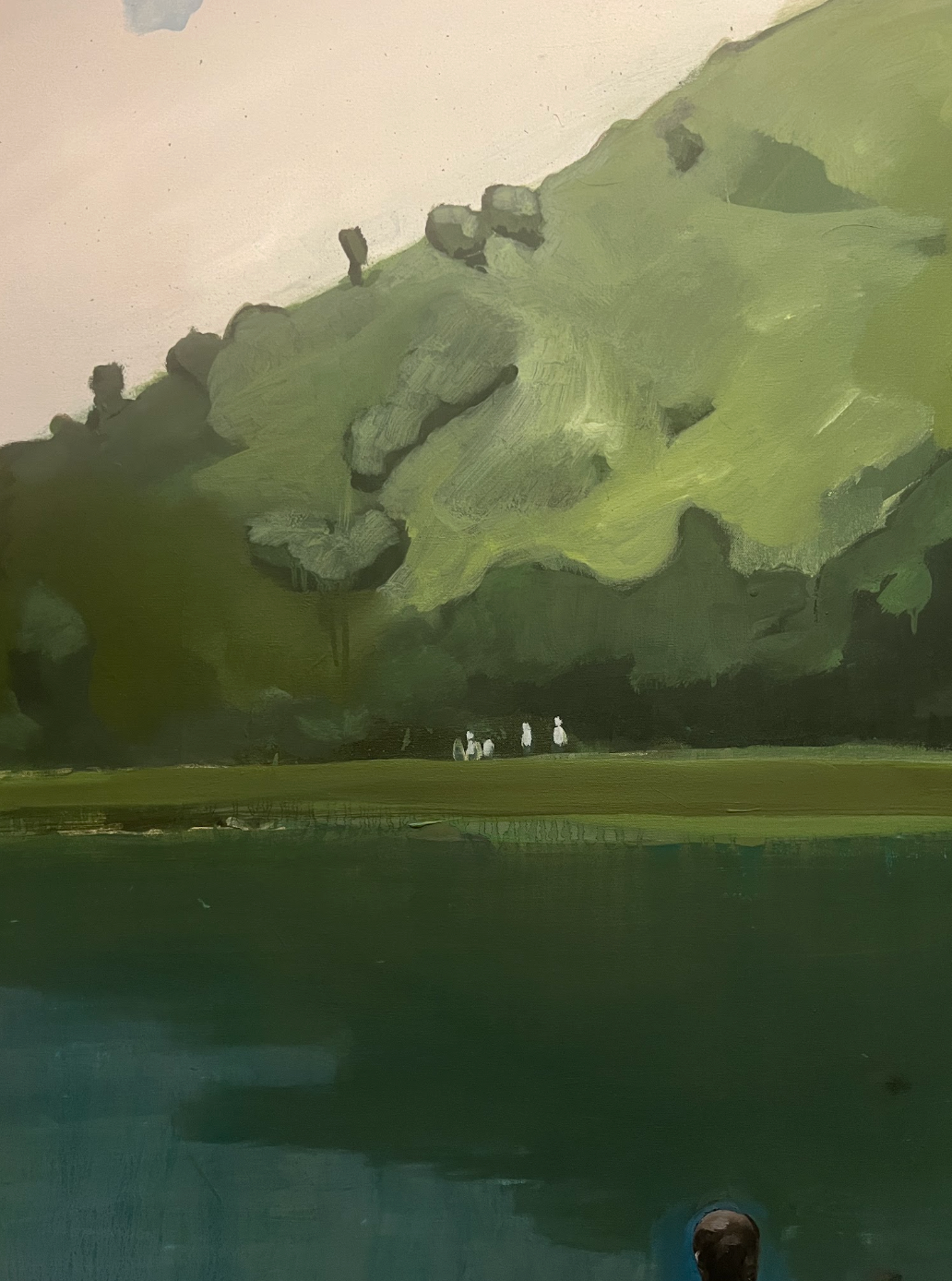
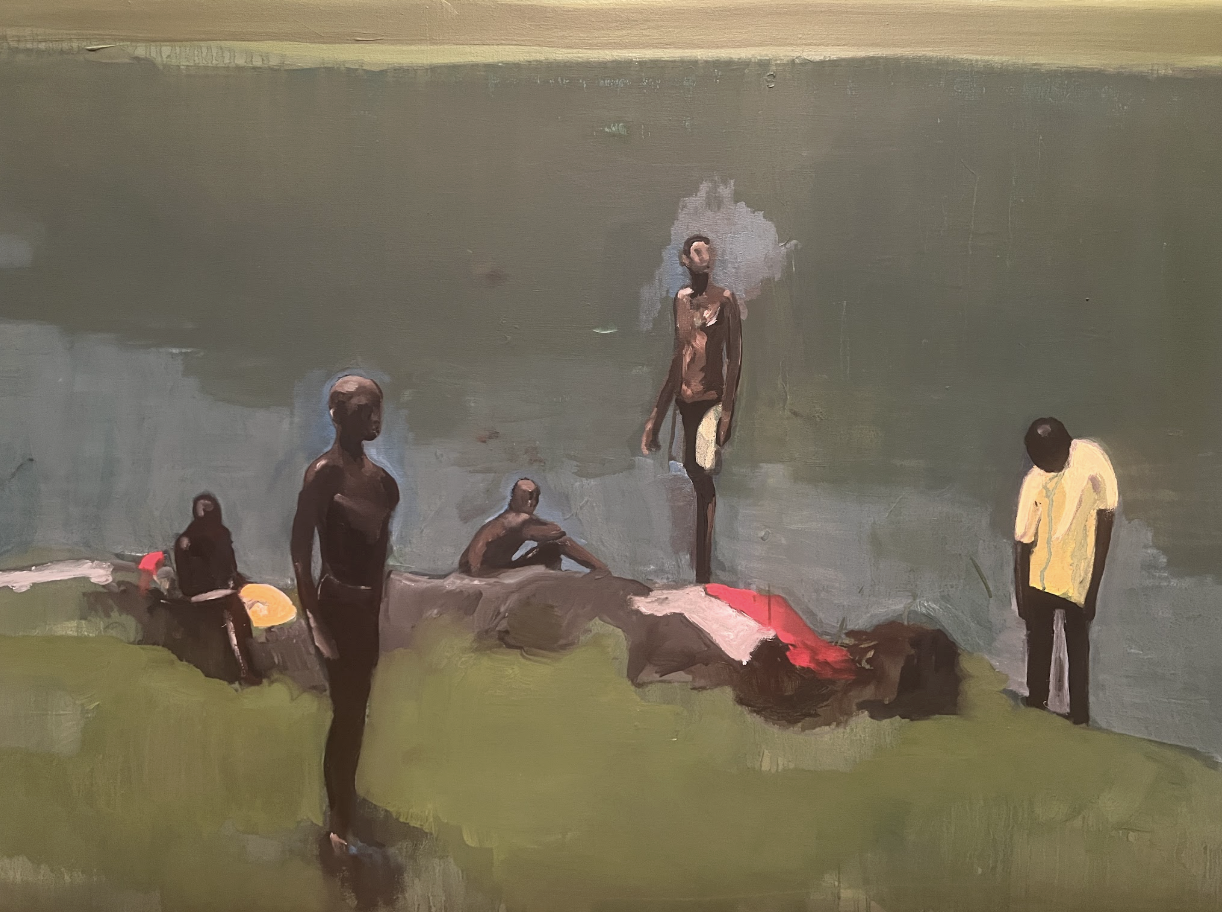
Congo is a painting based on a photograph taken by Davis’ brother on a trip to Africa. It elicits memories of more distant terrain, of human subjects spread across a ubiquitous lush. To some in the workshop, it recalled the landscape and weather of Panama, Brazil, Florida. So skillfully, Noah translated someone else’s perspective — an old photo — into a seemingly universally felt experience.
As I’m focused on the individual in the lower right painted into a yellow shirt — who seemed oblivious to the happenings around him — someone in the workshop pointed out some forms on the opposite side of the body of water, dubbing them spiritual entities potentially keeping watch over this group of young men.
I hadn’t paid the small white figures much mind before: it wasn’t my immediate thought to consider a spiritual or mystical presence in many of Davis’ works. In this moment, Noah’s attunement to a sense of magical realism was revealed to me. In retrospect, this sensibility reverberates throughout his oeuvre: He often uses enough just detail in his figures for one to approximate age, musculature and setting, but then leaves just enough for us to fill in the gaps for ourselves. He has created a body of work where viewers can find themselves in whatever way makes the most sense for their own stories and experiences.
The breathwork class reminded me of the expansiveness and possibility of the collective. I had initially been focused on Davis’ literal representation of everyday alienation, but he didn't just capture the mundane reality of modern city life; he imagined and illustrated the utopia of our origins, our futures and our fantasies. Through these paintings, I’m reminded: There is more beyond this.
In the video at the entrance of the exhibition, Noah claims: “I have an influence on something and it’s through painting." As we said our goodbyes to one another, it seemed like everyone, including myself, left the workshop and exhibition buzzing with a renewed sense of connection to the works and themselves, evidence of the integrity behind the artist’s proclaimed intention and determination.
This is the last stop for Davis’ retrospective and today, April 26, is the last day to see it. View the work, take a breath, and maybe push yourself to connect and discuss the work with a stranger. Who knows what you might find.


