
“Celebrating the Zither: Asian American Identity and Survival”
Oakland Asian Cultural Center
388 Ninth Street, Suite 290
Oakland
May 30, 2026
You’ve heard it even though you might not know it. One of the most recognizable Japanese folk melodies, “Sakura,” translated as “Cherry Blossoms,” has been used in countless settings since its composition during the Edo period (1603-1868), especially in film and television. A restrained, elegant piece, it opened the event “Celebrating the Zither: Asian American Identity and Survival,” which was hosted by the Oakland Asian Cultural Center this past weekend.
The house was nearly full to capacity for Saturday night’s program featuring musicians Shirley Muramoto and Winnie Wong. Ms. Muramoto, a fourth generation Japanese-American, introduced the piece, remarking that it’s “very representational of the Japanese culture.” She went on to say that it symbolizes the transience of life: “the life of the cherry blossom is short, just like our lives.”
"Cherry Blossoms and Jasmine" performed by Shirley Muramoto and Winnie Wong.
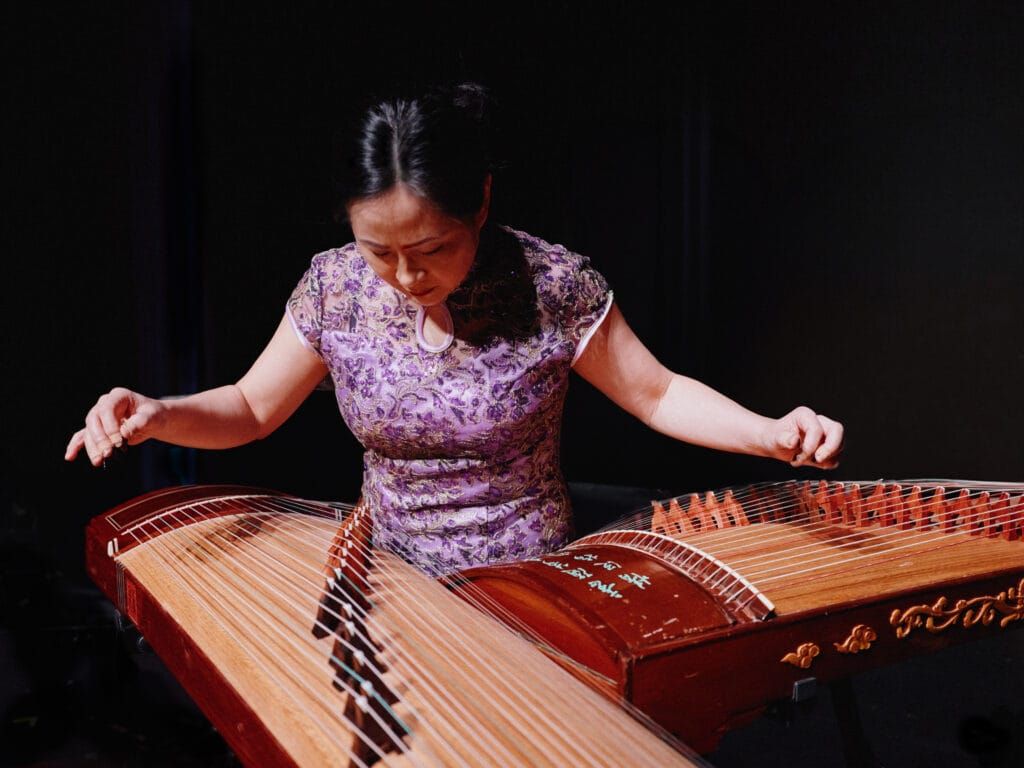
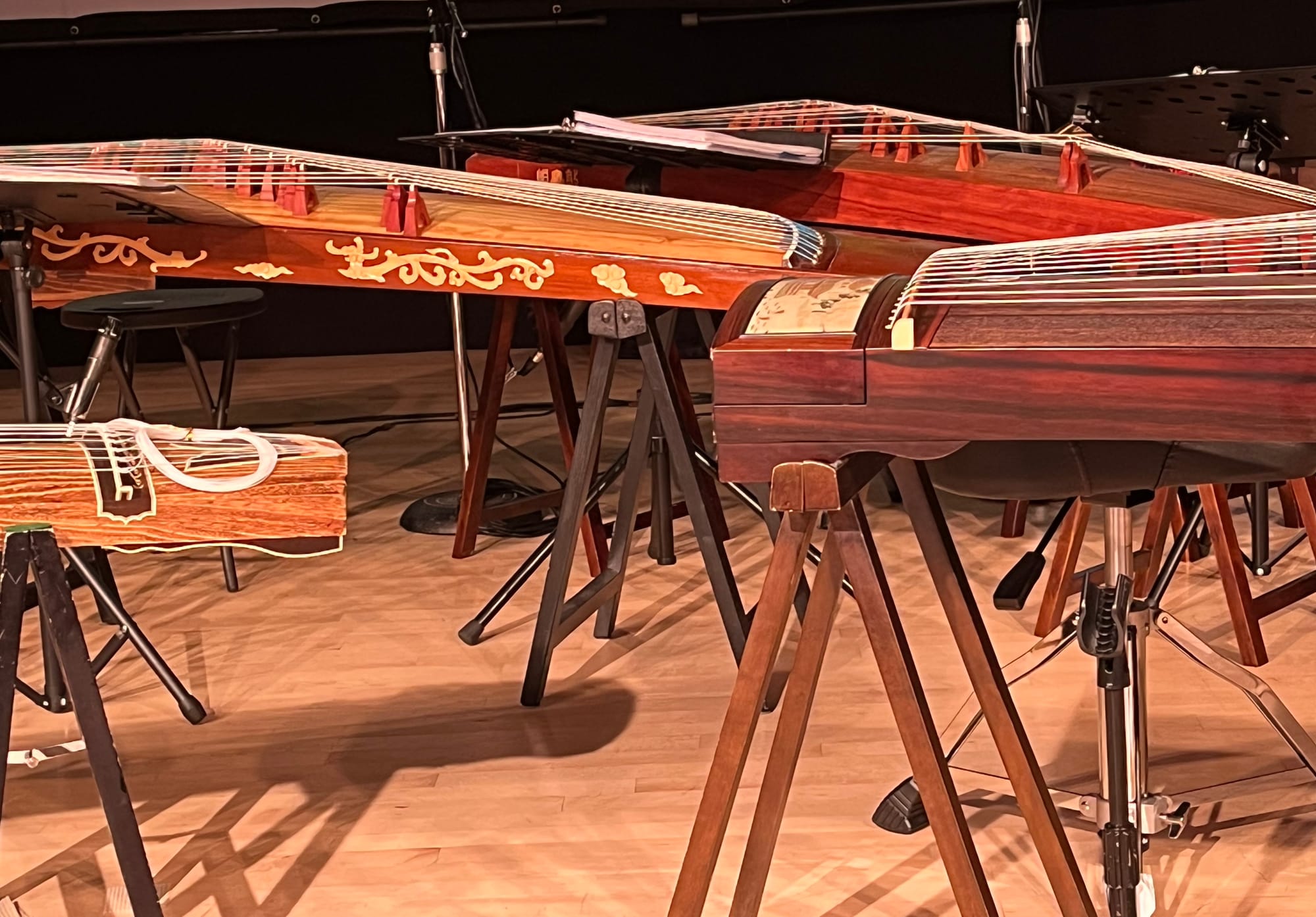
Muramoto, performing on the koto, along with San Franciscan and Hong Kong native Winnie Wong on the guzheng, improvised a medley on “Sakura” that wove-in the Chinese folk song “Jasmine Flower.” It was lovely, even a bit haunting. Besides the piece’s beauty, I was fascinated by how the strings on both instruments must be precisely controlled for their pitch and vibration — my eyes locked on the pair expertly picking at the long, wide zithers. Mesmerizing.
"Hana ni Naru" performed by Shirley Muramoto.
Before the second piece, Muramoto explained that the koto has 13 strings and that both it and the guzheng originated in China but were adapted to the cultures where they were adopted. It was this second piece performed by Muramoto, “Hana ni Naru” or “To Strive for Elegance,” that was my favorite. A huge bass koto was brought out for the solo. Composed by Tadao Sawai, it was modern, intense, and physical. Muramoto played the piece with fierce gusto, at times attacking the strings with vigorous slapping and strumming motions. An impressive solo.
"Echoes Beyond Borders" performed by Winnie Wong.
“Echoes Beyond Borders” was up next, an ancient guqin melody with a contemporary arrangement by Winnie Wong. Wong introduced it as one that brings tradition into the modern world, encouraging the audience to superimpose their own imaginations on the work. She performed the delicate piece on two guzhengs at once, her fingers lithe and supple.
"Kuon" from Kono Oto Tomare.
The dark navy curtains opened for the final two pieces, performed by Muramoto, Wong, and six other koto and guzheng musicians, including some young students of the two principal performers, members of China’s Spirit Youth Ensemble. “Plum Blossoms,” an ancient flute melody arranged by Wong was first. It was rousing, but the finale, “Kuon,” from the Anime film, “Kono Oto Tomare" or “Stop the Sound,” was even more full of energy. The eight-piece ensemble brought the composition by Aya Kitazato to life in a way I found surprising and deeply interesting for its complexity. Fantastic.
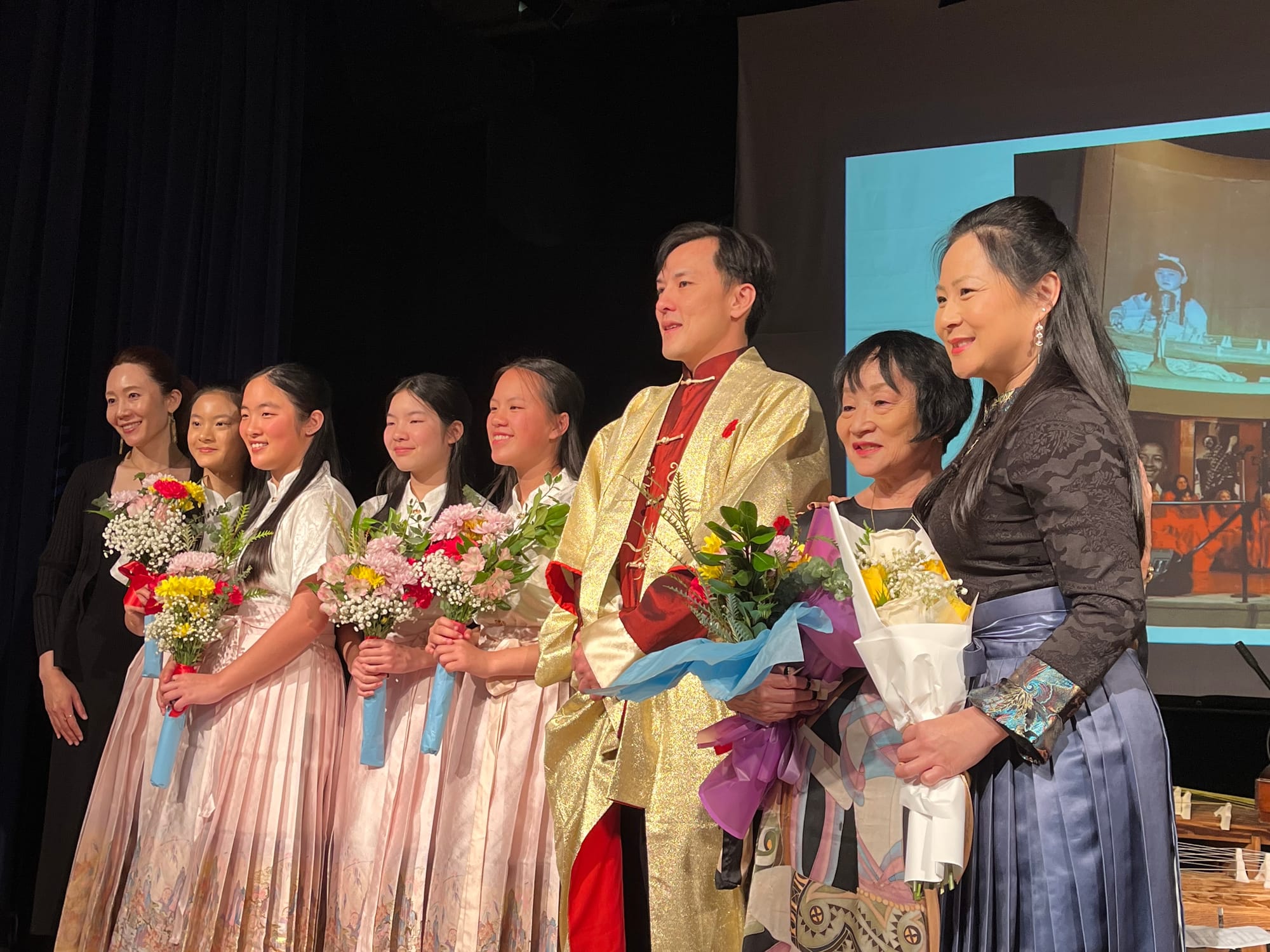
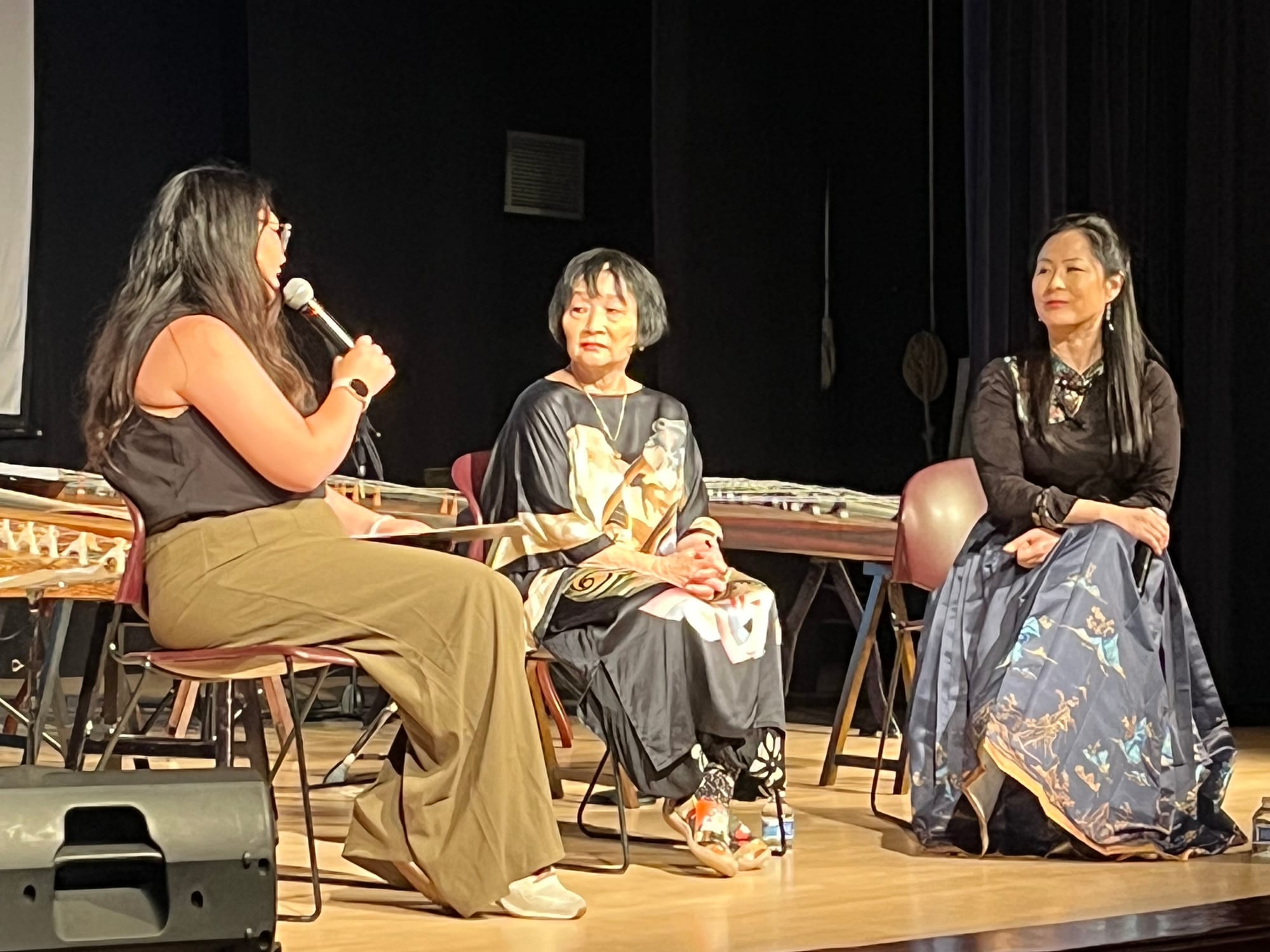
(L) A post-performance discussion with Shirley Muramoto and Winnie Wong. (R) R to L: Winnie Wong, Shirley Muramoto, Brian Mitsuhiro Wong, members of China's Spirit Youth Ensemble, and Rita Momery.
A discussion and audience Q & A sessions followed the performance.
Muramoto described growing up in a Japanese internment camp in the 1940s. It was there that she first began playing the koto, taught to her by her mother when she was nine years old. She said that those who were forcibly moved to the camp were only allowed to take what they could carry. For her mother, this included her koto, something Muramoto remarked was impressive given its size and awkward shape. After leaving the camp, she also studied the violin and piano during her childhood in Oakland.
Wong talked about how the zither is a very simple instrument but one that requires great commitment to master. She said she’s interested in exploring the cross-cultural aspects of the guzheng: “What does it sound like with a cello? With a guitar?”
The two also shared their thoughts on the current state of the U.S., with Muramoto remarking that she’s appalled at what the current administration is doing to immigrant communities considering the history we’ve already been through. “We need to remind ourselves that what makes America America is immigration,” she said. She went on to talk about how delighted she was by Bad Bunny’s halftime show performance at the Super Bowl. “Bad Bunny demonstrated what true American culture is,” she said.
I was moved by Muramoto’s insights, but most thrilled by her and Wong’s musical prowess and the lovely pieces they performed. The concert was superb. I’ll definitely be listening to more koto and guzheng music from here on out.


