
Jes Fan: Unbounded
Yale University Art Gallery
New Haven
Through June 28
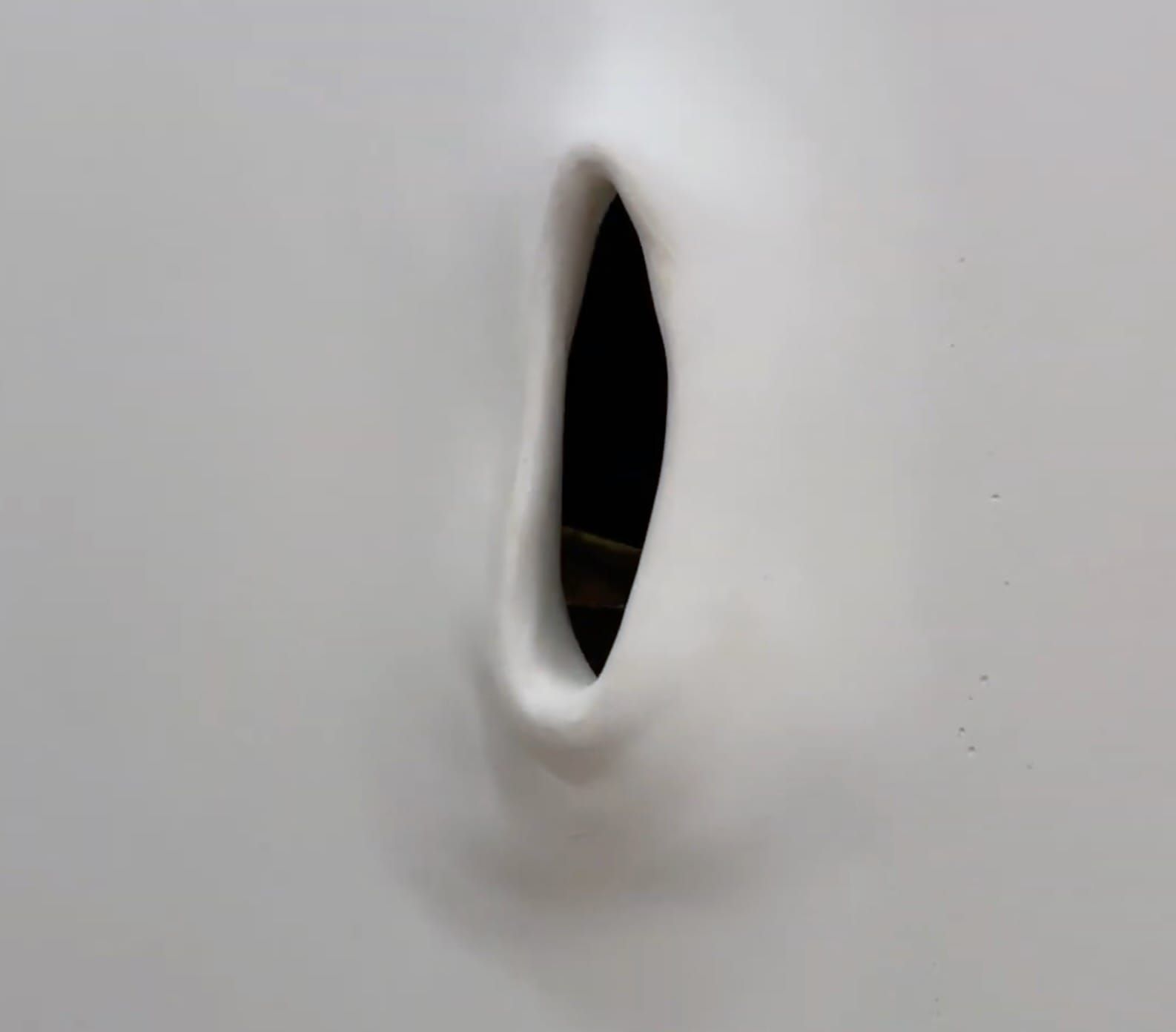
Jes Fan's Gut appears at first to be three holes in the wall, but they're fashioned to look organic. The accompanying note suggests they resemble "orifices," which hits the mark, no matter which specific orifice comes to mind. Other possibilities include the entrances to insect nests, or a badly healed wound. The holes contain a secret. Look inside, and something's lit and shimmering. It turns out that the thing inside the dark chamber is a CT scan of Fan's gastrointestinal tract, "modeled in resin and then painted and sanded to look like the mottled bark of the Aquilaria tree (the source of agarwood)," an accompanying note explains. Agarwood itself has a gnarly origin. It forms in trees after they're infected with a fungus. The tree defends itself by secreting resin. The resin-soaked wood is used in Asia and the Middle East in colognes, incense, and perfume.
Out of something unsettling comes something compelling—which sums up a lot of Fan's solo show, Unbounded, running now through June 28 as a special exhibition at the Yale University Art Gallery.
According to the accompanying notes, Fan "uses the language of abstract form to question the limits of binary categorization." They do this through a variety of methods, "from glassblowing to CT scanning to 3D printing, as well as their innovative approach to materials, including resin, silicone, and biological substances." The changeability of the media reflects the diversity of the subjects that Fan is interested in: "beliefs about identity that are mapped onto shapes and substances; the mutability of the human body; queer embodiment; human and interspecies kinship; and, most recently, the regenerative survival strategies of certain animals and plants native to Hong Kong."
Fan is Canadian by birth but their "point of view has been shaped by their experiences growing up in Hong Kong before and after Great Britain handed the region over to the People's Republic of China in 1997—a time of anxiety and transition. At this geographical and metaphorical crossroads, lines blur and categories blend: East and West, ancient and modern, colonial and postcolonial. Hong Kong's influence is apparent in Fan's works both visually, with aspects of its urban environment echoed in abstract forms, and conceptually, wherein binary terms are challenged and new possibilities emerge. Fan's work asks us to think expansively and to question inherited assumptions. It proposes a new way of considering the world, one in which systems of categorization are broken open, allowing us to see that things are more complex, disordered, and variable than we may have once believed."
What these notes are perhaps too polite to mention is that Fan's interrogations of their subjects are often kind of gross, in engrossing ways. Though static, many of the pieces give the sense that they're oozing or seeping, or that they would be moist to the touch. Fan likes to draw their art from bodily fluids and parts, hormones, molds, fungus, or oysters, the grossest of bivalves. The piece Form Begets Function involves urine, testosterone, and melanin suspended in silicone. The piece Mother Is.a Woman (Cream) uses estrogen Fan extracted from his mom's own urine.
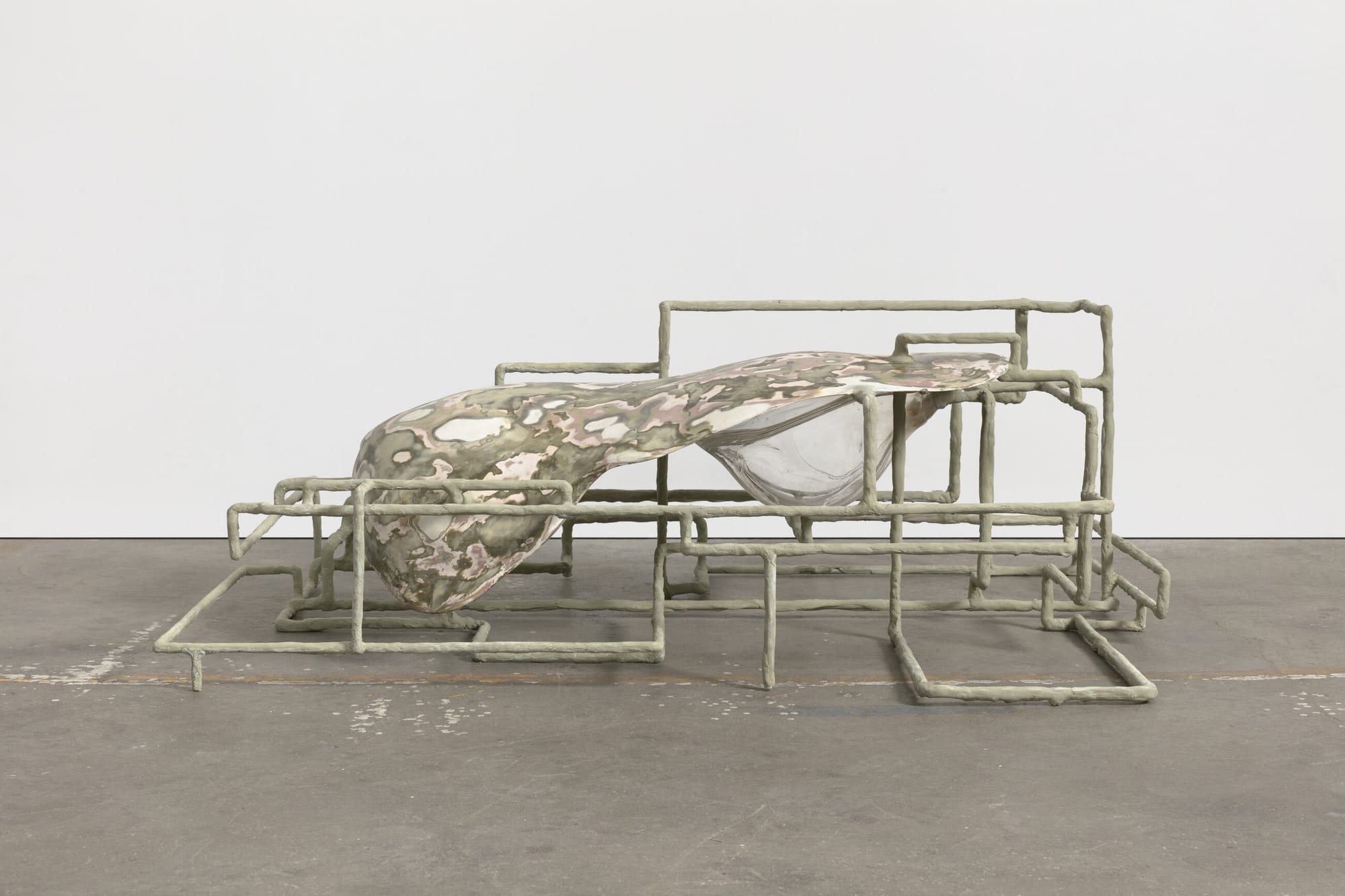
Even Fan's more structural pieces offer the possibility that they might be sagging slowly into collapse. "Fan's interest in oysters stems from their experience growing up in Hong Kong, a city shaped by British colonial influence," an accompanying note explains about Bivalve II. "The organism, which has evolved to absorb and transform the incursion of foreign substances into a highly valued material, functions in Fan's work as a metaphor for the impact of outside forces on life as a colonial subject. Bivalve II combines elements of the oyster and Fan's own body within a framework that references Hong Kong's built environment. The curved shell comes from a scan of Fan's body, under which nestles a "pearl" made of blown glass. The network of thin rods, which recurs in Fan's sculptures, alludes to the exposed piping that snakes along the exteriors of city buildings as well as to Fan's interest in rhyzomatic networks and systems."
As with much contemporary art, the explanatory notes do a lot of lifting to create a context to engage in the art. The explanations of Fan's processes and motivations help the viewer see what the art is about, bringing more people into the fold. But Fan's art also works on a more instinctual, sometimes literally visceral level. You don't have to know that Fan's art is about queerness, or colonialism, or interspecies kinship, to know that they're exploring the idea of change. Their emphasis on the process reminds us that often we're quick to think of change only in terms of the before and after—what a thing was and what it became, caterpillar to butterfly, ashes to phoenix. Fan's art is about the becoming, the pupa, the burning wood and smoke, and they excel at pointing out that becoming something is often messy, full of spills, problems, flails, mistakes. Going through the change—personal or social—can be ugly, difficult, repellant. But there's beauty in it too, even before we know what's coming, or where we're going.


