
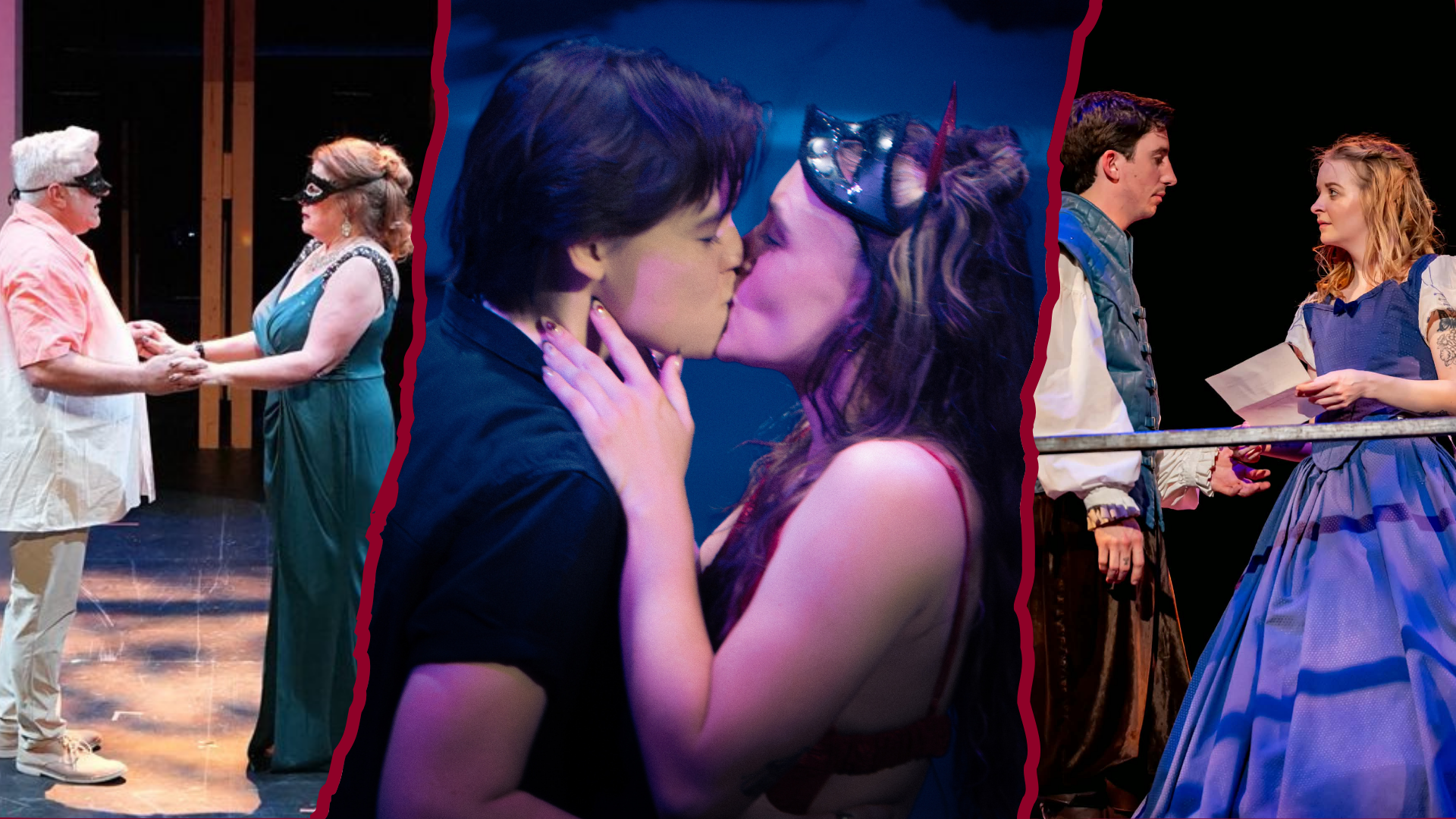
When Pembroke Players announced last January that their whole 2025-2026 season would be variations of William Shakespeare’s Romeo and Juliet, my first question was: why? It’s not unusual for a theatre company to choose a theme for their seasons, but this was a programming move I’d never seen before, promising three different versions of the same story. Pembroke Players’ promotional material pitched it as an opportunity to explore what it’s like to fall in love at all stages of life.
I’ll be honest: Romeo and Juliet isn’t a story that does much for me. I tend to find the “love at first sight” and “star-crossed lovers” romance tropes juvenile rather than profound and timeless. Since this aversion also applies to other well-known adaptations like the musical West Side Story, I went into this Pembroke season curious if seeing three different takes on the same story would open a door in my skeptical heart.
Is there really enough meat on this play’s bones to justify a company revisiting it through an entire season? The season-long meta-theatrical experiment didn’t make me a Romeo and Juliet fan, but it did present a strong message that feels like a direct response to the current moment.
Pembroke Players: Romeo & Juliet: Forever
Director: Jenny Guy
Tulsa Performing Arts Center, Liddy Doenges Theatre
October 30, 2025
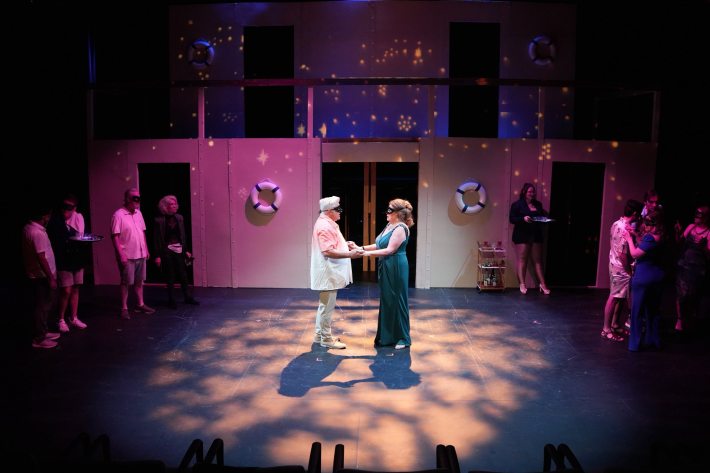
Pembroke Players launched its first venture into Romeo and Juliet by staging the play at sea, further upending expectations with an age-reversed cast, where the titular characters are played by seniors and the parents and caretakers are played by young adults. They all embark on what’s supposed to be separate Montague and Capulet family vacations, but everyone’s plans get shaken up when Romeo and Juliet spot each other at a party on the deck, and here’s the catch: they were lovers before!
From a technical standpoint, this production truly captured a mood from the moment I entered the theater. With acoustic covers of love’s greatest hits, a stop-you-in-your-tracks, two-story cruise ship set by Rich Goss, and Mal Lindsay’s dreamy lighting design—with twinkling blues, stars, and an effect that made the stage floor look like flowing water—I felt utterly whisked away. I continued to be impressed with Pembroke Players’ tech throughout the show, especially the fantastical light shift when Romeo and Juliet saw each other for the first time.
At times, the age-reversed cast highlighted Shakespeare’s original text in surprising ways, most successfully by Vivica Walkenbach’s Mercutio and Kathleen Hope’s Juliet. With Walkenbach’s performance, Mercutio’s usual hotheaded and youthful dialogue in the Queen Mab monologue morphed into a eulogy—a longing for glory days that will never be realized again—that became the most devastating moment in the play.
Hope’s Juliet was the definition of a successful boss babe, performing with unflappable confidence, at least until she encountered Romeo on the ship. As she fell in love (again), her own walls cracked, and the audience got to meet the clumsy, dorky, and absolutely lovable woman underneath. Love isn’t rational and may make you look silly; Hope fearlessly took the audience to that dimension.
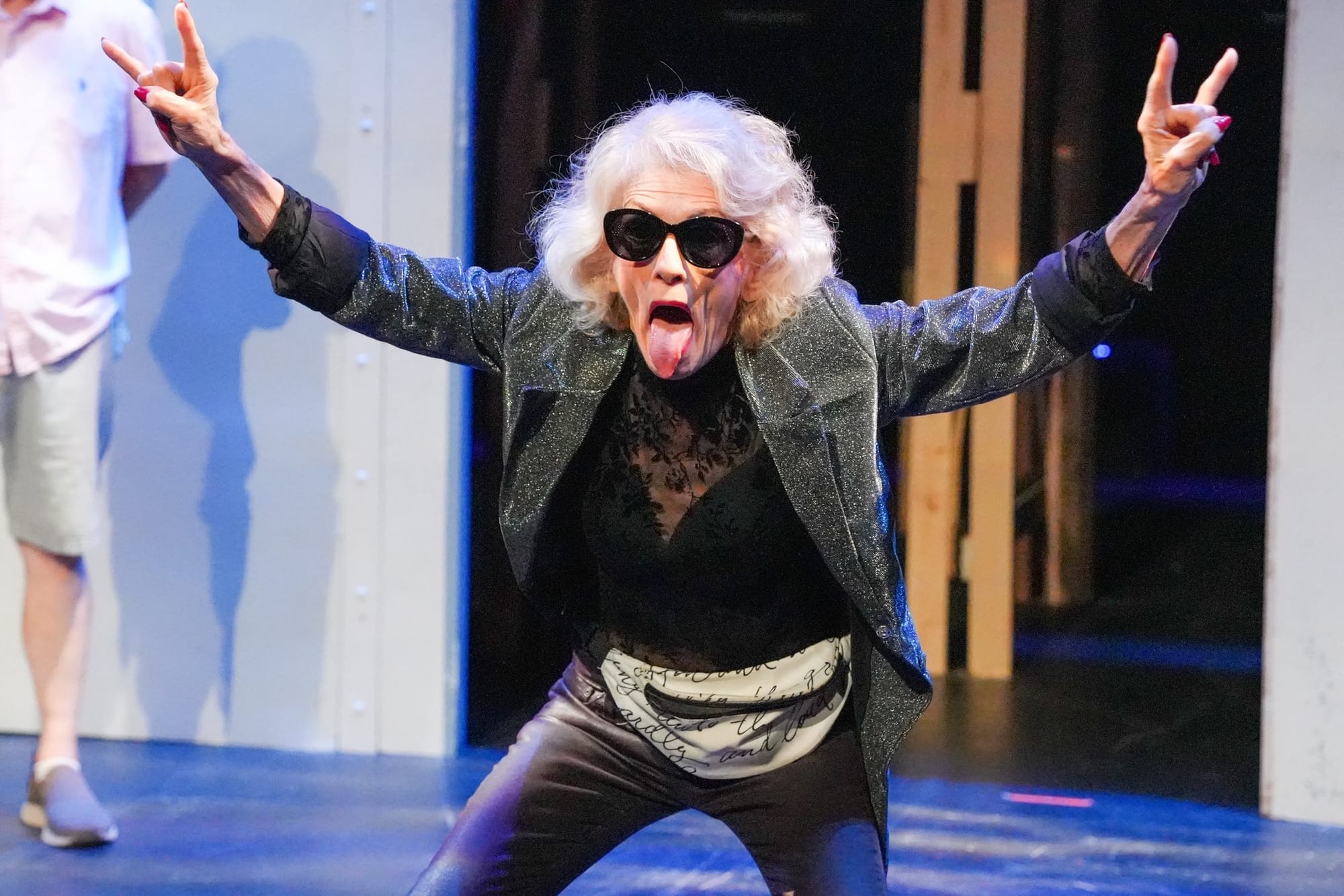
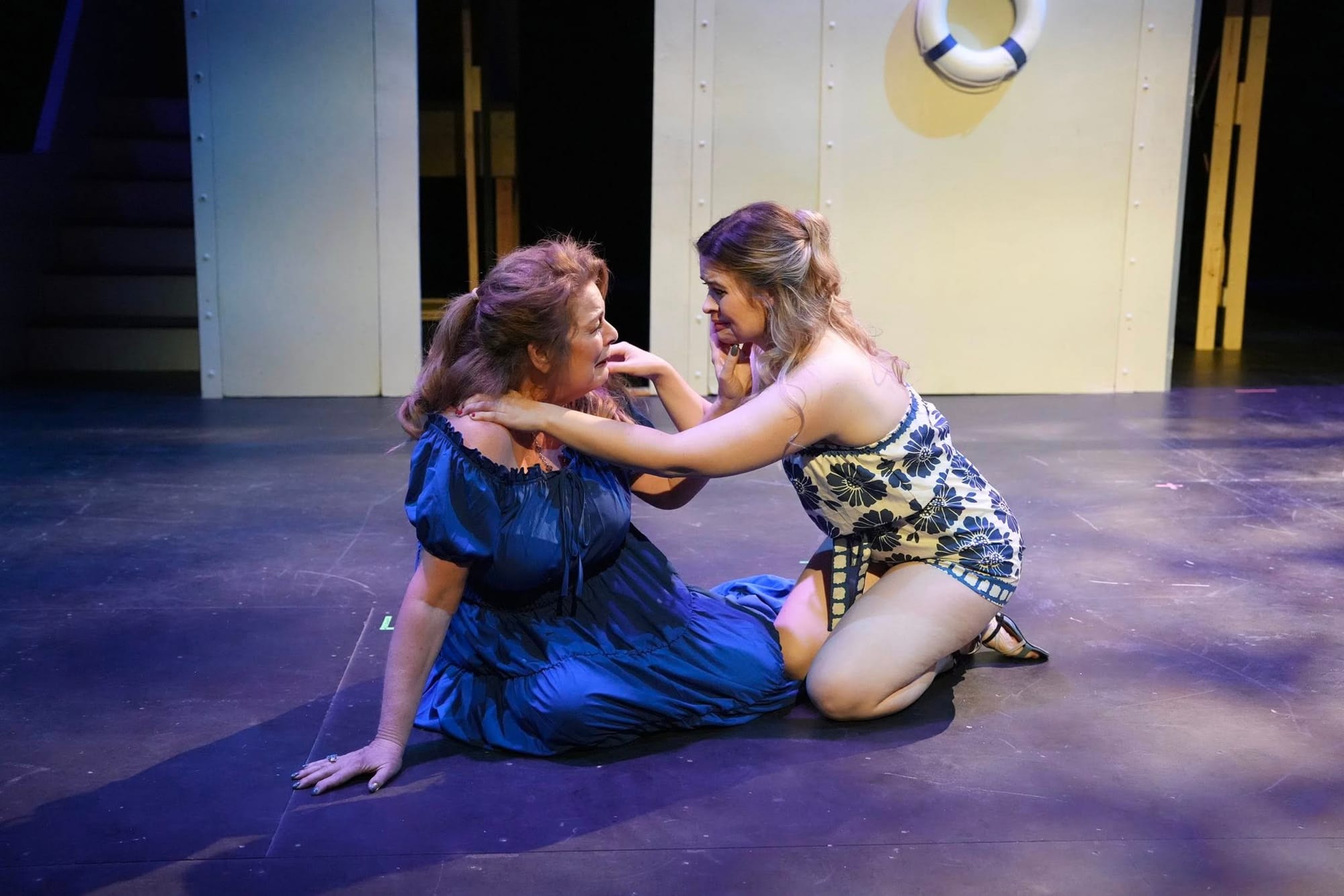
L: Vivica Walkenbach as Mercutio. R: Kathleen Hope (Juliet) and Emily Peterson (Nurse) | photos by Adyson Mastropietro
The intricate morphing of these well-known characters into this cruise ship aesthetic did not always come through on stage. Even with a few changes to the script, like Friar Lawrence calling Romeo “grandfather,” I found myself distracted from the plot, trying to figure how everyone was newly related and remember why everyone had beef.
Additionally, I had a hard time engaging with the language, which kept me from following and sympathizing with every character’s emotional journey. It was a bit easier to follow in act one, which was staged like a comedy and had the added benefit of physical humor to help the story telling. But in act two, drama took over and clarity weakened immensely when the actors’ emotions became heightened, as when the cast discovered Romeo and Juliet’s deaths.
This production had some strong moments and took a risk by adding a unique spin to a classic show. However, the age-reversed cruise ship overlay felt like more of a distraction at times than something that helped me sink into the story.
Pembroke Players: Shakespeare in Love
Director: Vern Stefanic
Tulsa Performing Arts Center, Liddy Doenges Theatre
March 6, 2026
Pembroke Players stayed with the theme but diverged from the original text with its spring production of Shakespeare in Love. A stage adaptation of the 1998 film written by Marc Norman and Tom Stoppard, this play tells a fictionalized account of how William Shakespeare wrote Romeo and Juliet.
Deep in writer’s block, Will struggles to finish his next play, first titled Romeo and Ethel, the Pirate’s Daughter. Viola de Lesseps, daughter of a wealthy merchant, is a self-proclaimed Will Shakespeare fan, and disguises herself as a man to be a part of the company that will bring the new play to life. The two characters end up entangled in a love affair, and the relationship inspires Will to rework his pirate queen concept entirely.
While it’s technically not the original text, the play fully embraces the concept of “art imitating life” as Will’s life begins to mirror the narrative structure we all know from Romeo and Juliet: two lovers from different worlds who cannot be together; parents trying to get the woman to marry a man she doesn’t care for; a party with dancing where the two fated lovers meet; a balcony scene where love is professed; a sneaky sexy moment; a tragic ending where the lovers cannot be together. With the story of Romeo and Juliet fresher on my mind, it was fun to spot these Easter eggs.
Michael Cossey led the cast as Will with a steady presence. His performance came to life (as does Will’s writing) whenever Hayden Abel sauntered onto the stage as Kit Marlowe, his literary rival and friend. Their lively rapport energized scenes and made for some of the play’s stronger moments. I particularly enjoyed their tight squabbling and physical comedy during the balcony scene, when Kit feeds Will romantic lines to tell Viola in an attempt to woo her.
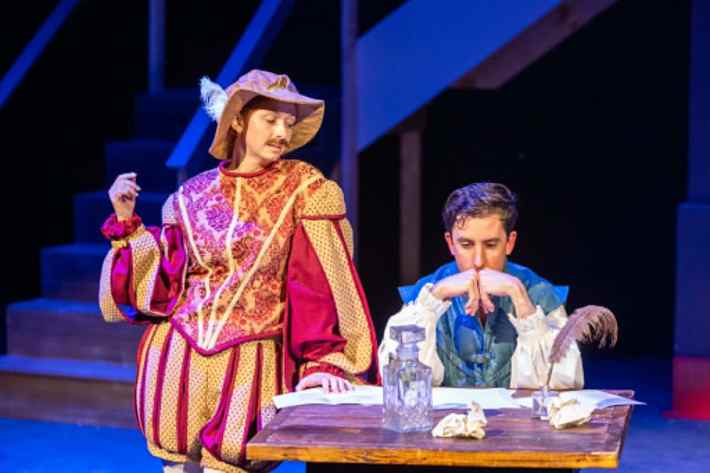
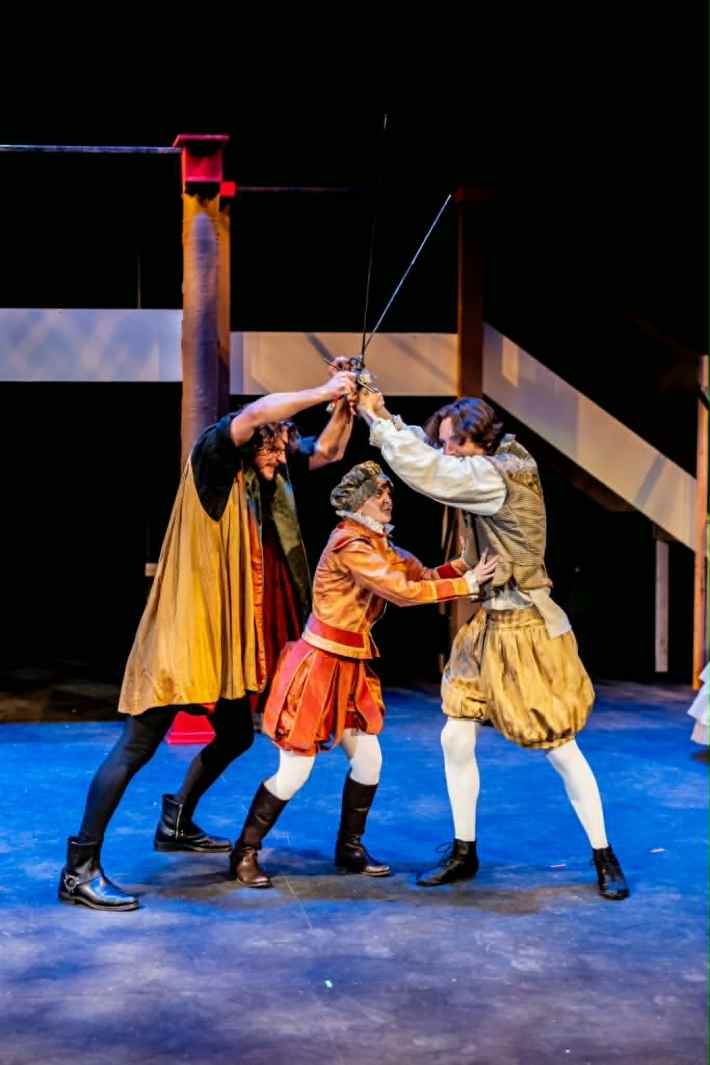
As Viola, Erika Reider was a wistful and reserved ingenue. It was fun to watch this facade crack during her early scenes with her betrothed, the downright terrible Lord Wessex (Aniq Zoha), and during a sharp fight scene (choreographed by set designer Rich Goss). With hilariously perturbed facial expressions and sassy sighs, Reider brought the character to life so much in those moments that I wished to see more of that zest throughout the show.
In each scene, a massive ensemble juggled lines and blocking with dances and set changes. Quinn Blakely, Kameron Clinton, Kurt Harris, and Davis Simpson were particular standouts, with Simpson shining as company lead actor Ned Alwyne while also enlivening group scenes by corralling and engaging with his fellow ensemble members in the background.
Even though this play was not the original Romeo and Juliet, I ran into the same act two slump that I always do with the source play. While the back half of Shakespeare in Love had more comedic elements than the original—such as a scene that straddles comedy and drama by showing the company performing Romeo and Juliet for the crown while Viola reveals her true identity behind the curtain—the energy didn’t build so much as wobble; I couldn’t sense what conclusion it was building toward tonally.
Perhaps the most traditional presentation of a play that Pembroke has ever delivered, Shakespeare in Love was beautifully staged and made for a fun evening, but it didn’t whisk me away into the forbidden romance in the way I had hoped.
Pembroke Players: Juliet and Her Romeo
Director: Cody McCoy
Tulsa Performing Arts Center, Liddy Doenges Theatre
June 14, 2026
For its final angle on Romeo and Juliet, Pembroke returned to Shakespeare’s original text, but in no way was Juliet and Her Romeo a “classical” rendition. The company’s artistic director Cody McCoy took the reins on this production and set fair Verona on the streets of the early 2000s grunge scene. He found some fun translations in this pastiche: the apothecary character transforms into a drug dealer, Lord and Lady Capulet are reimagined as Juliet’s older sisters who raise her, and our main romantic pair cannot be together not just because of their feuding families, but because they are a queer couple.
Another shift: McCoy and co-creator Jen Alden set Shakespeare’s tale to dance, so that at times it edged toward feeling like a musical. Choreographed by Alden, early act one group numbers created fluid movement that backed solos by the two leads and other key characters. While some of the song choices (like Sia’s “Chandelier” for the opening and a cover of Ariana Grande’s “God is a Woman”) extended outside the early 2000s punk era promised in the production’s marketing, the dances served a thematic purpose by alluding to the fact that Romeo and Juliet both feel trapped and swept up in their own worlds.
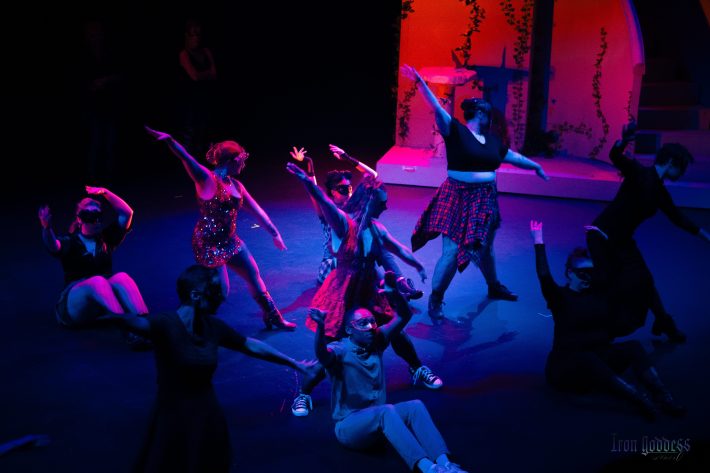
The first act had intoxicatingly high energy; it was easy to get lost in the spectacle. Mercutio’s (Emily Peterson) Queen Mab monologue, reimagined as a drug-induced dream sequence with a featured dance by Oklahoma Movement artists, was thoroughly entertaining. It was so entertaining that, while Peterson’s manic energy added to the fever-dream nature of the scene, I entirely stopped paying attention to what she was saying, even when she led Romeo, Abram, and Balthazar into the aisle of the house right audience and sat directly next to me.
McCoy employed a brilliant shift when we hit the balcony scene. This was the first quiet moment in the play: just Romeo and Juliet on stage with no music, dancing, or busy lights. It was such a distinct change that I got one of those bone-deep feelings that our two leads had found exactly where they were supposed to be.
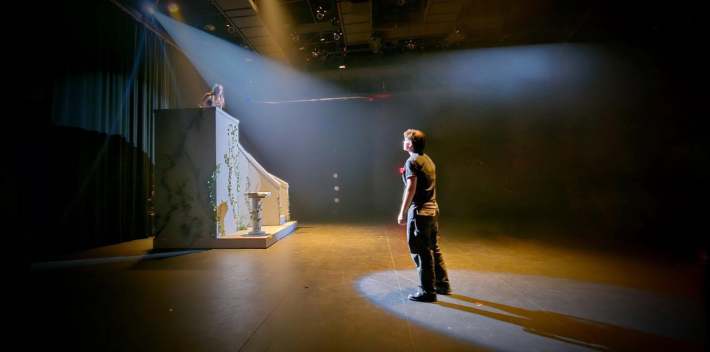
In the hands of Mal Lindsay (Romeo and lighting designer) and Kymber Sage (Juliet), this iconic scene sang with clarity. These actors had both stood out before this moment, thanks in part to their strong handle on Shakespeare’s language. An absolute smokeshow of a lead, Lindsay was the perfect suave heartbreaker as Romeo. Their multi-dimensional performance made for great comedic and swoony moments while never shying away from the character’s deep emotional range. Sage struck me mostly with her incredible dance solos, filled with tension and longing that made me want to learn more about her character. Together, these actors made the best kind of theatre magic on stage.
This chemistry continued in act two with a lively back-and-forth that emphasized the script’s language and literary devices, and a hot duet depicting the moment the characters spent the night for the first time. While both actors held their own, my attention switched to Sage, who showed us a woman stuck in her circumstances, trying to find a way out. The scene where Juliet confronts Friar Lawrence, demanding his assistance to escape her engagement to Paris, brought depth to a moment that often is seen as childish or irrational. Sage was neither, and through her, I saw Juliet and her circumstances in a new light. The tragic end of the play made a little more sense.
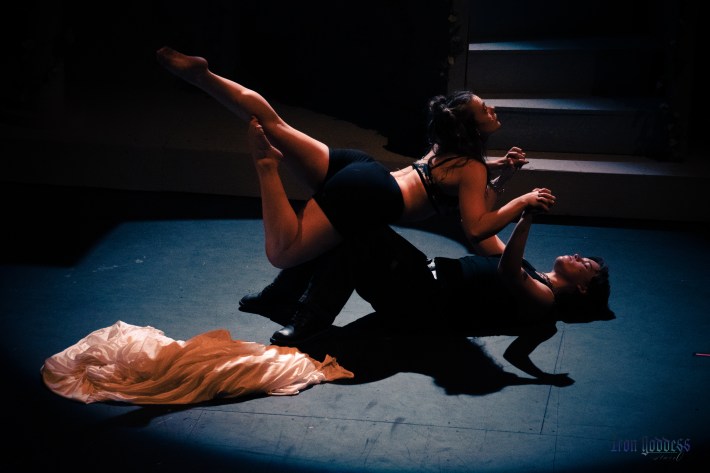
Even though I thoroughly enjoyed Lindsay and Sage’s work, it wasn’t enough to carry me through the post-death melodrama at the end of act two. Textually, this is a hard scene. Shakespeare writes it long and without interruption. Characters layer in one by one and have their own moment where they process what happened. It’s also a hard scene to structure on stage, since the audience needs a strong understanding of these secondary and tertiary relationships and the director needs to craft the tension so the performances build on top of each other until it hits a peak of sadness.
Watching this rendition, I was able to logically recognize it was sad, but I wasn’t emotionally pulled in. The production hadn’t given me a strong enough grasp on the other relationships to make this wrapping-it-all-up episode land. I was still trying to track things like: Why did the Montagues and Capulets have a feud? Why were Juliet’s sisters so excessively mean to her? What role does Tybalt play in this take? Where the heck did they find straight-laced Paris (played charismatically and wholesomely by Themba Ndhlovu) and why does he want to marry into this mess?
But before the lights went out, McCoy got me through the character Benvolio, played brilliantly by 15-year-old Nicholas Scharf. Throughout the play, Scharf had followed the Montague crew around, deliberately refusing recreational drugs and deescalating tense situations between the two families. At the end of the play, his brief yet strong solo kicked off the final dance number to Green Day’s “21 Guns.” The ensemble circled Benvolio continuously and gave him a knife and pill bottle. At the end of the song, he tossed them away and exited the stage: a strong declaration that he would continue to work against the cycles that caused this tragedy to happen in the first place. While it was a pronounced thematic divergence from the original text, this moment offered a very welcome glimmer of hope.
Pembroke Players’ Juliet and Her Romeo is a take on the tale for the modern era. While I didn’t agree with some of their adaptational choices (and almost feel like the script held back the vision), I still enjoyed this production.
Longing For Return, Longing For Change
I went into this season-long experiment thinking it would teach me something about love and relationships, but instead I find myself thinking about cyclical stories—those tales that have stood the test of time. Especially in the past few months, several local theatre companies have presented plays that examine generational violence, plays where a narrator looks back or relives a memory from their childhood, or plays that question the significance of stories we tell over and over again. With the artistic decision to present the Romeo and Juliet story three times in three different ways, Pembroke’s entire season seems to be a sort of meta-examination of this communal urge to return over and over to certain narratives.
But Pembroke’s three productions themselves tended to upend this urge, specifically with the decision to add original epilogues to the end of the two that used Shakespeare’s original script. In Romeo and Juliet: Forever, instead of being separated for eternity, we saw the spirits of the lovers reunite in the afterlife. Juliet and Her Romeo featured a similar moment, but the true break with “how it’s always been done” came with Benvolio’s decision to reject the devastation-generating lifestyle.
I’m curious about the reluctance to accept the tragedy that’s embedded in Shakespeare’s play—a reluctance also shown recently in the treatment of Greek myths in Little Shop of Productions’ Feathered. But I also notice a blazing fire in these works that seems to be saying, to the Bard and the world, “We get it. We’ve heard the story again and again. Now what? How do we move forward?”
I’m not entirely convinced Pembroke Players showed me Shakespeare this year, but its longing for change feels timely and urgent. With the company’s maximalist production value and willingness to take risks in reinterpreting classic works, I feel it’s primed to stage more crowd-pleasers, with a bit of bite.


