
The International Arts & Ideas Festival presents “The Stories We Carry”
New Haven Museum
New Haven
June 28, 2026
“Find your community, because your family probably doesn’t want you to be a writer,” Sandra Cisneros said bluntly, smiling as the audience burst into laughter.
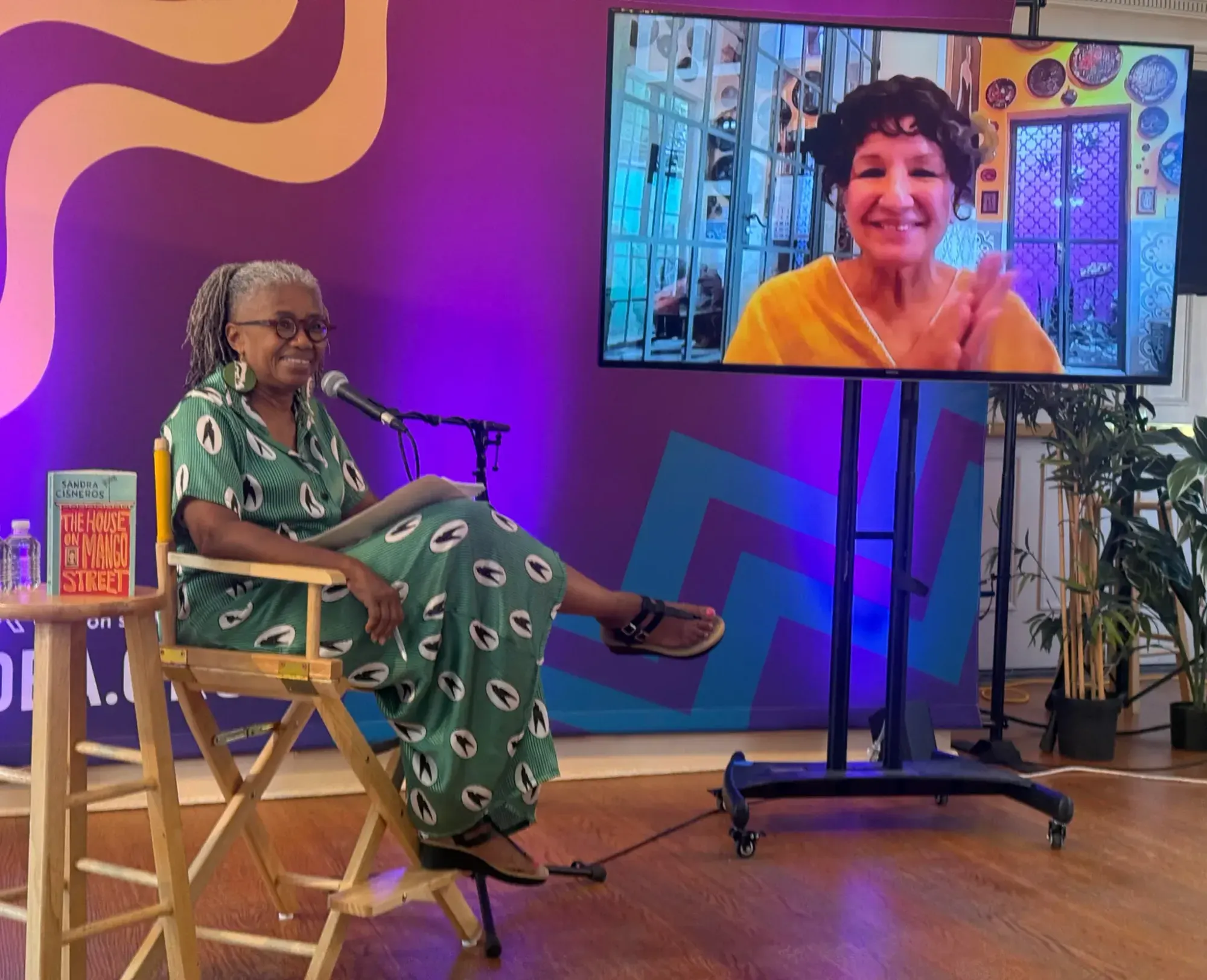
The writer’s mélange of humor and generous honesty made her feel warmly present in the New Haven Museum Saturday afternoon, despite her being a face on a screen thousands of miles away in San Miguel de Allende, Mexico. She was participating in a conversation at the International Arts & Ideas Festival’s event “The Stories We Carry.” It was a surprisingly intimate experience, though the room was packed. (There was a waiting list.)
Arts & Ideas chose Cisneros’s canonical book The House on Mango Street as this year’s National Endowment for the Arts (NEA) Big Read. It felt especially fitting for the festival’s theme, “Home & Belonging”: a loving celebration of the myriad cultures and spirit of fellowship and community that shape New Haven.
At Saturday’s conversation, Kulturally LIT Founder and Executive Director IfeMichelle Gardin asked Cisneros thoughtful questions that allowed the National Medal of Arts and PEN/Nabokov Award-winning author to be vulnerable and playful.
I expected this of Cisneros because that same wit is seeped into The House on Mango Street. Whether intentional or not, authors often leave traces of themselves in their work.
The House on Mango Street is main character Esperanza Cordero’s coming of age story, growing up in a house that doesn’t quite meet her expectations. She constantly dreams of creating a life of her own. In vignettes, the young Mexican American girl narrates keen observations about her Chicago neighborhood, family, poverty, girlhood, sexuality and the dreams and disappointments of those around her.
In the last chapter, “Mango Says Goodbye Sometimes,” Esperanza describes Mango Street setting her free one day. She imagines packing bags of books and paper (tools of the trade) while her friends and neighbors inquire after her whereabouts. But in the end, she says, “They will not know I have gone away to come back.”
The book’s prose is poetic and artful; as finely crafted as its message. To me, Mango Street suggests that freedom does not require forgetting where you come from. You can carry the people and places that made you while claiming a life of your own – though it’s also your responsibility to give back to your community.
If we imagine Cisneros pouring some of herself into The House on Mango Street, the book reads like a love letter to the Chicago that created the critically acclaimed author.
When Cisneros left home, she said Saturday, community became more significant. She didn’t feel like she belonged with her graduate school classmates; she was ashamed of who she was.
“I had never seen my community reflected with love,” she said. Then she asked herself, “What do I know that no one else in this room knows?” She found her voice. That singular voice carried Cisneros’ community far beyond Chicago.
She spoke with the exuberance of someone still astonished she’s able to make a living with her pen, something she could only dream of.
But to Cisnero, writing is more than her craft. It’s strength.
In a New Yorker interview, she said: “I believe in the power of the word and the ability of writers to make change. This is the time when we should be saying, ‘OK, let’s put the poets and writers in the front lines.’ We need them to be peacemakers and truth-tellers … what are the poets if not the truth-tellers? Poetry is meant to heal and transform people. It’s essential for that.”
To that end, she acknowledged our presently “unimaginable time in history,” saying that we’ve been “broken-hearted, surviving and limping along since Covid.” She also shared her own personal connection to today’s political climate: Her nephew is an American citizen but walks around with a passport in case he gets stopped.
“The state of fear we’re living in is unprecedented,” she lamented.
She reminded the audience that it’s important to write down what we witness because history is being rewritten in front of our very eyes.
Cisneros invited the audience into her writing process. She said she doesn’t write linearly, “from left to right.” She writes what “tugs at” and “breaks” her heart, what doesn’t allow her to sleep at night. A phrase or image will come to mind, and she’ll write it down. She called these tidbits of prose “buttons.” When it’s time to compose a piece, she rearranges her buttons. She said she’s even rearranged buttons on the floor, like she’s making a quilt.
“Writing a button a day keeps the doctor away!” she exclaimed.
She said she’s currently “wrestling” with a novel that will take place on both sides of the border. The novel is very different than her other work she shared. It has a male protagonist and is a gay love (triangle) story. “I feel like I have to write this story at this time in my life.”
She’s also full of poetry, saying a recent trip to Europe brought a lot to the surface.
Cisneros is at a time of her life where she fills it with wonder, pursuing all her heart’s desires: “Every day to me is just a rough draft.” Her freedom comes from finding joy in the little things; she adores animals, plants, the sky.
She said that The House on Mango Street opera was put on at the 2025 Glimmerglass Festival, prompting audible exhalations of excitement in the audience. For the opera, she joined forces with Grammy-nominated composer Derek Bermel. She’s hoping it will get produced.
Cisneros has also always wanted to be a clothing designer. She had a collaboration with fashion designer Nancy Traugott, who always wanted to be a writer. With their textile project, Cisneros adds her writing to vintage clothing, sometimes through embroidery.
Cisneros ended her talk by reminding us that we can all effect change, quoting 13th century poet Rumi: “You are not a drop in the ocean. You are the entire ocean in a drop.”
It was a fitting place to land for a writer whose work has always insisted that the small contains the vast.


