
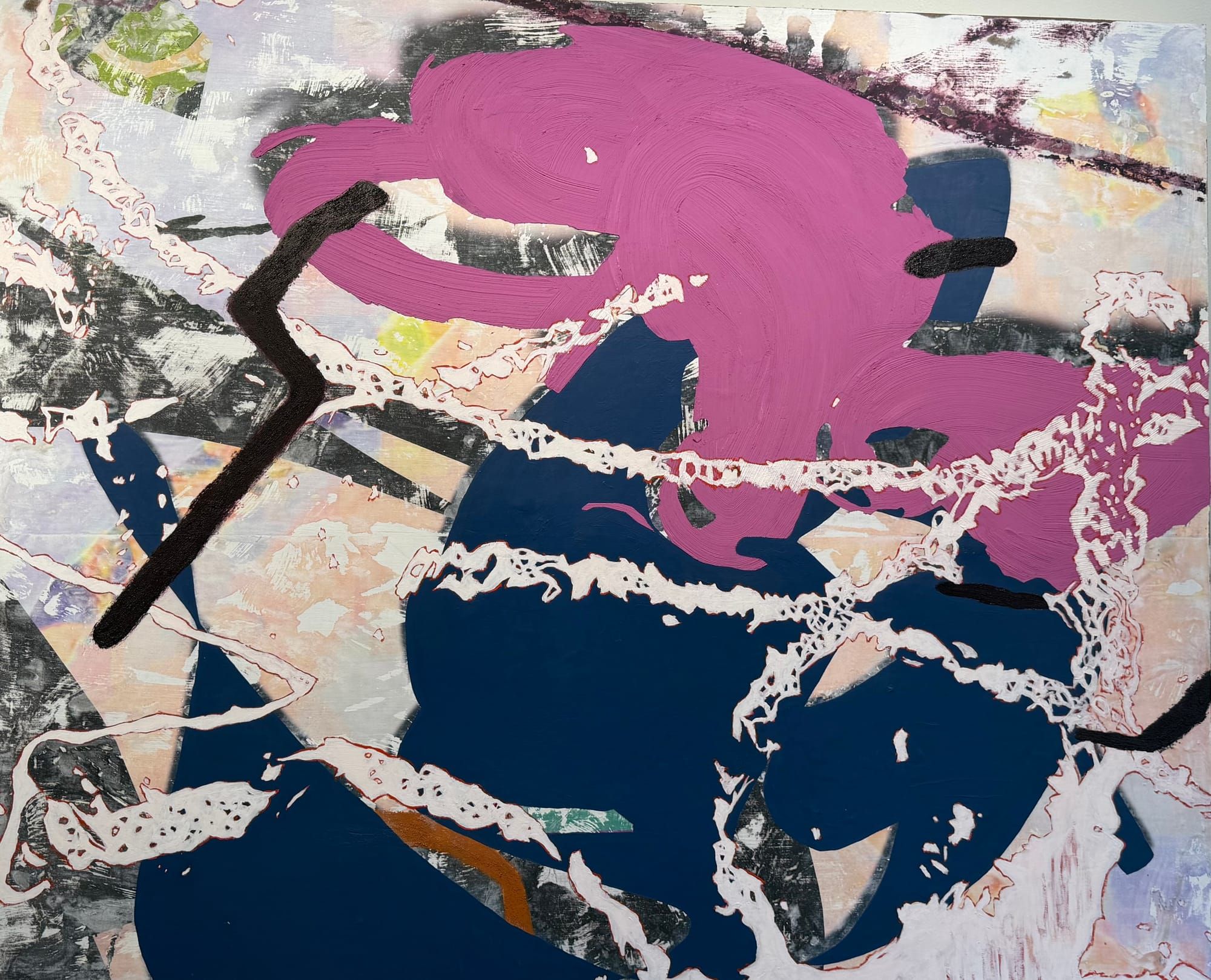
"Persuasive, Rather Than True" by Addyson Hoey
TAC Gallery
through August 29
Skin has become inadequate in interfacing with reality.
Technology has become the body’s new membrane of existence.
—Nam June Paik, 1989
When technology threatens to usurp art’s function, what’s a painter to do?
The invention of the camera in the 19th century sent art patrons running toward this new, fast, less expensive form of recording real-life images. With photography came a mechanical process of capturing realistic likeness. Many artists who were liberated from this requirement got to work creating what the camera could not, and abstract art was born.
Freed from a tether to the physical world, abstract art uses elements like line, shape, color, and texture to create a feeling or idea. Meanwhile, two centuries after photography’s invention, reality has become disembodied in digital space. Addyson Hoey’s current show at TAC Gallery—one of the most compelling presentations of abstract art I’ve seen this year—explores how we construct the real through the repeated accumulation of mechanical and physical processes.
Collapsing a traditional binary, Hoey brings the camera directly into the work of abstraction. After earning a BFA in Photography and Drawing from the University of Arkansas and an MFA from Washington University in St. Louis, the Sapulpa-born artist began this body of work by taking pictures of her drawings and uploading them into the digital space of Photoshop. She alters her images on her computer, then brings them back into physical space by printing them onto paper and transferring the image onto a wooden panel using matte medium. As the printed paper is peeled from the panel, Hoey reaches for her electric sander to remove any remaining material. While removing the stuck paper, the sander sometimes nicks the wooden surface, an encounter that begins the physical process of the painting. The sander is replaced with paint brushes and a traditional painting method begins.
Photograph, Photoshop, print, paste, sand, paint: This process of shifting between digital and physical spaces repeats itself many times, until Hoey decides the work is finished. Her process is evident in the multicolored, scratched surface of Untitled, one of my favorite paintings in the show.
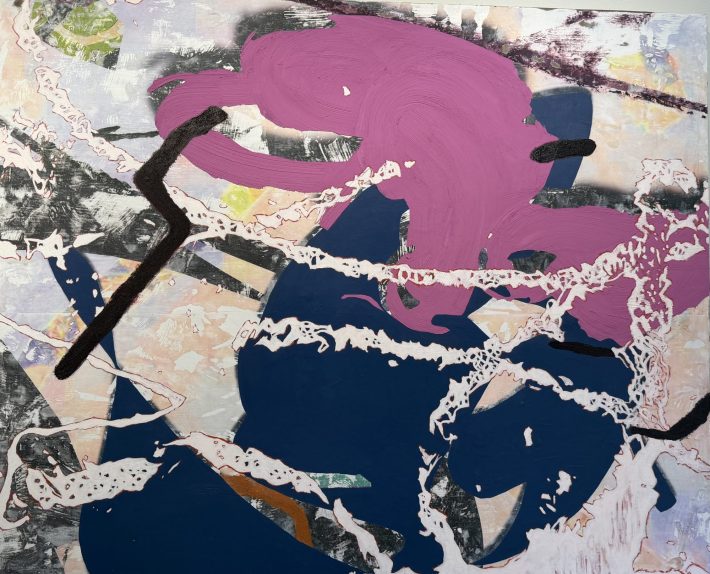
Confident pink brush strokes fill the upper part of this large horizontal painting. Thick, diagonal maroon lines strike the layered surface, revealing a multidimensional pictorial space. Hoey drags digital shapes in the editing suite and gives them new character in the physical world of the painting. For instance, Photoshop lasso tools become textured lines of broken white paint sitting atop blue and pink shapes. One of the two largest paintings in the show at 48” x 58”, Untitled confidently points to the beauty and balance we ultimately hope to achieve in our shifting digital and physical communications.
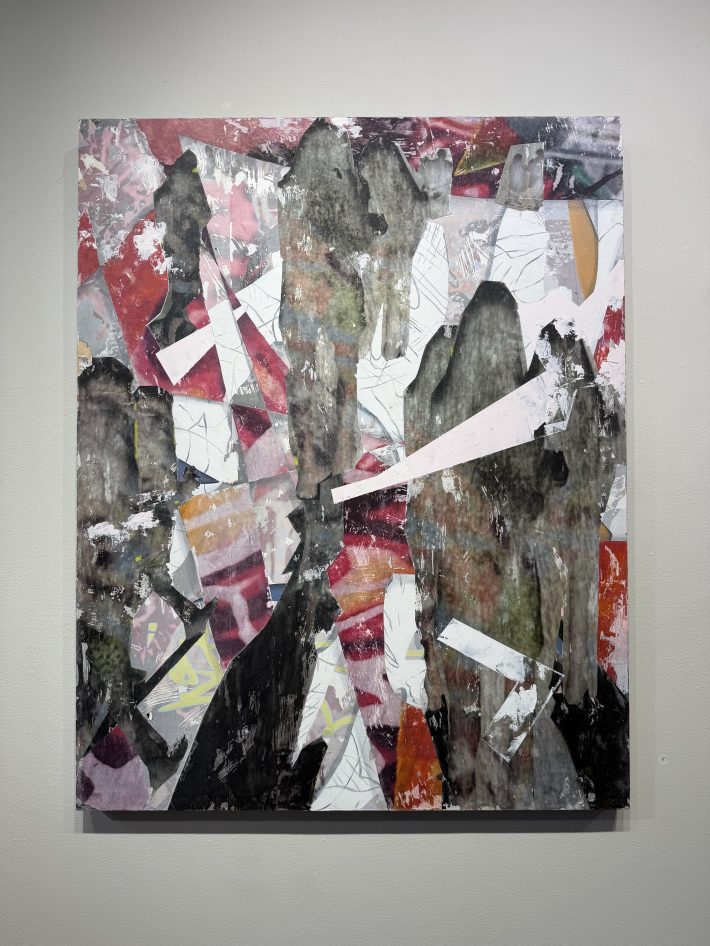
Another painting, Don’t Look Up, contains noticeable graphite drawings on white paper among the red, pink, and black layers of painted and sanded surface. This vertical work stands slightly smaller at 48” x 38” and is packed with thinner, sharp-edged shapes moving in every direction. Hoey’s figure drawings are all looking down, fixated in their digital worlds while occupying the physical space of the painting. The fractured shapes mimic our images translated into pixels on a screen, shared through various platforms, and brought together again in physical forms.
Modern life demands processing massive amounts of information and an abundance of virtual environments we never anticipated. Hoey’s paintings strikingly capture the movement of these rapidly shifting spaces on the simple framework of a wooden panel. Abstraction doesn’t necessarily mean disconnection. In the case of this exhibit, it’s exactly the opposite: a tool for visually navigating, even admiring, many layers of chaos.
Hoey will give an artist talk on August 28 at 7pm at TAC Gallery.


