
Jubilee: A Folk Opera
Yale Schwarzman Center
New Haven
May 28, 2026
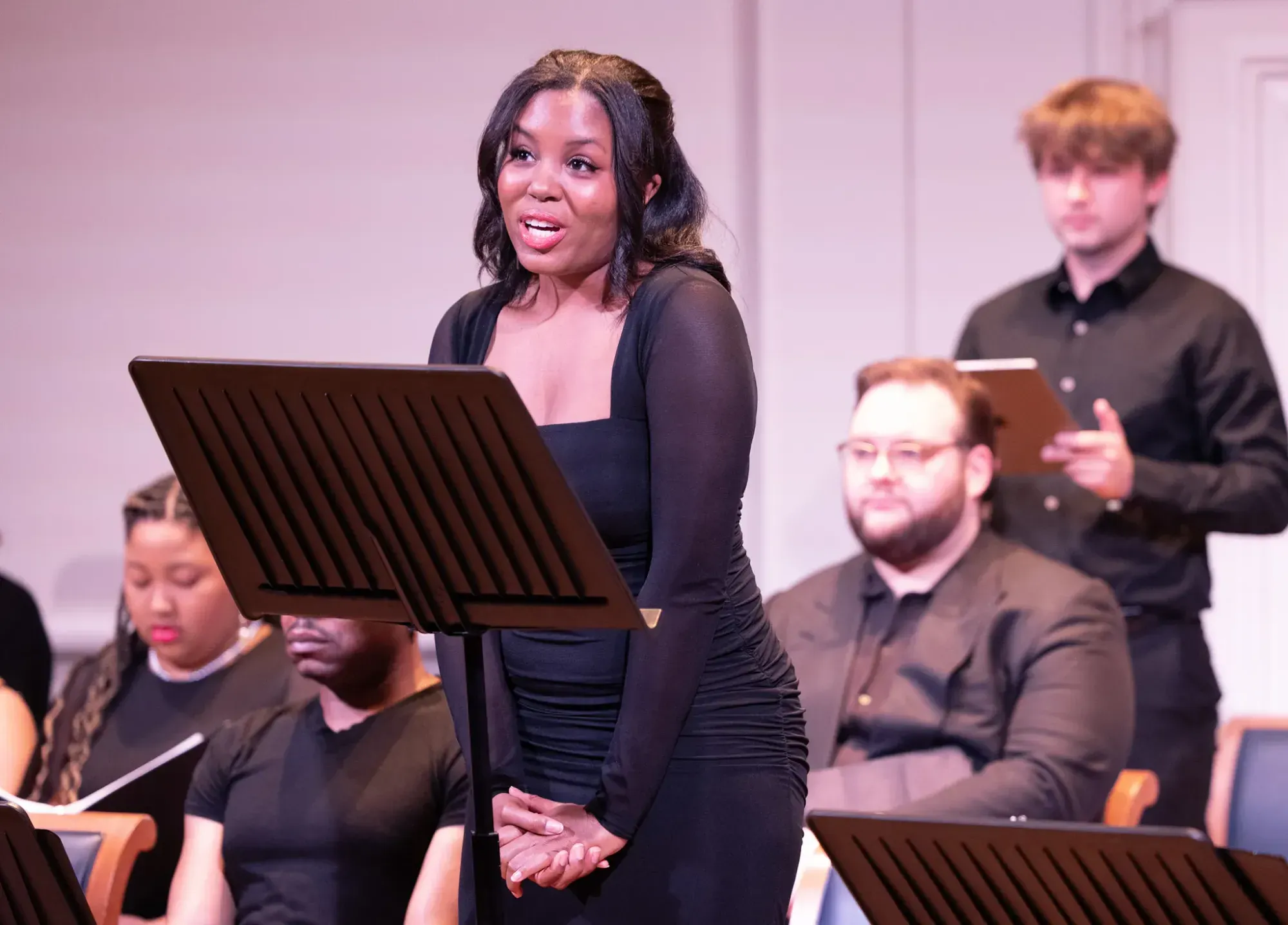
As a multicultural group of performers, dressed in all black, streamed into the Dome at the Yale Schwarzman Center Thursday evening, the audience exploded in applause. We knew we were in for an experience.
The night’s presentation of folk opera Jubilee was a work-in-process, so there was no staging or the typical operatic spectacle. There was no need.
The concert reading was so engrossing, it felt like you were witnessing a full production.
As pianist Jungmin Youn played thoughtful opening notes, the supertitle on the screen read “Flesh of My Flesh, This is Your Story.” Then the audience was immediately plunged into the abstract.
Margaret Walker (Patrice Pates Eaton), author of masterpiece novel Jubilee that the opera is based on, and Vyry (Jillian Tate), the fictionalized version of her great-grandmother from Jubilee, meet one another across centuries. Their joy during their reunion was palpable.
Jubilee tells the story of Vyry’s fight for freedom, from slavery through the Reconstruction era. Librettist Joan Ross Sorkin augmented the libretto with the inclusion of poetry from Walker’s This is My Century. In the next scene, the entire chorus stands up to sing lines from her poem “I Hear a Rumbling…”
I hear my children crying “Bread”/I hear my children crying “Peace”/I hear the farmers crying “Bread”/I hear the soldiers crying “Peace”/There is a rumbling…/…We want Peace./Bread and Peace are not enough; Freedom too.
As the sopranos held their notes, the deeper voices rumbled underneath creating a beautiful swath of sound. That powerful song sounded like a Negro spiritual, and established Jubilee as something entirely different than a classical opera. The entire folk opera was sung in English – often in historically Black colloquial English.
The piano took on a more romantic tone as the scene moved on to “I Want to Write,” another poem. Pates Eaton sang with a velvety richness; I want to write the songs of my people./…I want to catch their sunshine laughter in a bowl;/fling dark hands to a darker sky/and fill them full of stars…”
That stunning linguistic imagery, a hallmark of Walker’s writing, carried the show throughout, making visible the private ache and spiritual unrest but also the hope and joy pulsing beneath each character’s performance.
Each singer, down to the minor characters, employed their facial expressions with great utility; each emotion felt sincerely embodied. Tate’s eyes teared with sorrow in some scenes and in others shone with desire for salvation as her sparkling soprano soared over the audience. Her husband Innis (Edwin Jhamal Davis) threw his head back and opened his mouth wide as he full body bellowed, I’m a free man, his bass filling the room.
Throughout, the piano composition accented the action with steady streams of insistent notes, sometimes dropping away to highlight the performers’ voices or taking a darker turn to discordance when scenes heightened. Conductor Julius Williams guided the ensemble with assured sensitivity.
Time collapsed as Margaret and Vyry encounter one another throughout the opera. The story moves between the mid-to-late 1800s of Vyry’s time to the 1960s of Margaret’s time. They sang of the struggles of living through slavery, trying to escape to freedom, and then the repercussions of said freedom; still having to live with white people’s oppressive hatred. Like the Ku Klux Klan burning down Vyry and Innis’ newly built home.
Those repercussions extended to Margaret’s period. The audience heard it in the song/poem “Street Demonstration” about the Civil Rights Movement.
The Fighting may be long/And some of us will die/But Liberty is costly/and ROME they say to me/Was not built in one day.
The actual poem ends with: Hurry up, Lucille, Hurry up. We’re Going to Miss Our Chance to go to Jail. For the purposes of the opera, they change Lucille’s name to Margaret. At that line, the audience laughed; not because it’s funny to be jailed for fighting for God-given rights, but because sometimes you have to laugh to get through the godawful pain.
“[This is] what Black art has always done. It finds joy in the worst. It finds humanity in the most inhumane. It finds the unfindable, and I don’t think that will ever change unless America fundamentally changes,” said the producer, Yale School of Music Associate Professor of Music and Associate Dean for Student Life and Community Engagement at the Yale School of Music Albert Lee said.
Despite Jubilee’s heavy subject matter, the production found room for sly humor, with certain scenes sparking genuine hilarity. When plantation owner Big Missy (Janna Baty) encountered a Union soldier, she gleefully told him, “I hope my son sees you on the battlefield and whups your ass.”
During the “Inflation Blues” scene/poem, the chorus sang, What’s the matter with Uncle Sam?/He took away my sugar; now he’s messing with my ham. The audience laughed in commiseration as we likely all reflected on our present day. The song went on: The gas too high to fill the tank/One year cost more than did the car…/Cost more to live than foreign war./You can’t afford to live or die./…Hospital bed for just one day/Will scare your very death away.
That parallel to our current times was almost too much to handle. The old adage,“there is nothing new under the sun,” struck home.
In a near-final scene, Vyry’s first husband Russell Ware (Miles Wilson-Toliver), who was thought to be dead, appeared, showing all 32 teeth at their touching reunion. He was met with her new husband. “Innis, this is Randall,” Vyry blushingly explained. “Surprised me too.” The audience lost it.
The two youngest performers playing Young Jim (John Mugisho Mulaganire) and Young Minna (Penelope Klark Stewart) were a highlight. Even the chorus members couldn’t help grinning as they sang with voices beyond their years. Mulaganire was wearing the most adorable mini tuxedo, too – he took his job very seriously.
Every performer stood up for the final song/poem, “For My People.” They made a mellifluous roar as they sang, Let a new earth rise. Let another world be born/….Let a second generation full of courage issue forth;/Let a race of men now rise and take control.
“For My People” came from the collection of poetry For My People that won Walker the 1942 award for the prestigious Yale Younger Poets Series. So, it was a kind of synchronicity for the work-in-process opera to be staged at Yale. Even more of a coincidence, the director of the Margaret Walker Center at Jackson State University, Dr. Robert Luckett, who was present at the performance, is a Yale graduate who once lived across the street from Woosley Hall.
This work-in-process of Jubilee involved more than Yale, though it was sponsored by Yale ASCEND, amongst other partnerships, when Jackson State University ran out of funding to put the opera on. The ASCEND (Alliance for Scholarship, Collaboration, Engagement, Networking and Development) initiative is Yale’s effort to deepen their relationship with historically Black colleges and universities (HBCUs) and provide resources and collaborative opportunities.
Thus, in addition to Yale students and faculty, Jubilee’s cast was compromised of students from five HBCUs, including Jackson State University, where Walker was a professor of English and founder of the Institute for the Study of the History, Life, and Culture of Black People (now The Margaret Walker Center). In a couple of weeks, they will stage Jubilee at Jackson State University.
Composer Randy Klein had the honor of meeting Walker. Prior to composing for Jubilee, he composed For My People – the Margaret Walker Song Cycle based on her poetry. For more than 25 years, Klein has written music to Walker’s words. After seeing Jubilee, he shared: “Hearing the work come alive for the first time was an exhilarating experience. Jubilee is a special work that sings while sending a message of unity and inclusion. I’m sure it will take on a life of its own.”
“We want people to understand the history, and how it affects today,” said Ross Sorkin. “We want to change hearts and minds, and we hope that this is going make an impact on how people think about these questions of freedom.”


