
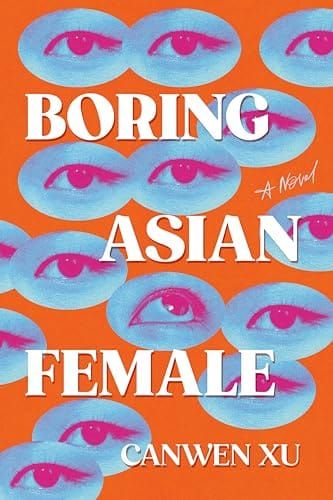
Boring Asian Female
By Canwen Xu
Berkley
To be a high-achieving Asian American applying to college or grad school is to know that the elite college admissions system is broken, but you’re not the person getting screwed over by it the worst, and no one wants to hear your sob story, which is the First-Worldiest of First-World problems.
Except ... what if we do?
In Canwen Xu’s debut novel, Boring Asian Female, protagonist Elizabeth Zhang is the model student Asian parents dream of. After getting into an Ivy League college, she has the perfect resume, glowing letters of recommendation, a 178/180 LSAT score, a 3.9 GPA at Columbia, and the perfect application to Harvard Law School. She’s confident she can get in. People with her stats get in everywhere they apply.
But when admission decisions come out, she doesn’t get in. Her frenemy, Laura, also an Asian woman but with lower test scores and an objectively weaker application, does.
This must be a mistake, Elizabeth thinks. She’s more qualified. Should she email Harvard to confirm they received the right test scores?
But it’s true. She didn’t get into Harvard. Why? According to her advisor, it’s because getting into Harvard is all she wants, so she was “too similar” to all the other applicants in her demographic.
“I was just another Asian kid who didn’t want to study computer science or go to medical school, so this was the only other option my parents would approve of,” she summarizes less diplomatically. “I was squarely in the ‘Asian female’ bucket, and that was a damn hard bucket to stand out in.”
If you’ve followed the news about affirmative action in the last decade, you’ve read about a lot of people like Elizabeth Zhang. Perfect stats, perfect application, but that wasn’t enough to get into their dream school. I’ll admit (now that I’m several years removed from graduating) that in my high school days filling out college applications, I was also worried about becoming one of these stories. I think on some level, most Asian Americans who apply to these schools do, whether they’re willing to admit it or not.
That’s why Boring Asian Female has gained such a foothold on Bookstagram since publication last April. There’s something cathartic about being so unabashedly entitled about admissions. Maybe because that’s the lie we’re fed growing up: Do the right stuff and it’ll be rewarded. Never mind that’s not how it works. Never mind that the Ivies reject thousands of qualified applicants every year. Elizabeth lives what would happen if we gave into our worst impulses – times a million – as she sets out to show the admissions committee that she can be interesting too.
“Each class at Harvard Law had 550 students,” Elizabeth calculates in the book. “According to the most recent demographic data, 50 percent of those were women. 10 percent were Asian. That meant there were twenty-seven spots for Asian females. And one of those had been taken by Laura.”
“I didn’t have any proof, but I was filled with the conviction that I would’ve been number twenty-eight. That if it weren’t for Laura, it would’ve been me.”
Elizabeth has already beaten the odds once: She got into Columbia while being a Boring Asian Female from South Dakota who went to public school (#1 in the state, but still public). It’s not enough. It’s not the best. To her, Harvard is the best. She’s stuck in a zero-sum game against everyone else around her. Elizabeth constantly evaluates herself and those around her in terms of percentiles of attractiveness, intelligence and other measures of worth. Her constant comparisons and ruminations on what she doesn’t have are so toxic, it’s impossible not to rubberneck around it.
At first, she’s just trying to figure out how Laura did it. How she got in despite being so obviously inferior. But as she continues on her quest, the reading experience spirals from relatable to jawdroppingly unhinged.
Boring Asian Female is anything but boring. It manages to deliver a story about what should be a deeply unlikable person in a page-turning way. Xu is a gifted story teller who gives readers just enough to keep them guessing. Eighty percent t through the book, one would think that the central plot is resolved. What else is there? Why is there still one-fifth of the book left?
But Xu manages to keep Elizabeth relatable through her intimate style of narration even as she throttles readers into more unhinged territory. Even after the worst of the worst of Elizabeth's actions, readers never lose the initial connection with her. Under Xu's careful guidance, there's just enough self awareness within Elizabeth that feels human despite her cruel (and illegal) behavior.
Maybe it's because spinning out and losing everything is a fear many of us have. Maybe it's because too many of us need to break free of seeing our self-worth through our achievements. Regardless, Xu has written an action-packed debut. It’s the kind of book you need everyone else around you to read just so you have people to process it with.


