R2 Collective
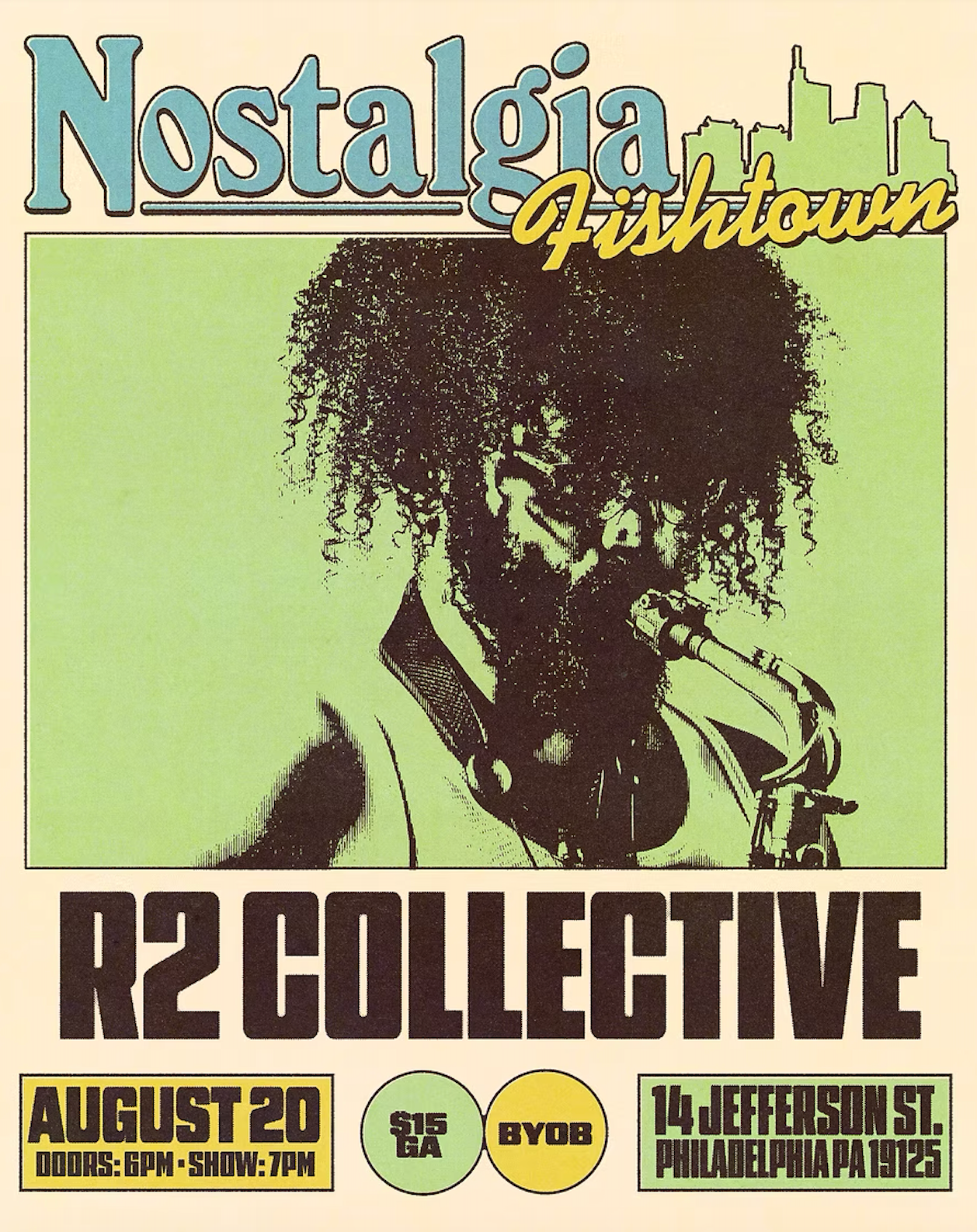
Nostalgia Fishtown
14 Jefferson St.
Philadelphia
Aug. 20, 2026
Unlike many of the great musical movements before and after it, jazz fusion did not happen as the result of a new generation of musicians emerging to challenge or completely destroy the old guard. Instead, fusion developed as a result of older and younger musicians working side by side to introduce a set of new ideas to the genre.
Miles Davis’ employment of electric instruments in his bands and recordings in the late ‘60s was a moment that created a great schism in jazz. Throughout the 1970s, the question of electric instrumentations vs. acoustic in jazz became a stand-in for a battle between orthodoxy and adventurism. The adventurous side of this supposed divide in jazz used their electric basses, synthesizers and effects pedals to open a new world of sonic possibilities for jazz. Today, the question of fusion’s artistic authenticity and viability has been settled. We are fortunate to live in a world in which jazz has been irrevocably shaped by fusion and young players are free to incorporate the sounds of rock, funk, hip-hop and R&B into their work.
Saxophonist, composer and bandleader Robert Rutigliano is a bright light amongst the generation of players who are using the freedom that fusion affords to create daring and original music. On Thursday night, Rutigliano brought his six-piece ensemble, the R2 Collective to Nostalgia Fishtown for two sets of fresh, electrifying jazz. A veteran of bands like The Chronicles and Start Making Sense, a Talking Heads/David Byrne tribute, Rutigliano was joined by Andrew Carson on trumpet, Roman Wyatt on keys, guitarist Matt Kahn, Zach Guise on bass and drummer Noah Uy. For the evening’s two sets at Nostalgia, the R2 Collective came together to unleash a repertoire of challenging and soulful tunes.
I didn’t catch the beginning of the first set, but I walked in while the band was knee deep into a groove, downtempo cut. Kahn’s guitar solo was a colorful, reverb-soaked dream and Rutigliano and Carson dovetailed into a furious, fiery whole as they improvised together. The original music (composed by Rutigliano) throughout the set was impressive, full of rich chords and deceptive, shifting meters. After one particularly strong composition, Rutigliano got on the mic, joking with the crowd and playfully reminding us that he “wrote this shit.”
After a brief break, the second set opened with a chill, breezy tune whose intro steadily built tension before releasing into a wistful main melody. Here, Guise took an exceptionally rich, melodic bass solo on this tune and the fiery, high register screams of Carson’s trumpet solo stood out as well. For the next song, singer Danielle Dougherty joined the band for a bittersweet cover of the Beatles’ “Blackbird” as Carson and Rutigliano joined with vocal harmonies. The jazz arrangement of the song was gorgeous, bringing out the wounded yet hopeful heart of the song. Speaking on his original piece “Departure Day,” Rutigliano described the tune as a song about grief; “One thing people do in life is of course live and we love and we lose and nobody really tells you how to grieve,” Rutigliano said before leading the band into the song. Following the slow count off, the band jumped into the heavy, resilient composition. Carson’s trumpet solo reached cosmic heights as the notes danced around the small venue, awash in reverb and delay. Rutigliano’s solo was not only technically precise; his playing soared through a maze of emotions. Hearing this music in 2026 makes the ideological debates of jazz’s past seem quaint. Perhaps fusion’s greatest, unpredicted gift is that it has extended jazz’s viability by providing enough stylistic space for contemporary musicians to continue to get int where they fit in. Tonight was evidence that this approach to the music continues to be a powerful incubator for jazz’s next generation.


