
Prologue: Soul in Hand
SOURCE/MATERIAL
New Haven, CT
Through Oct. 31
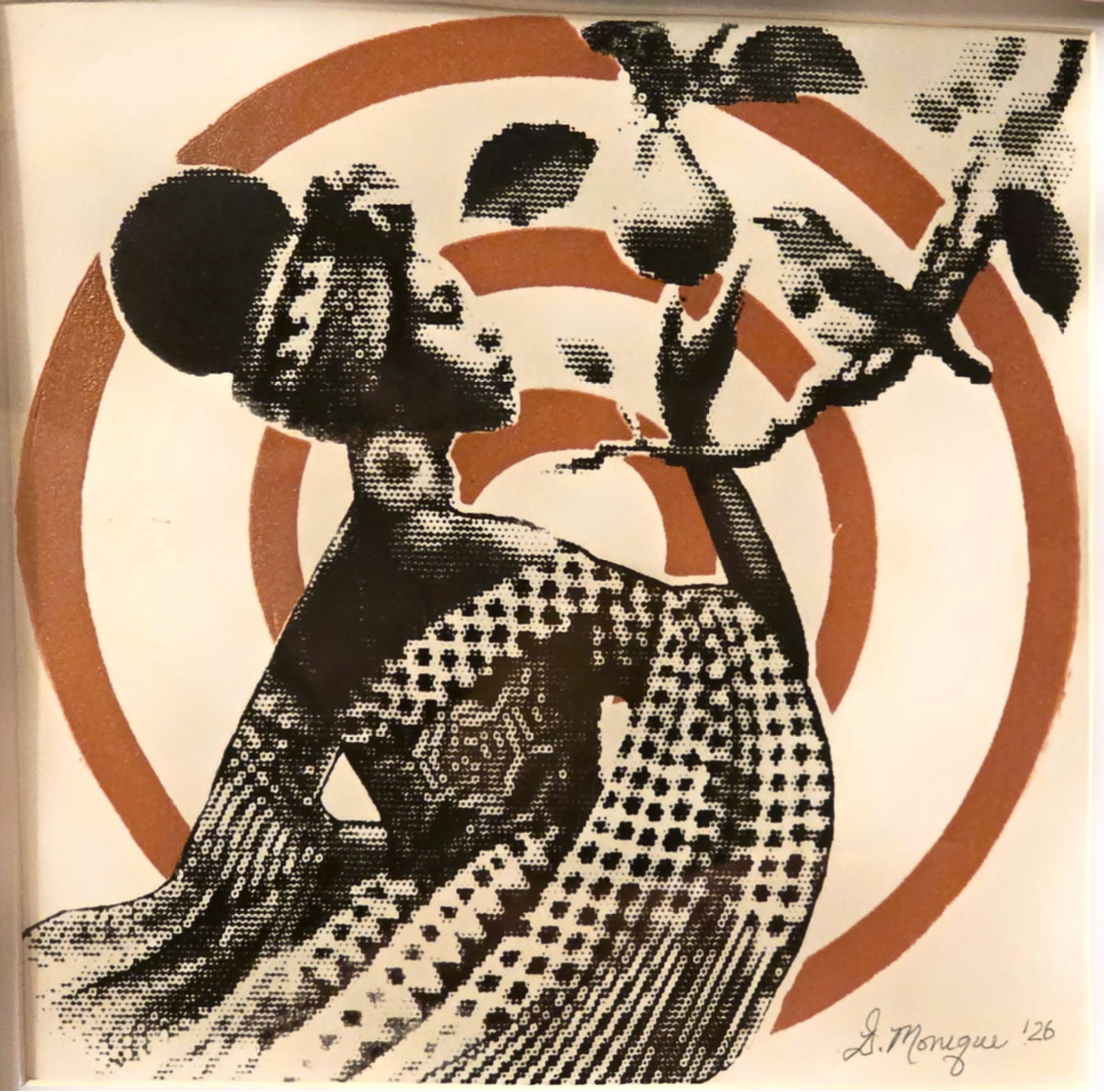
The pixellating effects of the print can't take away the graceful sweep of the image, the way the cloth flows around the figure's limbs. The title of the piece — Not Tempted Like Eve — orients the viewer toward the intentions of the artist, Dana Monique, but the piece itself conveys more than enough. The woman in the print exudes confidence. She will eat the fruit if and only if she feels like it. She doesn't need whatever wisdom that pear might impart. But that doesn't mean she won't enjoy the taste.
Monique's bio explains how Not Tempted Like Eve and the other pieces in the show are part of a broader artistic mission. She "explores the intersections of nature, healing, and the human condition. Inspired by the shapes, textures, and colors of the natural world, she creates art as both a personal refuge and a communal offering. Her practice reflects her journey as a Black, sick, and spiritually gifted woman in the United States, centering on themes of resilience, fluidity, and transformation." She "invites viewers to consider what freedom and justice mean for failing and captive bodies. Living with chronic illness has deeply informed her artistic process. She embraces setbacks as opportunities for growth, allowing chaos and imperfection to become integral to her work. For her, art is not only an act of creation but also of survival, an affirmation of power, hope, and healing."
The piece is part of Prologue: Soul in Hand, a show running now through the end of the month at SOURCE/MATERIAL, a gallery space in Westville that launched in May, coinciding with Westville’s ArtWalk. The gallery has featured two shows so far with Artists' Bloc, a collective of 50 artists, most of them local to New Haven. Both SOURCE/MATERIAL and Artists' Bloc are organized under The Building Fund, of which nico w. okoro is the founding CEO. okoro curated the first two shows at the space after it opened. For this show, organization came from New Haven-based artist Shaunda Holloway, who had the idea of a show focused on Black printmakers.
“I turned over the keys and hung the work,” okoro said. “It’s very much their vision, the show they wanted to put on.” The collective has its first museum show coming up and this show functions as a “test before the larger opportunity.” Though the opening, okoro added, was “like a family reunion.”
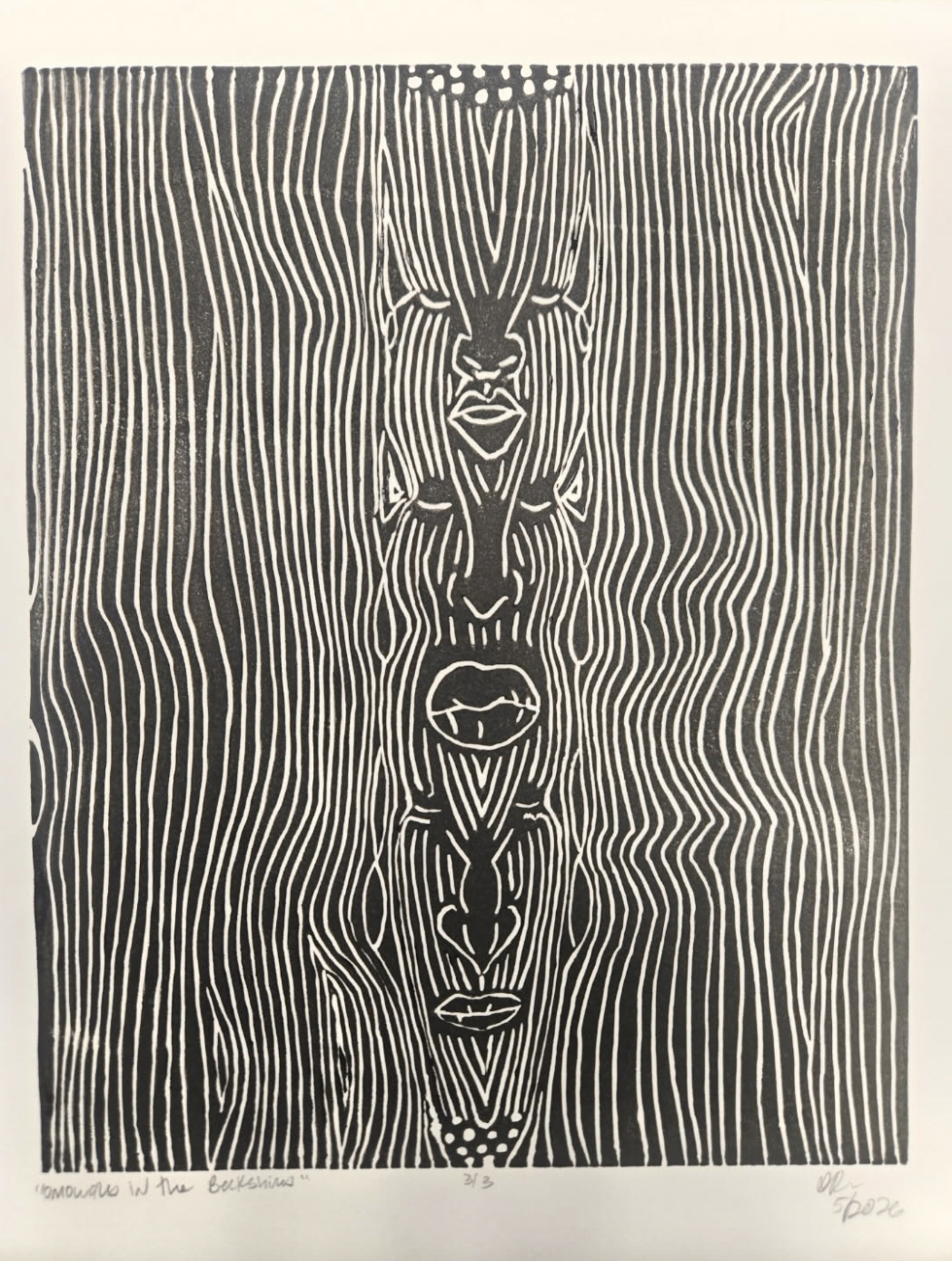
The sense of family extends to the pieces themselves. It begins with their general tilt toward warm, earthy colors, and the way that they show that they were made by hand. Siobhan Carter-David's Omowales in the Berkshires revels in the texture of the bark that inspired it, setting white and black off one another until they nearly vibrate. It creates a contrast with the peacefulness of the faces, suggesting that they're as powerful as they are serene.
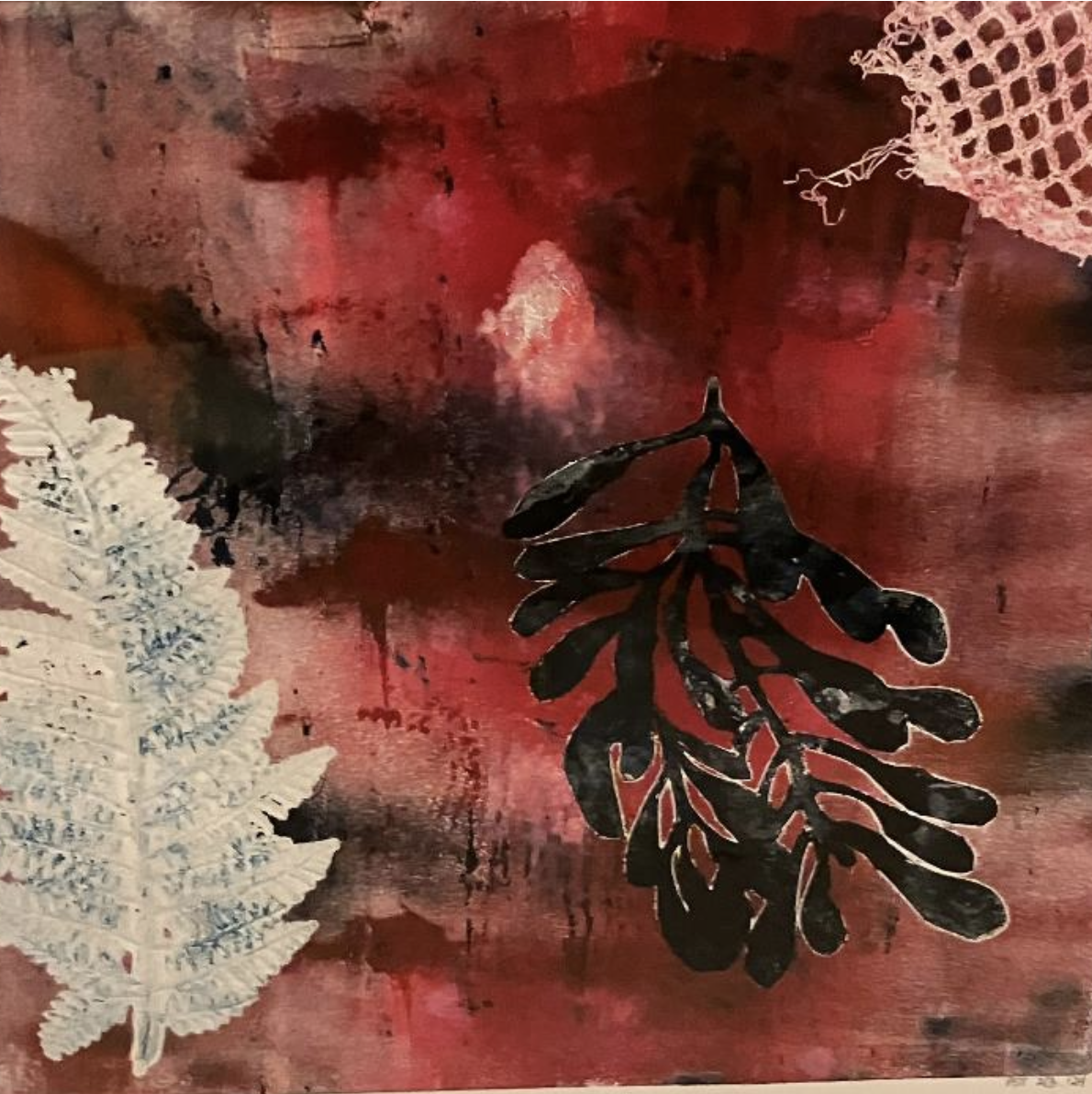
What Carter-David accomplishes in linework, Portia Scott-Thiam creates through vivid colors and textures. The objects in the print Wings Scales Posing as Algae II: Dark Blue Series may be small, but Scott-Thiam makes them look huge, inviting us to look close, notice the details in their forms that might otherwise elude us on the beach, or in the forest.
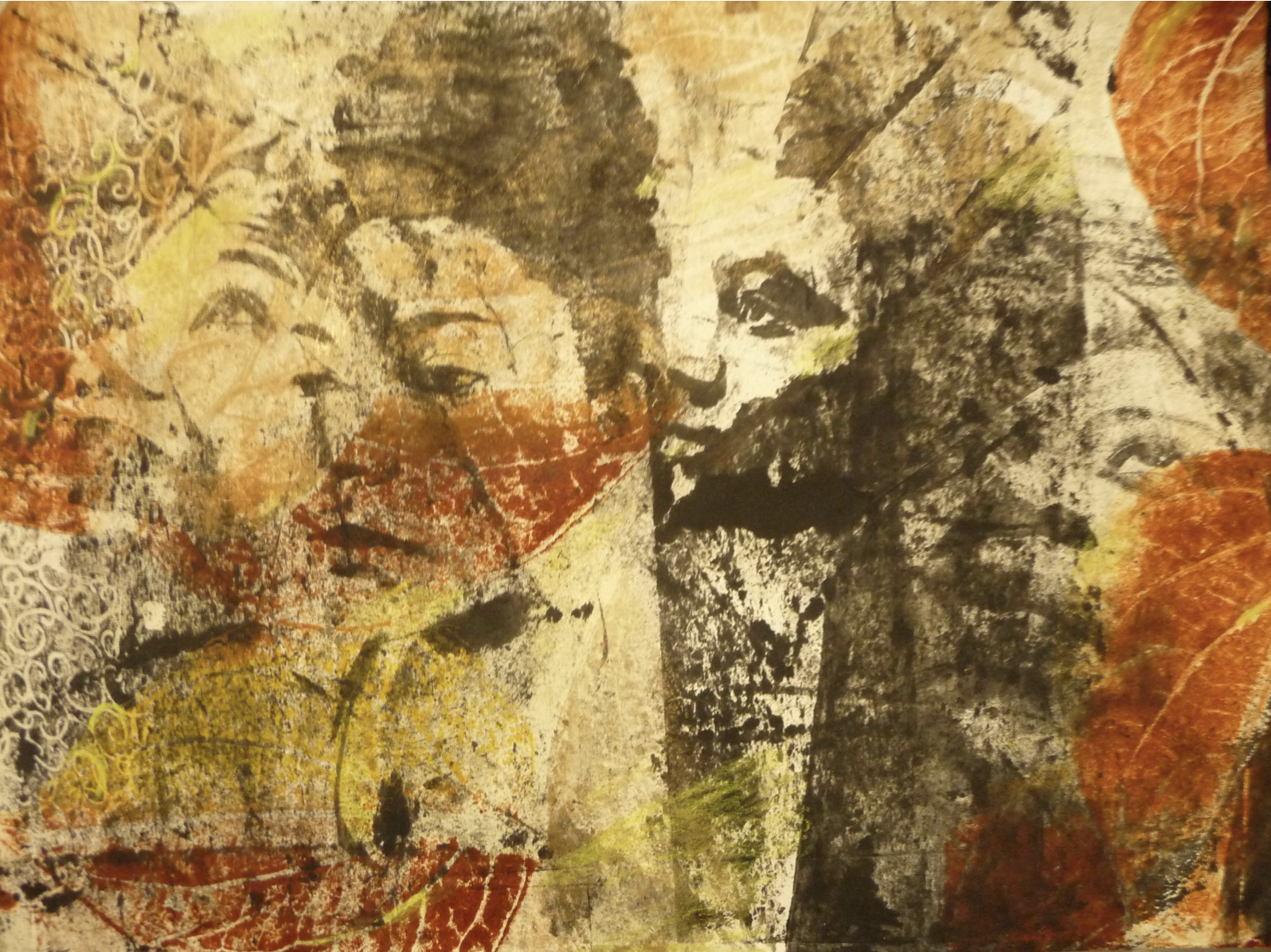
Shaunda Holloway's own contributions to the show carry the sense of bringing all the pieces together. The faces in her piece TheseFOURWomen keep their own personalities distinct, but flow together to create a larger whole.
The scale of the pieces — most of them are small enough to hold in your arms — make the show feel private, intimate. For printmaking, the pieces are also quite figurative, featuring human forms and faces, though some aren’t as obvious as others. “They look super conceptual and abstract from far away,” okoro said, but added that when young people have visited the show, they have gotten up close and seen that, “wait, there’s a face in there.” When okoro hung the pieces, “I tried to put the works in conversation with each other” to create a “narrative,” okoro said, “like you’re seeing a page or a chapter of a broader story.”
“I’m excited to see what they continue to do as they learn from each others’ processes and work as a group,” okoro said. “On their own, they are all amazing artists. Together, it’s a whole vibe.”
The show at SOURCE/MATERIAL thus has something to say in the context of the region's arts scene. This spring, okoro started as the new executive director of the International Festival of Arts and Ideas, and for her, both A&I and the Westville gallery space fit into a larger story about an arts scene in flux. Not long ago, New Haven's visual arts landscape had a few anchor institutions with physical places downtown, like Artspace and the Ely Center of Contemporary Art. Those spaces don't exist as they did. Artspace closed its doors. ECOCA is in transition, with a temporary home in Fair Haven. New Haven's nonprofit arts pains echo what's happening at the national level. The Kennedy Center, an emblem of the larger problem, is closed. State and private funding for the arts is more scant than ever.
Arts nonprofits that are still functioning as if conditions haven't changed struggle to continue as they have in the past. "All of us are fighting for the same resources, without different mission statements," okoro said. "We're all doing everything." okoro also pointed to what she perceived as artists being "more distrusting of arts nonprofits." They have seen some nonprofits do well in the past while the lives of artists haven't changed. "And we are slowly reckoning with how to right-size it," okoro said.
But the challenges of the time also present opportunities. At A&I, staff and board are “braced for change," okoro said. To navigate the new landscape, "you have to come up with a new mission and a new program." For arts nonprofits, lurking behind that work is a fundamental question: "Who are you for?"
Last year okoro passed around a needs assessment to working artists in the area. "What do you want more of? What do you want less of?" she asked them. "And 93 percent said they just needed space to show their work, meet other artists, and meet people who might buy their work."
okoro created SOURCE/MATERIAL to respond to that need. She welcomes the idea of her gallery becoming more artist run, with okoro managing promotion and design. “Then it can really exist as a community space.” Right now, she said, “the future is open" for the space. "There’s just folks from the community who want to host different events and I’m open to it.” She also sees how SOURCE/MATERIAL fits into a more horizontal ecosystem of smaller places, joining Lotta Studio in Westville and threeiota in Cedar Hill. It can be disorienting to an arts scene to lose longstanding institutions. But what if a constellation of smaller venues rose to take their place?
"Let's be creative. Let's do something that doesn't hurt us," okoro said. "We have a lot of work to do for artists, and especially artists of color." When local artists and entrepreneurs coordinate, "we're as a group able to solve some of our own problems."


