
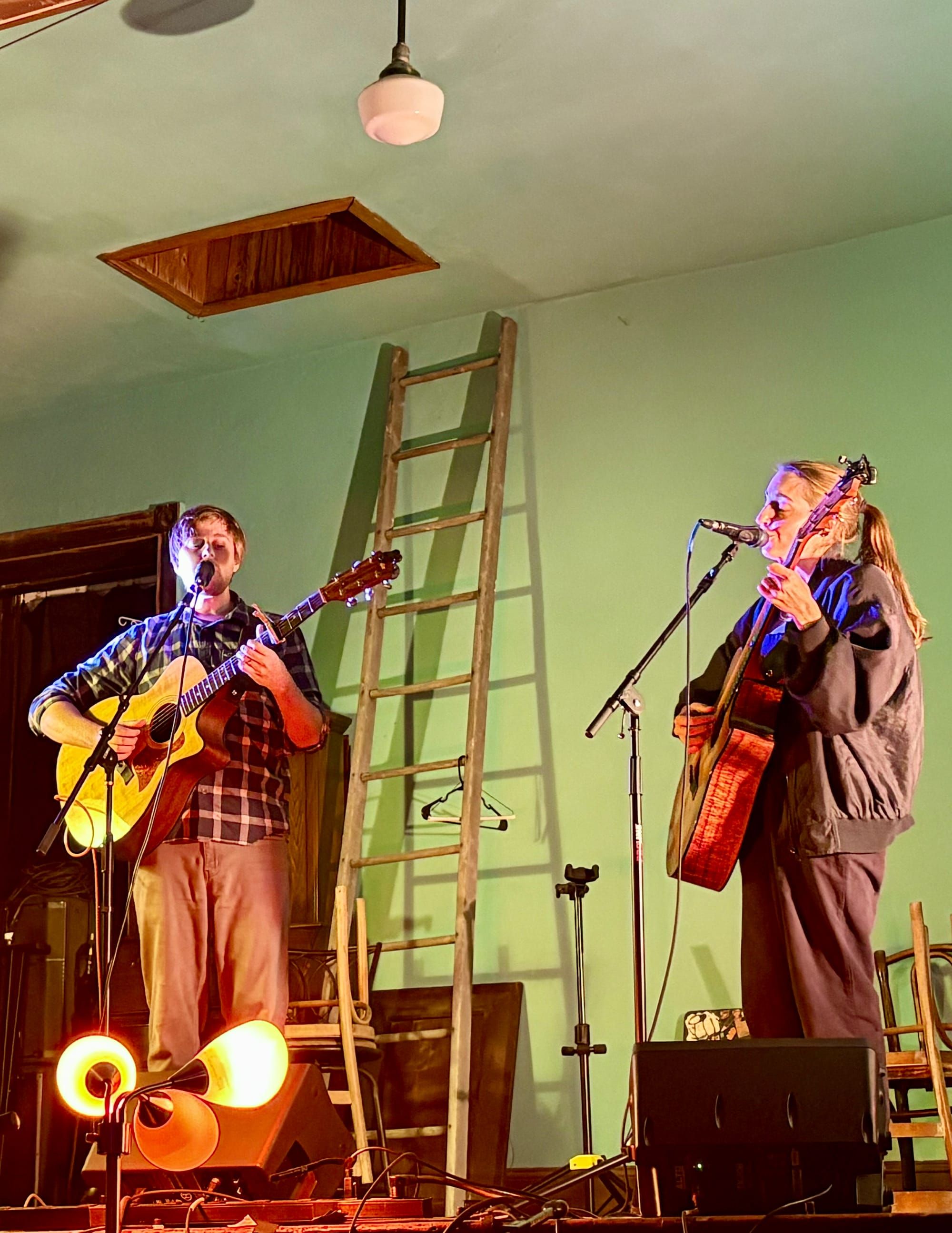
Cricket Blue, Madeline Lee, Ilan Isakov
Harmonie Hall
4372 Fleming St.
Philadelphia, PA
Oct. 3, 2026
The coziness of Manayunk’s Harmonie Hall makes even more sense, and is extra welcoming, now with the abrupt arrival of fall and all its sweater-weather trappings; with old wooden pews set along the wall, folding chairs spread out sporadically amongst couches covered with quilts and blankets, I was at ease from the get-go, ready to sink in and relax. The warm, soft light filling the room was dimmed a little when Madeline Lee took the stage to start things up.
“Hi guys! How’s it going! Pretty good?” Lee said, settling into her chair, then sharing, “This is the first time I’ve played in a couple years.” I may or may not have been at one of those shows – at Abyssinia, I think? – around the release of her album In the Name of Starting Over in 2023. Then she was playing with a band, but last night she took the stage alone, softly thumb-strumming a nylon-string guitar and sometimes singing unaccompanied. (A banjo made an appearance at the end.) Lee mostly stuck to songs from that record, opening with “David’s Fruit,” a voice-only song that could have passed for Jean Ritchie: a honeycrisp-sweet major-scale tune, with refreshing, tight phrasing, nailing little melismas. “I’m so happy, I could cry / I’m so sad, I could cry” she sang, dropping down to the tense leading tone on “sad” – a whole emotional arc of experience in a couplet and a handful of notes. “More Sugar” came next, another would-be hit from that record, a lovely, yearning song that makes no apologies for having a sweet tooth (or a tender heart). Lee’s voice and songs are gentle and sincere, and winningly so – I hope she doesn’t wait another two years before the next set.
Lee was on the bill at the invitation of her Vermont friends Cricket Blue, the self-described “indie chamber folk” duo of Laura Heaberlin and Taylor Smith. I was quickly reminded of artists like Sufjan Stevens and Madison Cunningham; this was only “folk” music in terms of the acoustic guitars and close harmonies. Other than that, it was complex fare: musically, their songs heavily involve classical and jazz-informed harmonies, the structures complex and far from formulaic. (On the first song they played, Smith moved his capo not once but twice – that alone tells the story of their progressive, key-modulating tendencies.) With Heaberlin often playing the lowest part of the guitar and Smith often capo’d up high, the sound conjured the way a composer uses the piano to orchestrate, the left hand and right hand combining into a small orchestra: they were playing expertly-arranged pieces, counter-melodies and polyrhythms set up against one another, with spotless, often-haunting vocal harmonies. An older song called “June” delighted me with its brisk and flighty shifts between the keys of C and G – borrowed chords left and right – and a song from their only-weeks-old, 20-song new album Sweet Animal called “Landfills, Gardens, Nurseries” was such a graphic, poetic, scientifically-detailed account of killing pesky ants that I couldn’t help but feel a little sinister. I was blown away by the sheer compositional clarity and vigor, yet another reminder of how much is possible on a guitar, how endless music can be; knowing that their lyrics are as carefully considered as the music (and that this new album is essentially a concept-record conversation between the pair, each philosophically interrogating their individual sense of death itself, no big deal), I’m excited to dive in more. (Which reminds me: the pair had a cool tendency to, instead of counting their songs off, do a kind of simultaneous lunge, rising and falling together, involving gravity in their shared downbeat. In a small but potent way, it made the emergence of song out of silence a more physical, exciting thing.)
I’ll close with a quick mention and shout-out to Ilan Isakov, who operates Harmonie Hall and played a wonderful show-closing set, mostly on piano and baritone ukulele. Singing his songs in that dimmed, magenta light, Isakov was quite the host, his lyrics invoking myth, saints, and scenes utterly universal in their specificity. I loved these lines from “Those Who Go”:
What I thought was a coin in the rain —
A promise kept from the cold and the wet, the regret, and the remembered pain —
Was just a trick of the light
But from the street I heard the choir
Just for a moment when the door was opened
To the poor and the tired
“Those who go without, let them come in”
To the gray sky and gloom outside today as I write I say: bring on the sweater weather if it means more softly nourishing nights of song like this.


