
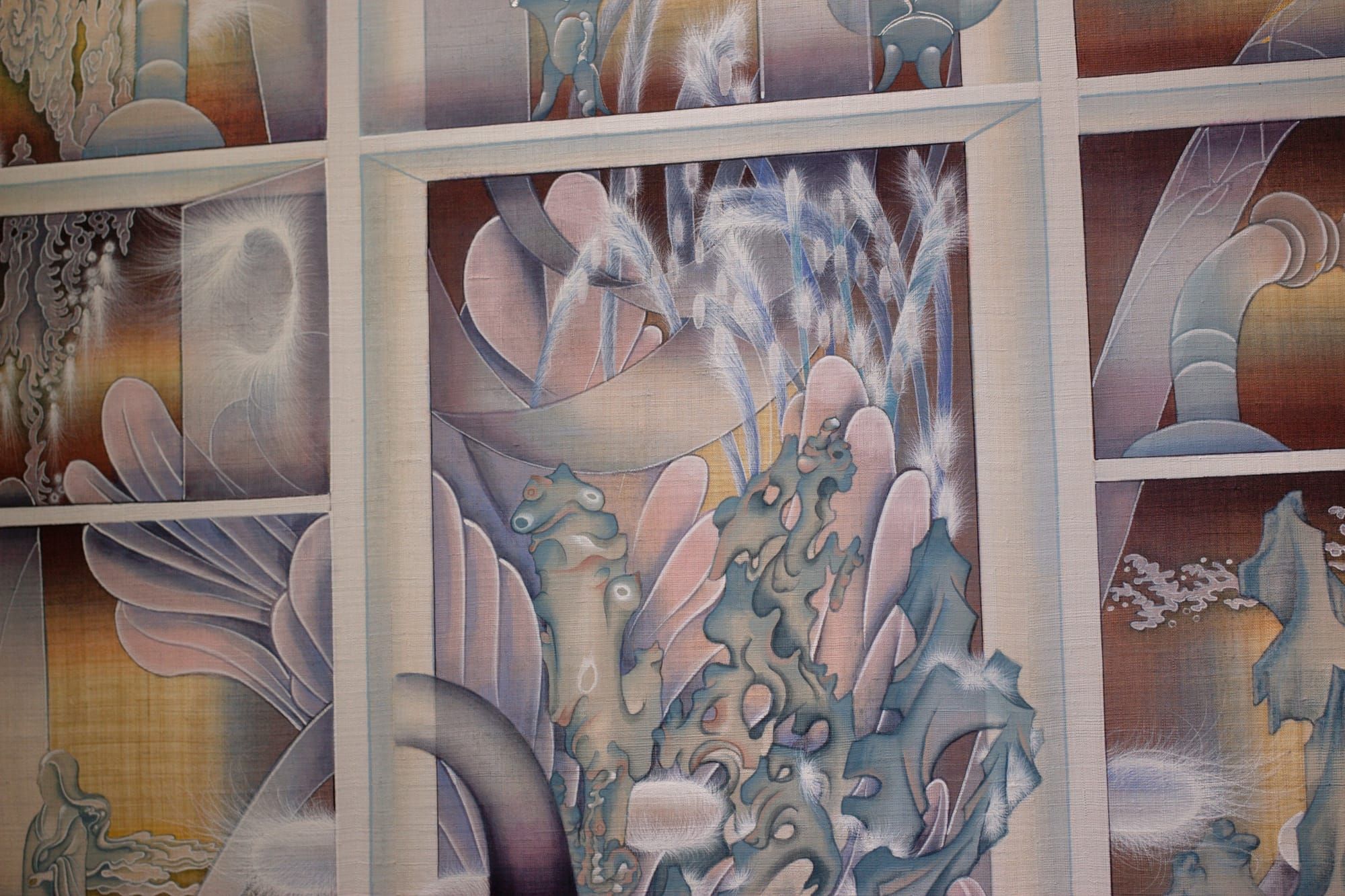
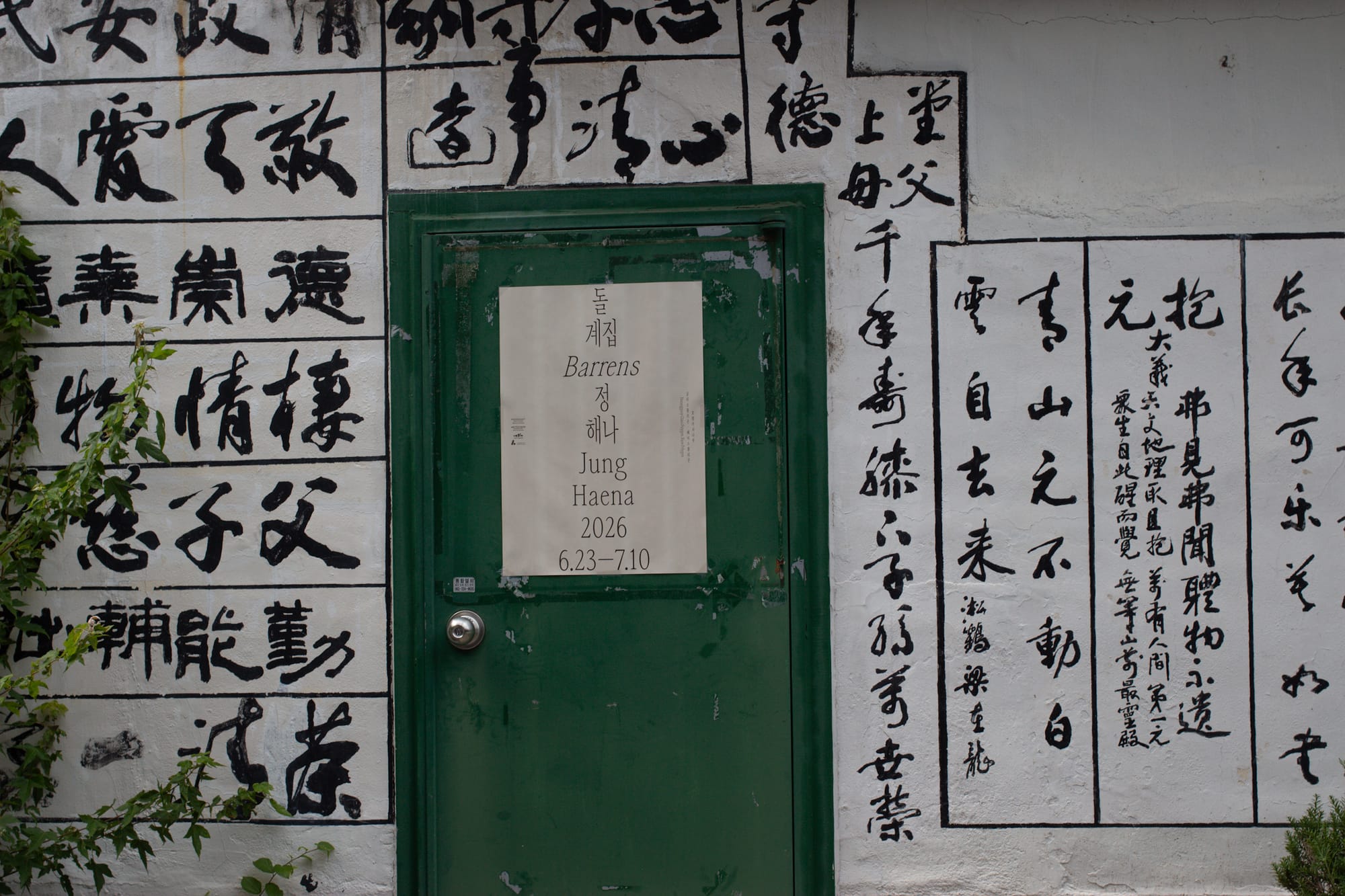
돌계집 / Barrens
Paintings by 정해나 (Jung Haena)
Horanggasy Art Polygon
Gwangju
Through July 10, 2026
(Jisu Sheen recently moved from New Haven to Gwangju, South Korea, where she’s covering local arts and culture for the New Haven Independent and Midbrow.)
On Tuesday afternoon, I found myself in a cool basement beneath the sweltering summer elements. A slice of lamplight fell across the entrance to a room, landing on a painting of cutouts revealing abstract objects on metallic gradients.
At first I thought I’d come at the perfect moment, when the light was centering the painting just right. Then I remembered I was underground. This wasn’t sunlight we were working with.
In this zone of suspended time, the set stayed where it was placed. The perfect moment was…always.
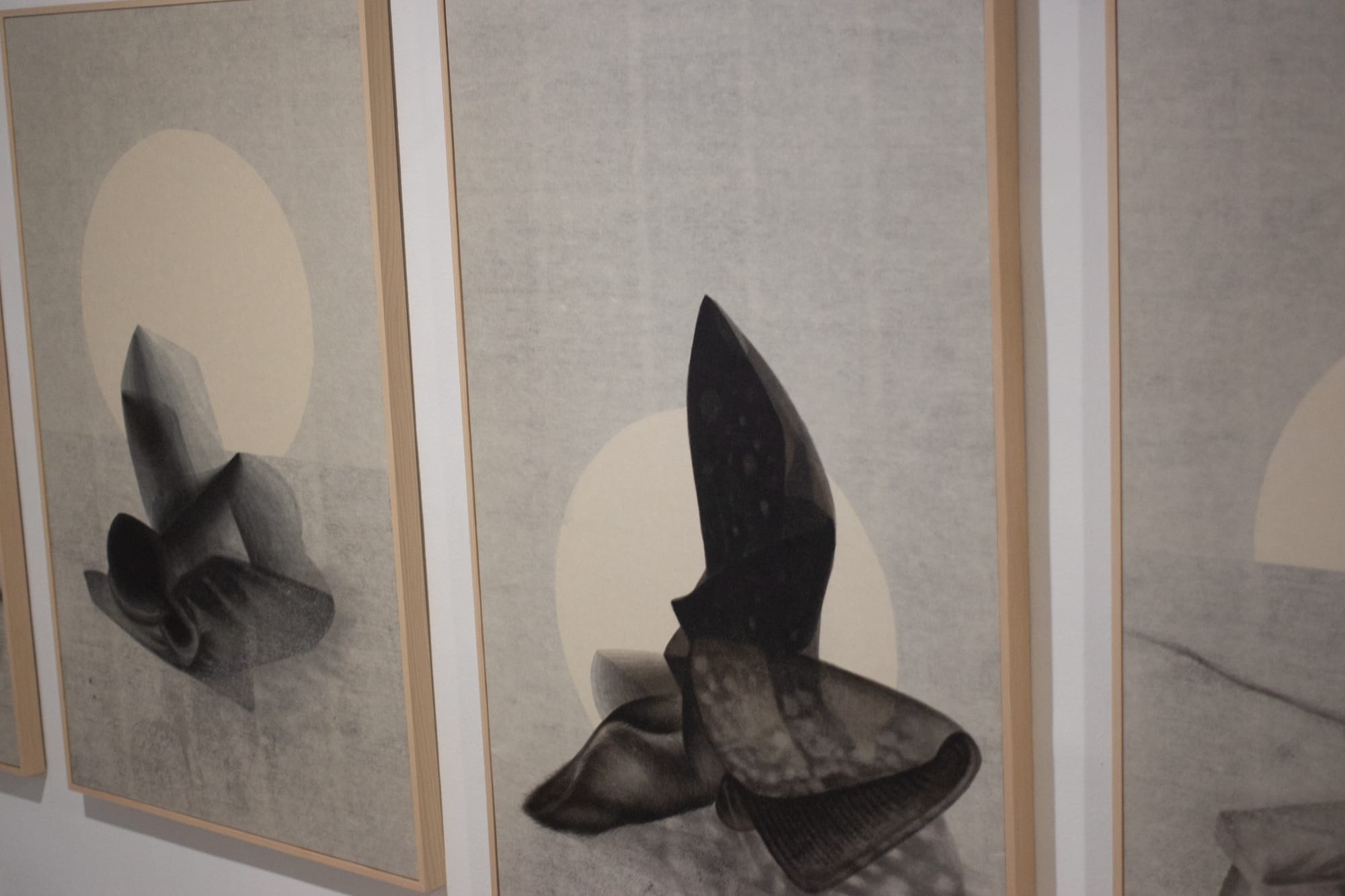
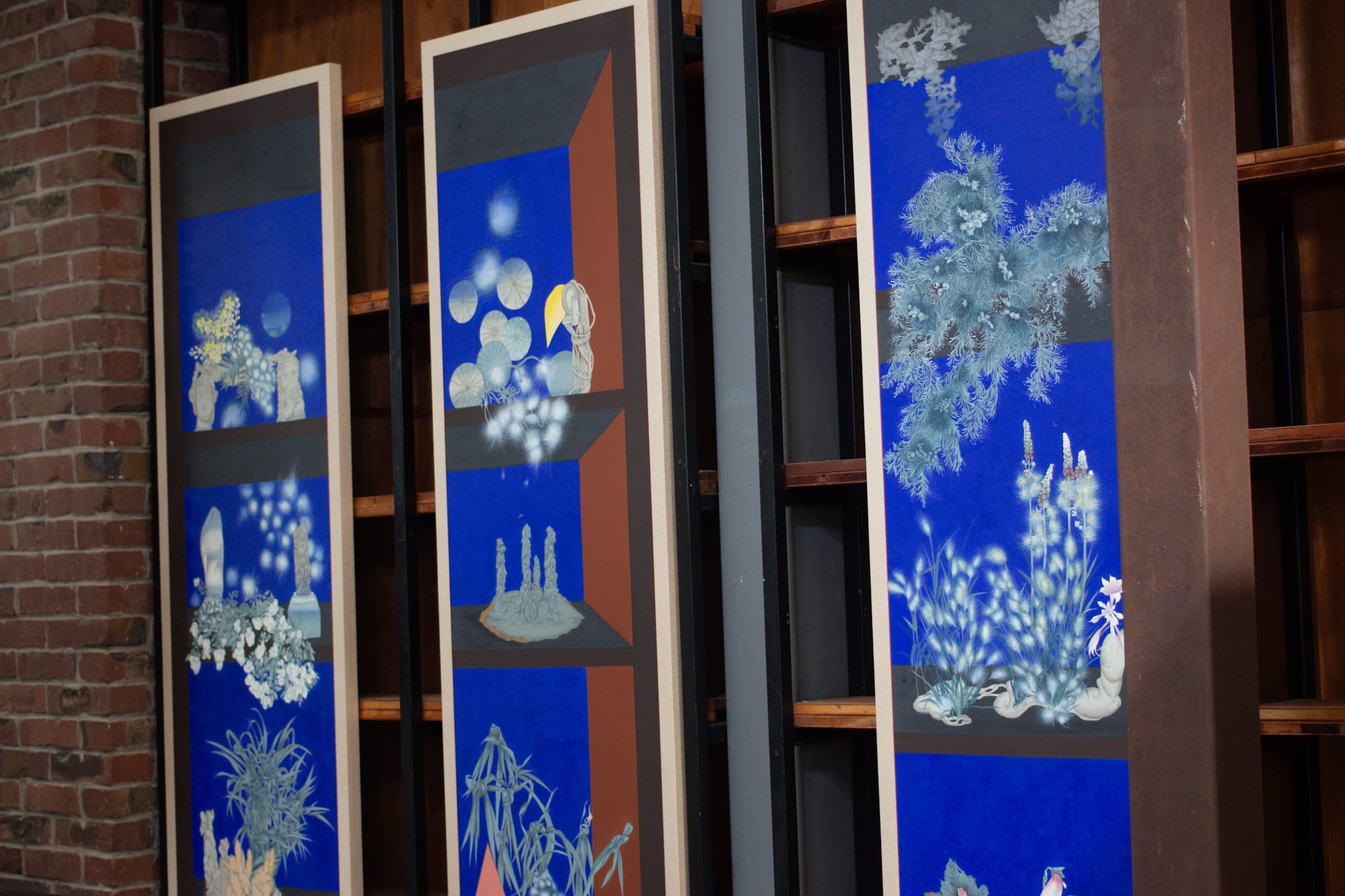
I was visiting the Horanggasy Art Polygon in Gwangju’s Yangnim-dong neighborhood, where artist Jung Haena is showcasing a series of otherworldly vignettes in an exhibit called Barrens. The Korean name for the show, 돌계집, refers to a house of stone. The paintings, appearing as collections of multiples, continued as I climbed the stairs onto the ground floor of the terrarium-like glass venue.
Jung’s assortments on painted bookshelves nod to an 18th-century Korean still-life style known as chaekgeori. Unlike the traditional bookshelf scenes, the items in Jung’s paintings break out of their containers, complicating the clean geometric lines.
This disobedient streak made me think of the truths artists depict by maintaining fictions. For example: Where does one shape stop and another begin?
At the border of the object’s visible form?
Well, that’s in our heads (which doesn’t mean it’s not real). Physical objects continue beyond what we can see, while our eyes’ experience of them ends at their visual edge. Painters can decide how hard or soft to make that line. Sharp perimeters and noncontinuous lighting between layers make elements feel like they’ve come together from different universes.
The objects in Jung’s painted cutouts create a friction of continuity and separation. Inside the lines, their gradients are smooth, like a mirror surface. The edges, meanwhile, are razor-sharp.
Then the organic and the ordered collide in a timeless expression of magic: a glow of light not from the sun, but from some internal source.
Long, fiber-like strands in Jung’s paintings soften oval forms, giving them a blurred, dreamy look through repetitions of crisp lines. These organic elements pulse from the surface of the paintings. They spill over the painted shelves.
The hazy effect reminded me of the grain of black-and-white films. Up close, each dot in a throwback movie still is clear-cut; as a scene, the textures take on a subtle, soft quality.
Metallic purple and turquoise clouds in Jung’s invented landscapes evoke a retro psychedelic vision of the future. Behind the colors, the natural fabric textures of the canvas show through. The veil, as they say, is thin.
Jung’s Barrens is a meditative show, both in its multiples and in the experimentation between what is visible and what’s not. The elements’ shine comes from mysterious sources. Glowing organisms sprout from sterile surfaces. Edges are not what they seem. Here, time stops just long enough to bend the rules of reality.
Sign up here to get Gwangju Midbrow email updates delivered straight to your inbox.


