
Midsummer Night's Nonsense Performance
박세진 (Park Se Jin), A.K.A. 닻 (Anchor)
서로 사랑하세요 (Seoro Sarang Book Salon)
Gwangju
Aug. 7, 2026
(Jisu Sheen recently moved from New Haven to Gwangju, South Korea, where she’s covering local arts and culture for the New Haven Independent and Midbrow.)
Call your smartest friends. We need the world's best and brightest working on this age-old puzzle: Why does heartbreak pair so well with the concept of a habit?
In 2022, Steve Lacy gripped hearts with "Bad Habit," the song that goes, "I bite my tongue, it's a bad habit" (and even worse for fragile yearners, "I wish I knew you wanted me").
Four years earlier, independent musician 박세진 (Park Se Jin), who goes by 닻 (Anchor) in his music, released his own "버릇" ("Habit") in his first album, 사랑이라는 것 (A Thing Called Love).
I heard Park's "Habit" for the first time on Friday at Seoro Sarang Book Salon, an independent bookstore and hole-in-the-wall art exhibition site at the end of an alley in Gwangju's Baegun-dong neighborhood, also known as "Mapgie Town."
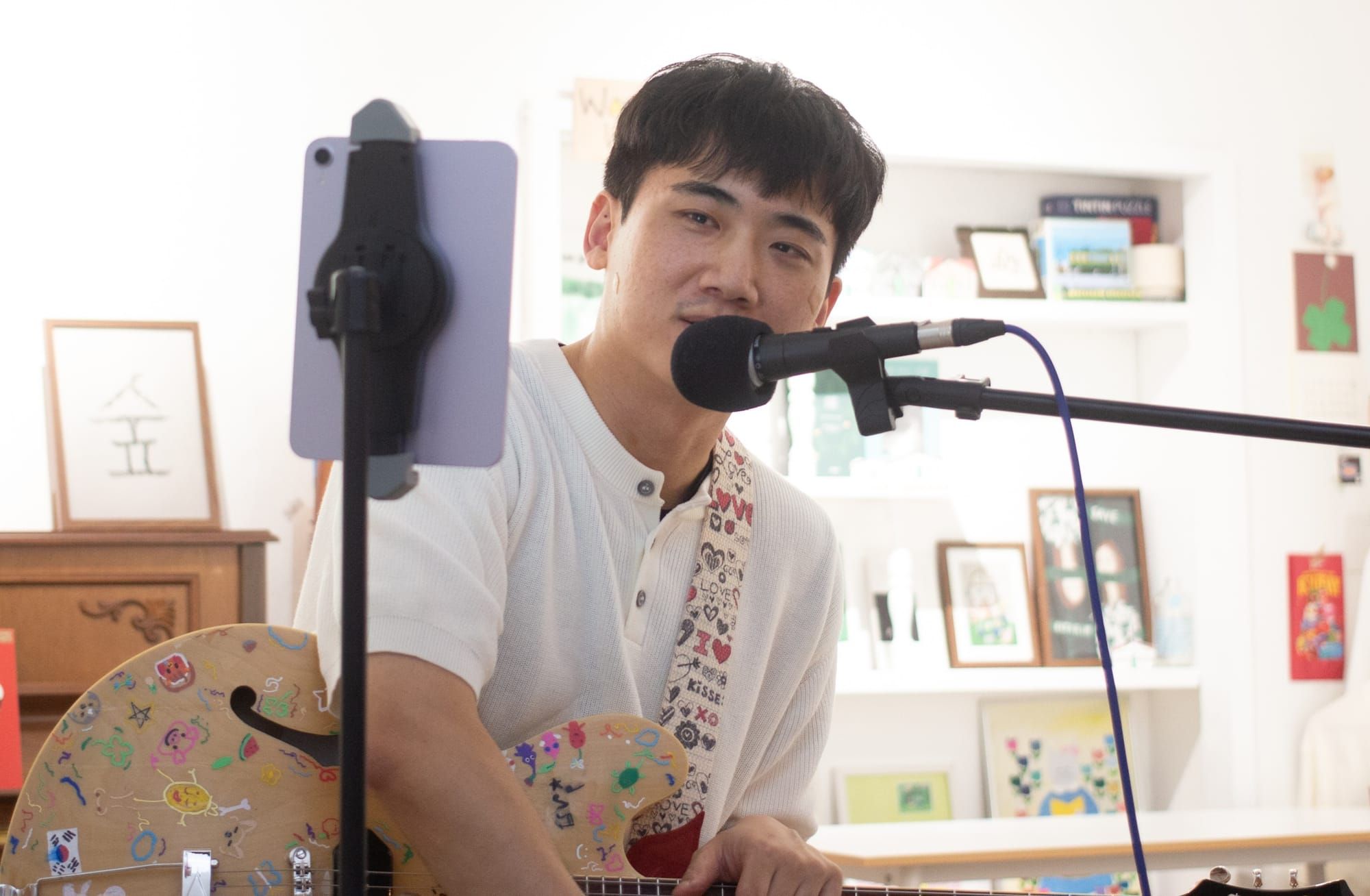
집에 가는 길에/ 눈 감는 버릇이 생겼어, Park sang into the mic after over a minute of build-up in both melody and storyline. In English: "I've gotten into the habit of closing my eyes on the way home."
The refrain had the strong chords of an emo rock ballad and the sentimentality of an acoustic performance. With only his guitar, a stool, and a red amp on the makeshift stage, Park laid out the timeline of a breakup with bare-bones flair.
"It would be great if only five people came," Park remembers thinking as he prepared for the show. Park has played in front of one-person audiences before. Small crowds are fine with him; he has fond memories from busking days.
In a self-admitted challenge for Park's nerves and a cozy turn for audience members sharing the night's summer vibes, the seats in Seoro Sarang Friday night filled almost to capacity.
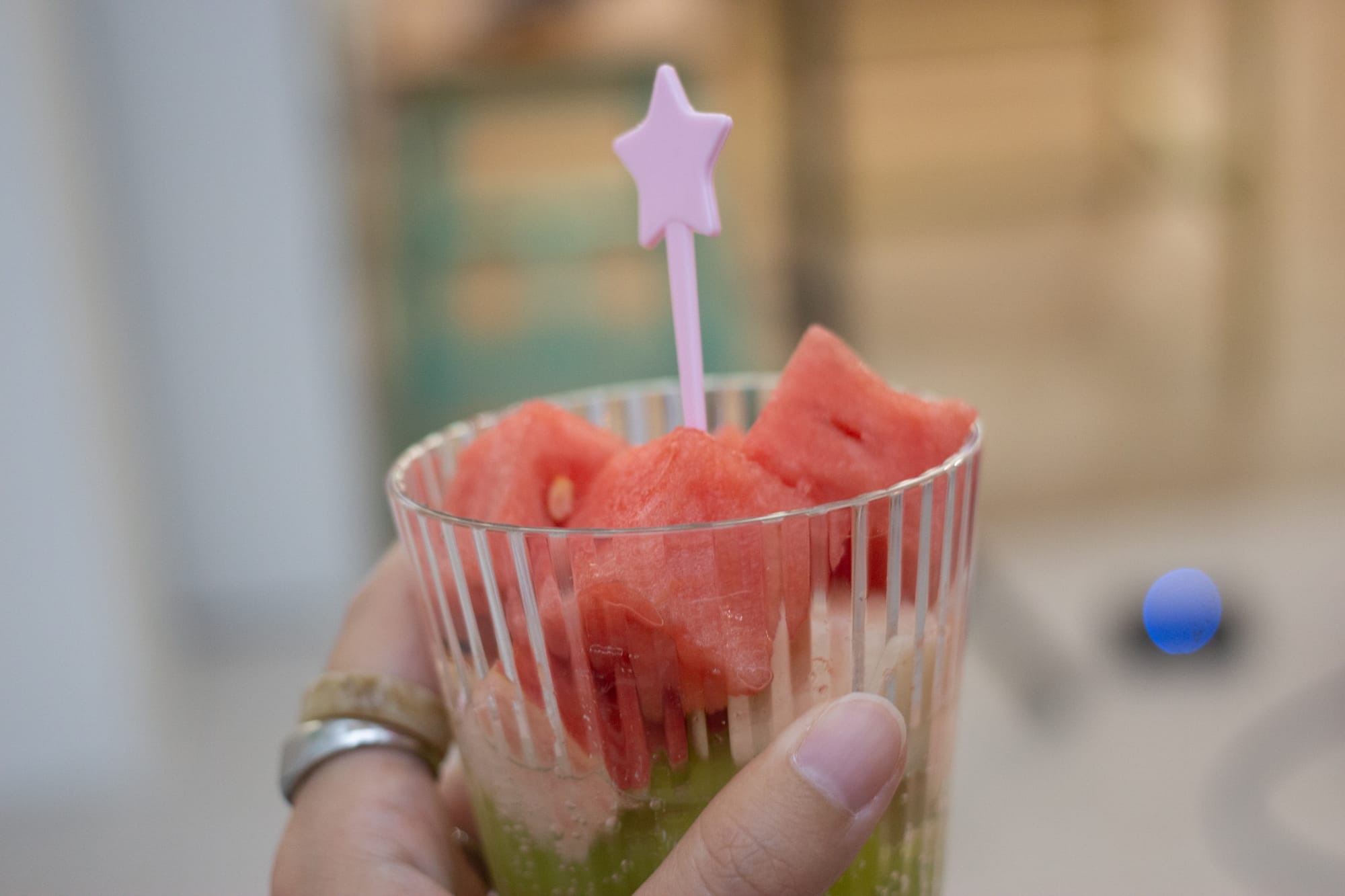
It was, according to Seoro Sarang, a "Midsummer Night's Nonsense Performance." The book salon's owner, 도도 (Dodo), paired the music concert with fresh fruit and a display of ten books related to summer. Each attendee got back half of the cover fee, a modest 10,000 won ($7), in the form of 5,000-won coupons to use at the store.
Park's "Habit" gets into the details of everyday routine: a bench, a smell, a tone of voice. Is he closing his eyes to remember the sensations of a love lost? Or is it a harbringer of splitsville that he knows the road so well he doesn't feel the need to look? Maybe the riddle is a bit like Julia Jacklin's 2019 tearjerker "Don't Know How to Keep Loving You"("...now that I know you so well," the lyrics continue).
Park was born and raised in Gwangju and moved north to Gyeonggi province for work a decade back. Now he's an elementary school teacher, making songs together with his students.
Being far from Gwangju also means Park is physically far from the friends he made in his years in the local music scene, though he still keeps in touch. The night at Seoro Sarang Book Salon was a chance for everyone to be in the same room again. He promised to try to come back soon—maybe once a month.
"Your guitar is pretty!" someone called out from the crowd.
Park showed off the front and back of his guitar. It was covered in bite-sized doodles by elementary schoolers: creatures, stars, a watermelon.
Then he shifted our attention to the guitar's strap, which had hearts and romance-related words like "love" and "kisses." He had gotten it in honor of Seoro Sarang Book Salon, whose name means "love one another" in Korean.
Park's preparations even extended to gifts for the audience: phone grips for everyone and, for a handful of lucky attendees, a selection of the prettiest bookmarks he had gathered from a bookmark-making project going on in one of the book salon's side rooms.
Park closed his eyes to repeat the high notes of the chorus. Though he had told the crowd multiple times he was nervous, his singing voice came through clear. Maybe it was all the practice from completing "Habit" early in his music career.
The world may never know why familiarity gets under listeners' skin quite how it does. We slide into habits without thinking and make ourselves comfortable inside them.
After leaving the show, I took a detour on my way home and ended up at a book and whiskey bar where I met interesting strangers. Thinking back, I might have been inspired by Park's fruitful discomfort. Habits are nice; breaking them can be even nicer.
Sign up here to get Gwangju Midbrow email updates delivered straight to your inbox.


