
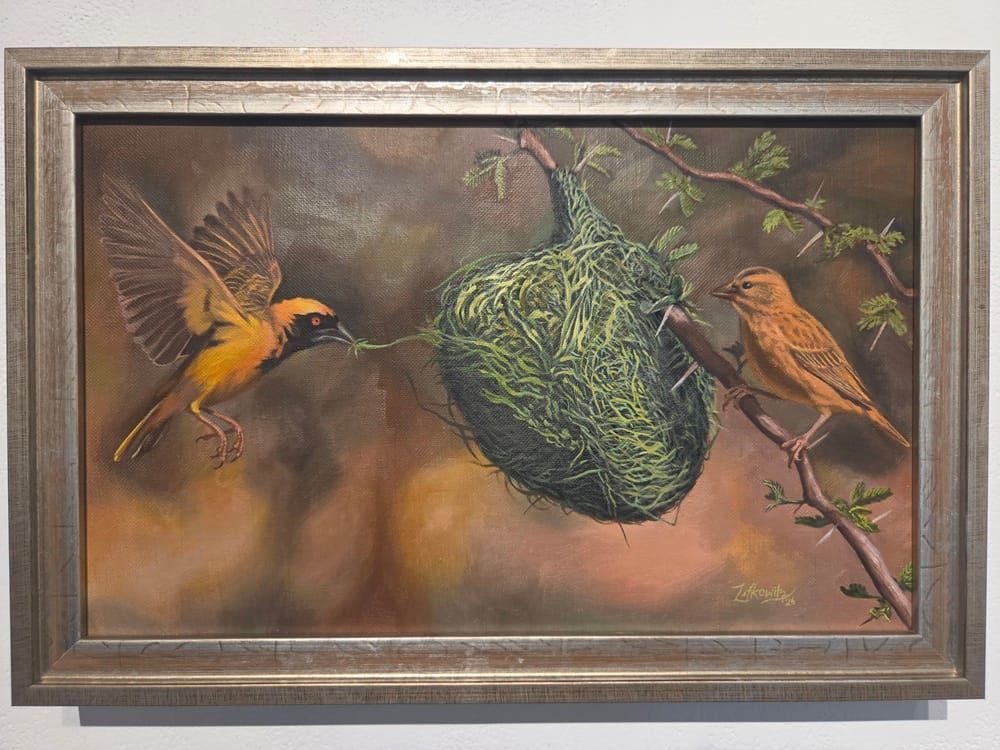
There’s No Place Like Home: The Wonder of Animal Dwellings
Donald and Linda Silpe Gallery
University of Hartford
West Hartford
Sept. 14, 2026
It turns out the people who draw the illustrations in science books are pretty good artists.
That’s obvious, right? Then again, it took the new exhibition at the University of Hartford’s Silpe Gallery for me to consider that actual people draw the pictures in textbooks and manuals.
I don’t mean that as an insult or dismissal, but rather as a compliment. Scientific illustrations are like technical writing: When done correctly, the human being fades away. Only the information remains. After all, you don’t think about the person who wrote the instructions on the back of your Hot Pocket, because you’re not supposed to.
There’s No Place Like Home exhibition centers the artists who have helped us to understand the natural world around us. The exhibit features the artwork of the members of the Guild of Natural Science Illustrators, an organization that represents artists engaged in communicating science through visualization.
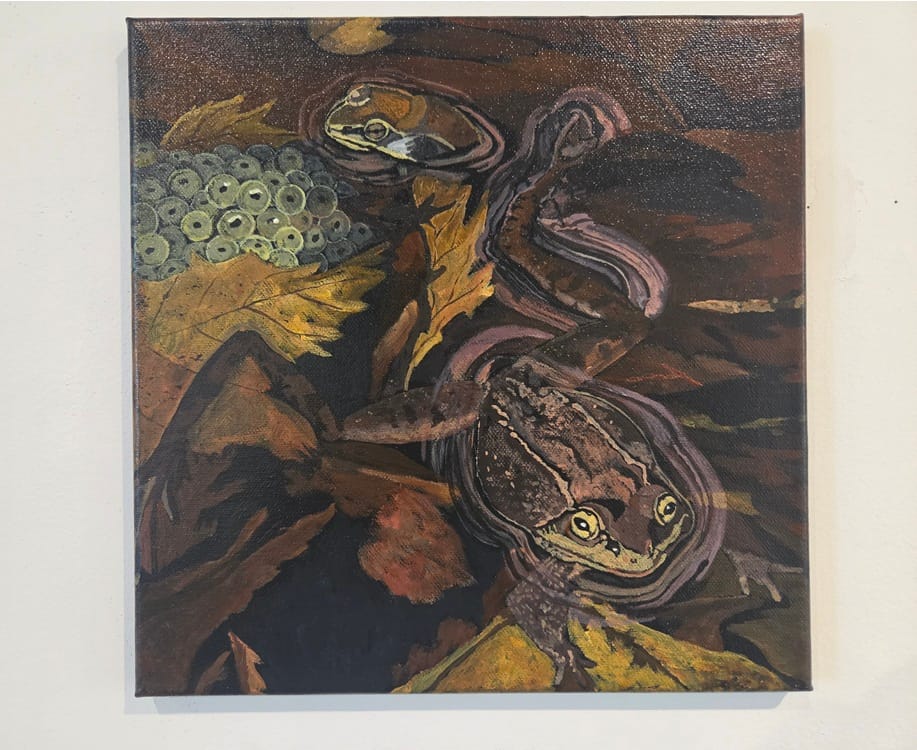
Artists like Melissa Guillet applied their talents to the exhibition’s theme of animals in their homes. Her work Frog Moon features the wood frog laying its eggs in a vernal pond, which forms from rain and melting snow in the winter and spring and completely dries up in the summer.
Guillet’s understanding of environment and physiology gives the painting remarkable realism. Her lavish use of the various shades of brown provide texture and depth to the image. Despite similar coloring, Guillet keeps every element distinguishable, from the leaves to the rocky bottom of the pond.
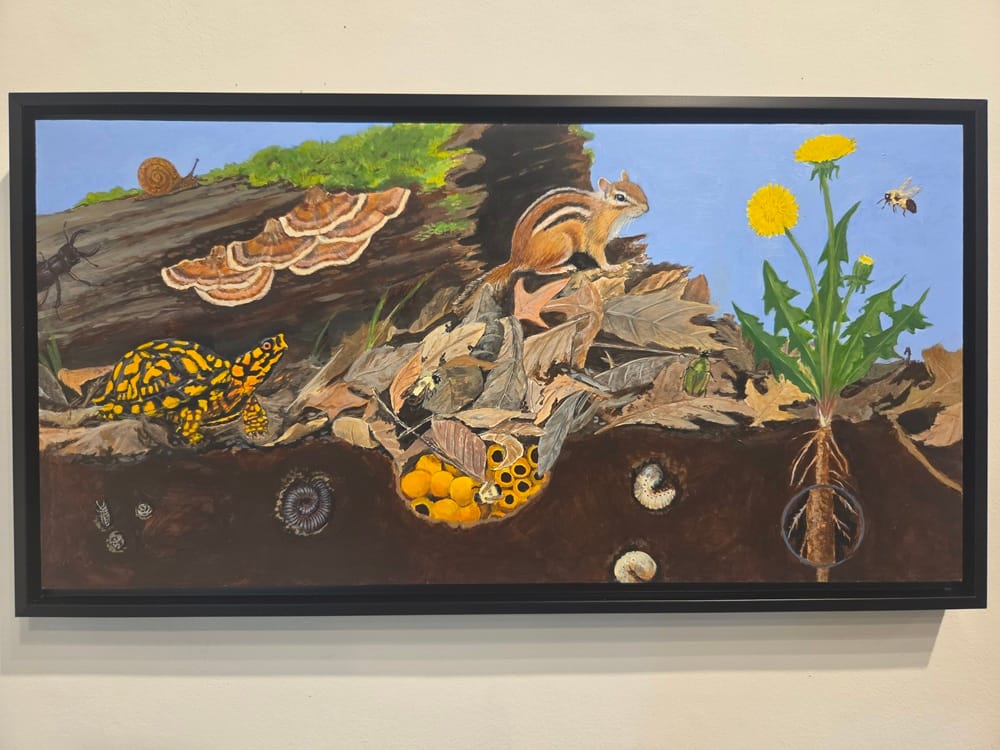
Susan Brand’s Life in the Leaf Litter is a two-part work that shows how a host of creatures have turned trees, both living and dead, into a home. Brand’s work combines scientific accuracy with natural whimsy, displaying both the life forms we love (chipmunks, dandelions) and the creepy crawlies underneath. A nice touch in her work is the inclusion of moss and fungi, two elements a traditional artist might ignore, but a scientist like Brand shows how important they are to the survival of the cute creatures.
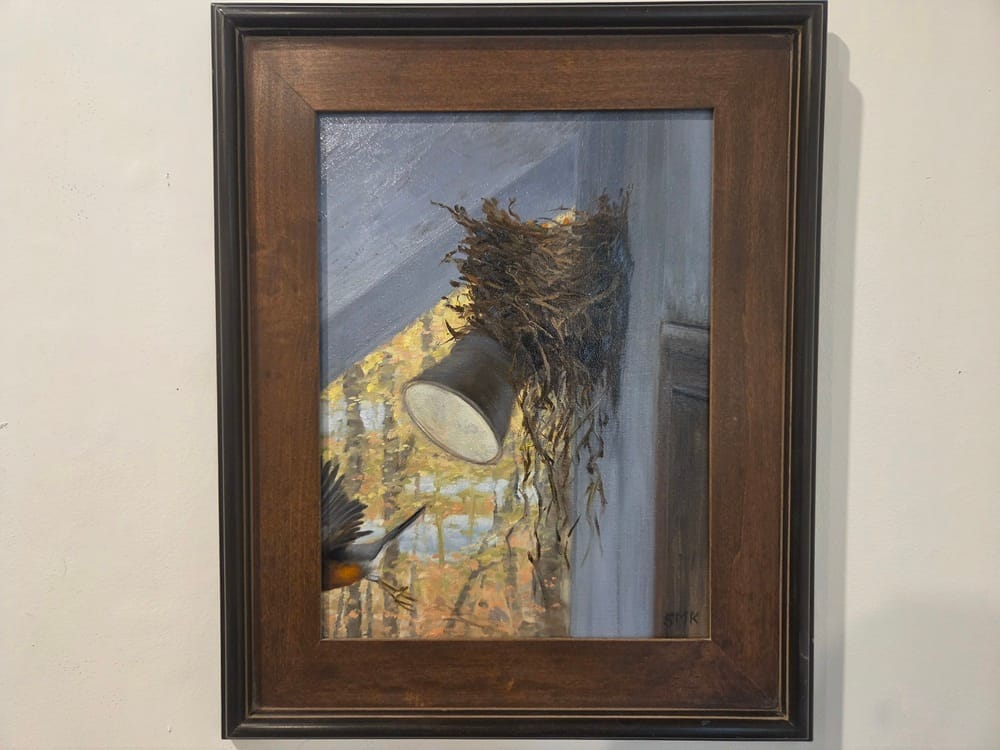
There is tension between the human and natural worlds though (a distinction I’m becoming less and less certain of, although that’s a different topic), and artist Sigrif Knemeyer captures it in her piece Where we are allowed to stay. Knemeye’s artwork is stunning, showing detail and texture in the bird’s nest juxtaposed against the sterile sameness of the human construction it rests on.
I love this painting because I had pigeons living on my back porch for one season. They built a nest on one of the support beams. I thought it was awesome to have a part of nature I could visit whenever I wanted. Until the birds started pooping everywhere, that is. There are reasons we’ve separated ourselves from most of nature.
There’s No Place Like Home shows us the human side of animal habitats, the creativity of the people who helped teach us about the world even though we’ve never met them. Check it out firsthand.
NEXT
There’s No Place Like Home continues through Oct. 17.
Jamil goes to learn what we should do with all this plastic.


