
By Allan Appel
In God We Trust: The Knights of Columbus and the American Experience
Blessed Michael McGivney Pilgrimage Center
1 State St.
Through Sept. 5, 2027
“I promise and declare that I will, when opportunity presents, make and wage relentless war, secretly and openly against all heretics, Protestants and Masons, as I am directed to do, to extirpate them from the face of the earth; and that I will spare neither age, sex, or condition.”
Those words are contained in what became known as the “Bogus Oath.” The virulent and widespread anti-Catholic screed dates back to 1912. It was similar to a Jewish canard, the Protocols of the Elders of Zion, which emerged first in Russia around the same time.
You can read these troubling words, in incendiary pamphlets and calumny-filled broadsides written around 1910, among other revelatory historical artifacts that are part of In God We Trust: The Knights of Columbus and the American Experience.
The exhibition of some 200 items on view at Knights of Columbus Museum (now officially re-named the Blessed Michael McGivney Pilgrimage Center), curated by Bethany Sheffer .
The Knights of Columbus, a fraternal organization founded in New Haven in 1882 by Fr. Michael McGivney, wasn’t in existence at the writing of the Declaration. But the organization wanted to make sure to be part of the state’s 250th U.S. anniversary activities, Sheffer said.
The Bogus Oath emerged shortly after the Knights of Columbus added “patriotism” as a core pillar in 1990.
The K of C helped young men, including many Irish and then Italian immigrants, assimilate into American culture. Givney established K of C with a basic mission: To offer life insurance to precariously employed young Catholic factory workers and to smooth the edges of fitting into American life while keeping them within the fold of the faith – and out of the clutches (!) of competing fraternal organizations like the Masons!
That’s why K of C is technically a lay (rather than church-run, fraternal benefitsorganization, with the double aim of providing financial assistance to members while performing general charitable works. It also conducts social activities akin to other immigrant-focused mutual aid societies that arose in late 19th Century America.
Religious bigots in America weren’t having it.
The deleterious effects of the Bogus Oath contretemps and its aftermath enduring through the 1960s, said Sheffer.
The best-known single incident is perhaps when JFK, running to be the country’s first Catholic president, had to convince the electorate that his loyalty was to the Constitution and not to the Pope.
Sheffer said she was clearly aware of the Bogus Oath episode. She was still surprised to learn in putting together the exhibit how far the hatred of the K of C went. “It kept popping up.”
The main focus of the exhibition less about anti-Catholic prejudice. It focuses more on how U.S. history affected K of C’s creation and direction over the years.
It features the “tom tom” alarm clock produced by the New Haven Clock Company and a glistening hand saw, a new purchase by the K of C museum, specifically for the exhibition
Sheffer said those objects reflect the story of working-class and poor Catholic factory employees who were always a paycheck, a serious illness or accident, or a plant closing away from abject poverty. And what was to be done with the widow and the children?
Enter Father McGivney basically with the idea of life insurance for the to be provided by the K of C. Life insurance had been around. But now it would be available to Catholic working men age 40 or below, paid for through the accumulating membership dues in a fraternal organization.
It began to spread from New Haven to other Connecticut towns. Today there are 2.2 million Knights worldwide.
The Masons and Odd Fellows and other fraternal groups during this period were attractive to young Catholic men, Sheffer said. In part, that was because that’s the way you met people in America, old-fashioned 19th century networking, and thereby got out of the factory and got ahead.
McGivney found the ideas of these organizations incompatible with Catholic belief, and so the Knights of Columbus emerged.
It embraced “Columbus” for its name as a demonstration of Catholic-American patriotism — an aspiration the Bogus Oath business sought to undermine and discredit.
The first room of In God We Trust features a copy of John Trumbull’s famous painting of the signing (actually, the handing over of the committee’s draft to John Hancock for review) of the Declaration of Independence. Beside it is a copy of the Declaration displayed in a floating case, visible from both sides. You can see there is actually a bit of writing on the back of the document.
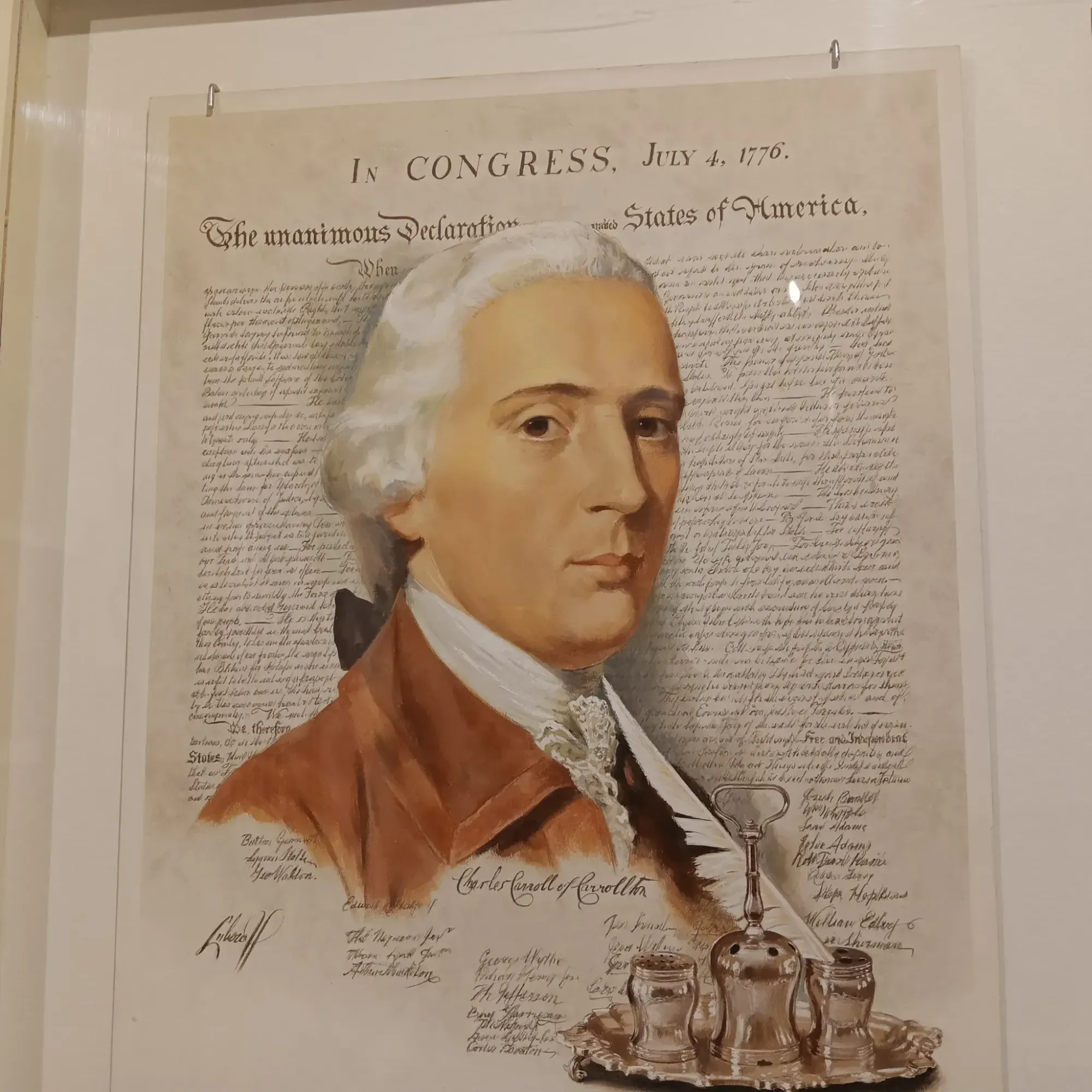
Across the K of C’s cozy gallery and peering at the Declaration, with a bit of a sidewise glance, is Charles Carroll, the only Catholic who signed the founding document among 56 attendees of the Continental Congress.
Two Catholics signed the Constitution – Daniel Carroll and Thomas Fitzsimons of Pennsylvania.
“If a Catholic signed the Declaration,” said Sheffer, “you know he’s going to be from Maryland.”
Maryland was founded in 1634 by George Calvert, also known as Lord Baltimore, as a safe haven for persecuted Catholics. The great tide of Irish immigrants to arrive on American shores, including the parents of McGivney, dated from the mid-1840s following chronic famines in Ireland.
The K of C exhibition also includes buttons and brass fittings from 19th century Waterbury factories, and saws, knives, and other metal implements that New Haven’s Winchester Repeating Arms Company turned to make after World War One. Here the focus shifts: You see the effects of immigration and of the largely unregulated industrialization of the American workplace on the creation and evolution of the Knights.
As a young man, McGivney worked in factories making spoons. He was a seminarian when his father died; he had to interrupt his studies to go home because there was no one to earn a living and to care for his mother. It was the kind of family that needed insurance.


