
Devotional Alchemy
63 Audubon St.
New Haven
Through Nov. 19, 2026
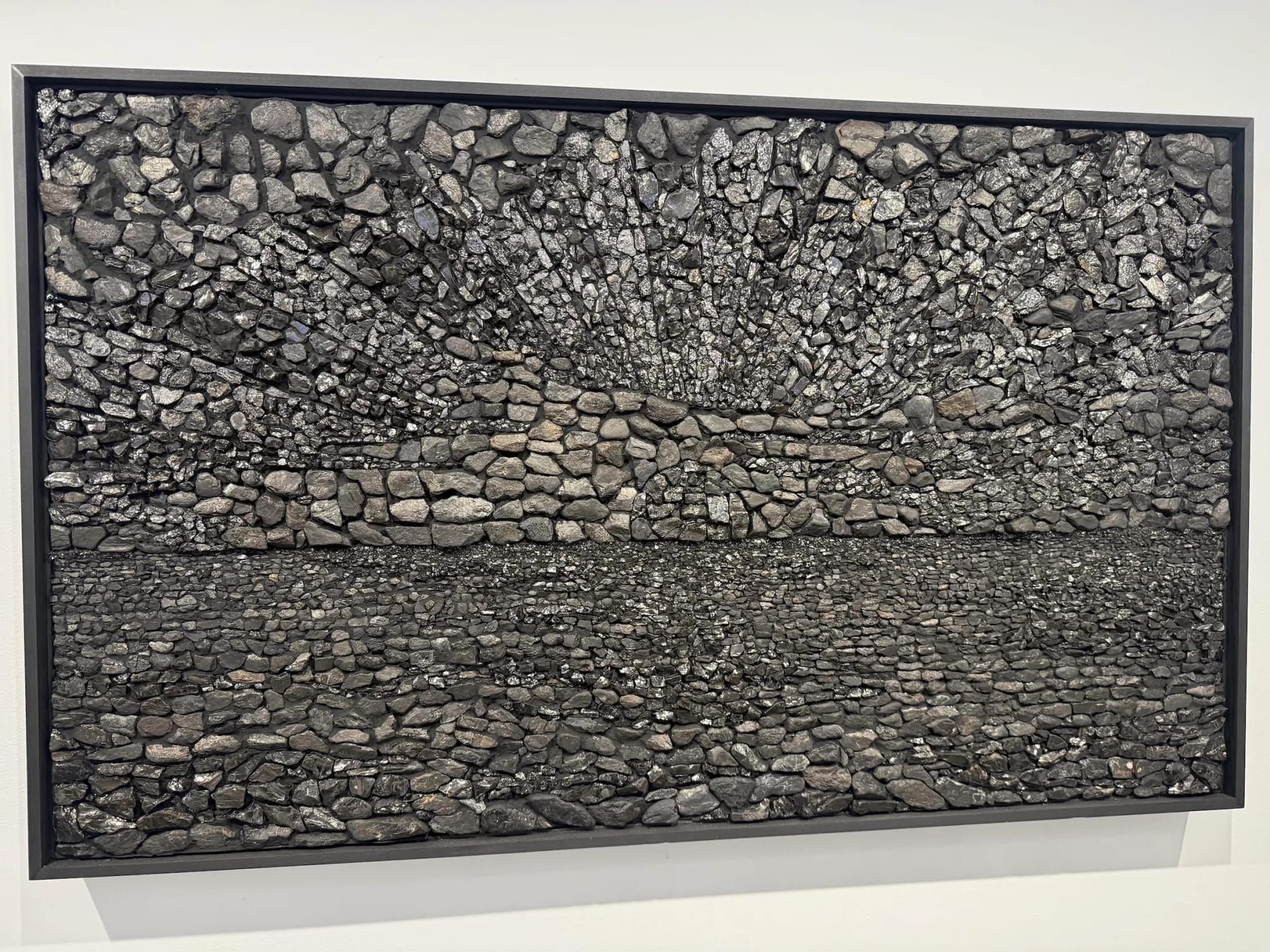
A canvas arrayed with hundreds of jagged gray-black rocks stopped me in my tracks at the Devotional Alchemy art exhibition on Thursday evening.
“Mourning Sun” by artist Joseph Smolinski featured sea coal mounted on a panel.
What transfixed me was that though each rock was distinct in shape, size, even color, they communicated a language of cohesion when put together. I felt like an archaeologist who just stumbled on an undiscovered rock formation.
The artist placed the top-most coal in an angular pattern, radiating towards the center of the canvas. Larger pieces of coal centered the frame. Just below were rows of impossibly tiny fragments of coal that gradually grew to slightly larger stones.
The effect was arresting. The piece looked like it was glittering and undulating a bit on the wall as light from the exhibition space glinted off the coal. I was fascinated that “Mourning Sun” was entirely composed of the earth. With the imposition of art, somehow the artist managed to contain materials that are inherently unruly, though each stone retained its character.
I wondered if Smolinski’s piece was saying the “sun was mourning” because of humankind’s poor treatment of the earth.
“Mourning Sun” spoke to a larger theme within Devotional Alchemy. Each piece selected by the curators was distinct in its form and subject matter. Perhaps because the curators — Kristy Hughes, Blake Eason, and Maria Markham — are multi-dimensional artists themselves.
When Ben Weathers, galleries and exhibitions manager at community art space 63 Audubon, sent out a search for curators for a show, Blake Eason, studio manager for esteemed artist Titus Kaphar, was one of the multi-hyphenate artists tapped. Eason said that over the course of many weeks, he and the other curators pored over artwork from about 60 New Haven area artists and selected their favorites through several rounds.
Eason found the task to be challenging because it was his first time curating a show and there was such a large breadth of work. It took them a while to settle on the title, Devotional Alchemy.
The alchemy part, he said, fits “because we’re thinking about the collection as the different types of materials that people are using from Earth,” as well as “varied pigments” and “technology.”
According to Merriam-Webster, alchemy means “a power or process that changes or transforms something in a mysterious or impressive way.”
As for the devotional part of the title, the program states, “For all artists, a creative practice is an act of devotion.”
Eason noted that though each featured artist used a different medium, they are united in that they want to make viewers think and feel something. The collection speaks to art’s ability to transmute thoughts and emotions, as well as the human impulse to imagine and invent.

Artist Jason Ting’s “Near Radiance” spoke to humans’ capacity for invention as he utilized a large screen to display his nearly 12-minute digital animation via HD video. What I saw on the screen upon entering the exhibition was markedly different than what I saw when I exited.
First, I saw a black screen with a constellation of blue light at its center. The ball of light looked like a fantastical fireworks display or even some unknown deep-sea anemone. When I left, the screen looked like an electric watercolor. Streaks of blue, orange, yellow and white light mixed with black cascaded down the screen. It was thrilling to know that I wouldn’t be able to guess what would appear on the screen next.
Say what you want about technology, but what it offers us in the way of art-making possibilities are endless.

The next piece I viewed both amused and unsettled me: “The Suit That Bends Light” by Edwin Gendron. The oil on canvas features a man clad in a multi-colored suit jacket and scarlet dress pants. He’s standing stiffly in a lush green meadow, his arms by his sides. With his shining side-parted brunette hair and black tie, he looks like a businessman from the 1950s.
But the upper half of his body contorts unnaturally to the right, giving his suit jacket the effect of a rainbow. His shadow behind him is also curved on the grass. The trees, tranquil meadow and the blue birds resting on the grass appear to be painted with freer, broader brush strokes. Meanwhile, the rainbow suit jacket on the man is painted with precise lines that signal rigidity.
Though I couldn’t quite decide what this piece was saying to me, I felt a lack of joyfulness emanating from it despite its vibrancy. The fact that the brightest part of the canvas was bent in this unnatural shape made me feel uneasy. I felt like I was watching beauty being marred. The painted man’s expression was also creepy, his lips curled in a sardonic grin.
As uncomfortable as I might have been, the piece still made me feel. And that is all I ask of art.
Desiring to view the art untouched, I waited until I got home to read the exhibition’s program. I loved that I learned something new. Laurel McLaughlin, chief curator at Tufts University Art Galleries, shared the following note about Smolinski’s “Mourning Sun”: “Sea coal was likely mined in the southern U.S. and shipped to the historic and global port of New Haven. The coal now mixes with the sifting sands of northern shores, often unnoticed by human eyes.” McLaughlin goes on to say that “Mourning Sun” was arranged to evoke a sunset.
It was wondrous to me that Smolinski could elevate such a looked-over material. It gave me the opportunity to really see the beauty in something I would normally walk right past. And isn’t that the alchemy of art?
Perhaps that’s why Eason’s greatest hope for Devotional Alchemy isn’t simply that visitors appreciate the artwork, but that they recognize the creative possibilities within themselves. “I want people to feel empowered in knowing that they can create,” he said.
After all, if a handful of forgotten coal can become something that stops a person in their tracks, imagine what else is possible.


