
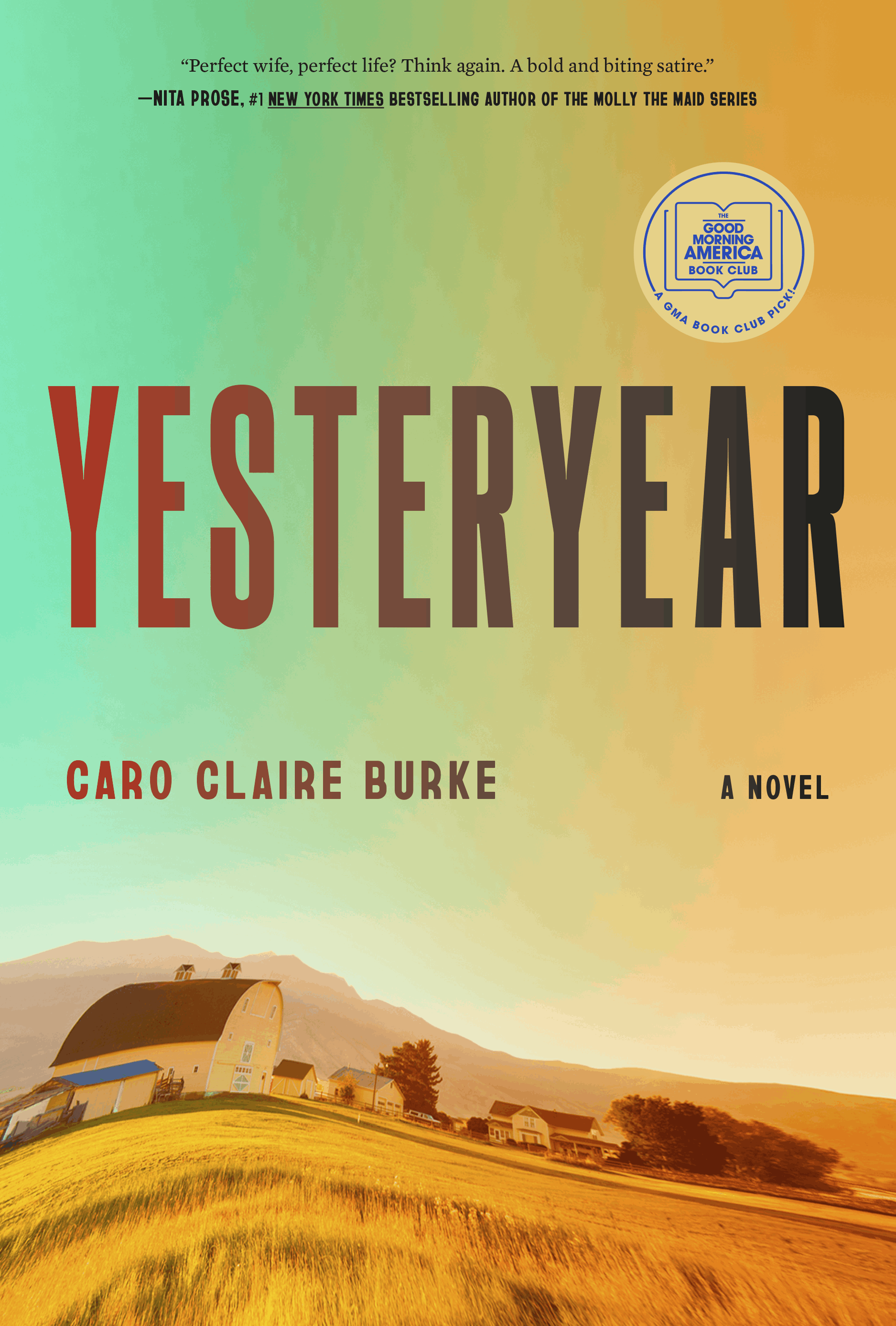
""Yesteryear"
by Caro Claire Burke
Alfred A. Knopf
Sometimes a novel is such a zeitgeist-y sensation that you feel like you have to read it – just so you can participate the cultural conversation happening around you.
Caro Claire Burke’s “Yesteryear” assumed that mantle in recent months, and it’s no mystery why. Natalie, the book’s prickly protagonist and narrator, is a trad-wife Christian social media influencer who lives on a huge, supposedly organic family farm in Idaho. (Think Hannah Neeleman's Ballerina Farm in Utah.) Among the things her millions of followers don’t see are the two live-in, full-time nannies who care for (and home-school) her five children; a talented college dropout from Brooklyn who produces her idyllic videos; the containers of pesticide hidden outside the barn; the ultra-modern kitchen appliances tucked away behind rustic facades; and the farm's many migrant workers.
Natalie may claim herself "a flawless Christian woman," but in the book's first chapter, nastiness and violence simmer right at the surface. Of her farm's chicken coop, she says, "I loved our chickens. They were domesticated as dogs, as harmless as toddlers. Sometimes I went out to the coop just to sit with them. I liked to stroke their silky necks, let them peck softly at the feed in my cupped palms. We'd be killing them soon. In the darkness, my mouth watered."
If this feels blunt and heavy-handed, well, there's more where that came from.
But I'm getting ahead of myself.
After a bitingly fun, exposition-packed opening chapter, Natalie wakes up to find herself in the mid-nineteenth century, living in the conditions she'd long only pretended to replicate on social media, with a family that vaguely resembles her own, but not exactly. Her husband, "Old Caleb," is brutish and cruel; her oldest (preteen) daughter is a workhorse who regularly eyes her mother with disdain; and the two young sons are being led down their father's "manly" path, spending their days with him. Only the youngest daughter, Maeve, seems to offer Natalie moments of tenderness – when Natalie's not freezing her fingers doing the laundry outdoors, or getting her foot caught in a steel trap while trying to escape, or making terrible-tasting bread.
The dramatic question driving the novel's plot is: How and why did this baffling time-jump occur?
As narrative engines go – Burke alternates chapters between the current time and Natalie's life in the distant past – this is a pretty good one. At first, Natalie's unapologetic, condescending meanness toward, well, just about everyone feels bracing. Women and female characters both suffer from the onerous weight of needing to be liked, so seeing the world through Natalie's narrowed, judgy eyes feels, for a time, fittingly countercultural, as does her open hatred of motherhood.
Indeed, Natalie believes that every mother that came before her has lied about their experience. When she turns to her mother in a low moment, she asks, “How were you always so good at everything? The house was always clean. You always got dressed and put makeup on. We always had outfits planned for us. How did you do all that?”
Natalie's mother – a single, hardworking and devout parent who'd publicly assumed the role of widow when her husband left her – says in response, "I would imagine I was being watched. … I pretended I had a little audience sitting on the couch with me. Watching me vacuum or take out the trash. Cheering me on!”
This moment illustrates what may be "Yesteryear"'s biggest achievement: highlighting the exhausting, performative nature of womanhood and mothering, where everyone's watching and judging (not cheering) you at all times. You needn't be a social media influencer with millions of followers to feel you're always under scrutiny. All it takes is a fussy kid's breakdown at Target, or forgetting your child's coat on a stressful winter morning.
That having been said, the satiric novel's big twist, when it comes, beggars belief, and flirts with a perhaps-too-clever-by-half contrivance. But that's not what really put a bee in my prairie bonnet.
No, my primary objection to "Yesteryear" is that instead of offering some surprising insights about what the interior life of a trad wife might look like, by way of a complex, fully human, three dimensional character, Burke presents (and repeatedly dunks on) a rage-fueled, one-note caricature, demonstrating precious little curiosity about, or compassion for, her protagonist. ("Yesteryear" seems to lightly suggest that a woman's mental damage and her political conservatism go hand-in-hand.)
In the same vein, Natalie has zero capacity for joy, empathy, or generosity – making her an obvious mirror image of the politically progressive "Angry Women" who troll her accounts daily.
Natalie says, "None of them realized it, of course, but they needed me as much as I needed them. It was a symbiotic relationship. I was a shark, and they were five million tiny fish, nipping at the nutrients along my belly. Little idiots. They were desperate to eat me. They had no idea. I was the one who was keeping them alive."
I should confess that I fall into Natalie's "Angry Women" camp, politically speaking. But that's also precisely why, in approaching "Yesteryear," I'd wanted my broad assumptions about trad-wives and their ilk occasionally challenged and tweaked, not simply re-confirmed.


