
Painters, Ports, and Profits: Artists and the East India Company, 1750–1850
Yale Center for British Art
New Haven
Through June 21
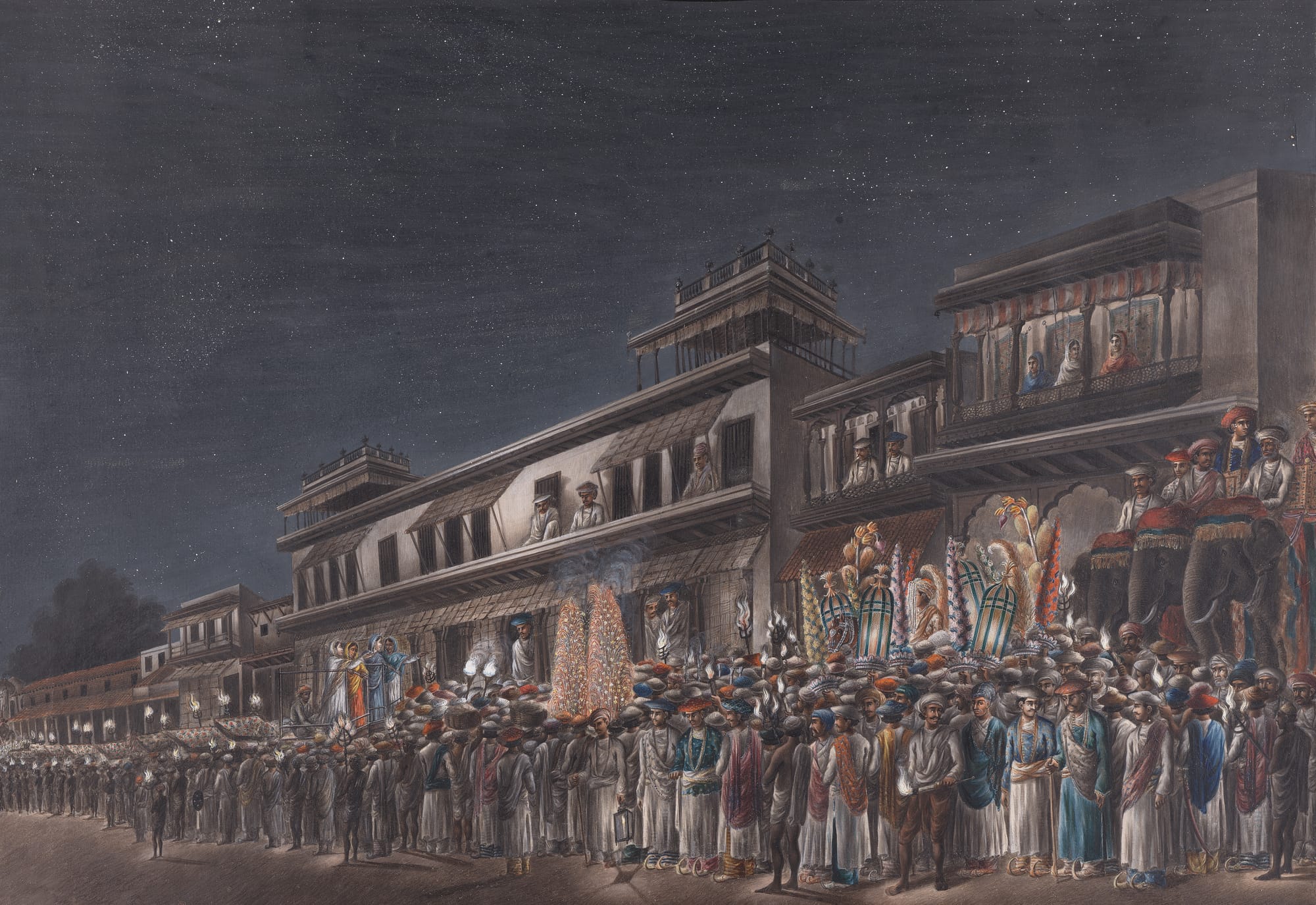
The painting has the air of a historical document, showing a cultural event. It transports us at the level of the senses: The throng of people is almost audible, and maybe we can even imagine the humidity in the air. But the painting doesn't convey a lot of information. We know from the caption that it's a marriage procession, but without that caption, we might not have been able to guess. If we're not from the Indian subcontinent, we're in a foreign place, taking in the sights and sounds without really understanding.
A Marriage Procession at Night neatly encapsulates the place of art in empire as it appears in Painters, Ports, and Profits: Artists and the East India Company, 1750–1850, running now at the Yale Center for British Art through June 21.
The exhibition "tells the story of artists from India, Britain, and China who worked in the era of one of the most powerful corporations in history," an accompanying note states.
"The British East India Company began in 1600 as a private trading enterprise but grew into a military and political force during the 18th and 19th centuries. It waged war to rule India and sell opium in China. To support its commercial and imperial goals, the Company encouraged its agents to commission art. Works of art depicted commodities, functioned as gifts to ease trade deals and build alliances, and visually recorded the places and societies where the Company traded and governed."
"The artists featured here came from many different backgrounds," the note continues. "Some trained in art schools in Britain, others in Indian courts, Chinese workshops, or military institutes. In their artistic exchanges, they combined regional methods with new materials and techniques. They interacted in places where the Company sought and claimed power. This exhibition, drawn from the YCBA's rich collection of works from Asia, takes us on a journey through these port cities and into the worlds of artists. It shows how artists shaped, and were shaped by, the Company's ruthless ventures while creating artworks of great beauty and innovation."
A quarter-way into the 21st century, social critics often conceive of us as living in an era dominated by corporations. Painters, Poets, and Profits reminds us, first, how relative this is. As big as the largest companies today are—say, WalMart and Amazon—they pale in comparison to the British East India Company. At its height, the company functioned as an empire. It controlled large swathes of present-day India as well as a thick strip of land that encircled most of the Bay of Bengal, encompassing territory in Bangladesh and Myanmar; the extension of Myanmar southward along the bay's coast today bears the echo of the company's previous holdings. At 260,000 soldiers, its private army was double the size of Britain's.
But unlike some colonial enterprises, the East India Company didn't utterly destroy the societies it extracted wealth from. As a result — as the exhibition demonstrates — under the company's domineering force were a panoply of complex cultural exchanges, involving people from the United Kingdom to the Indian subcontinent all the way to China. The artifacts in the show may not be brilliant works of art, but they offer a fascinating glimpse into what those culture exchanges were like, the ways people did and did not connect with those around them and their environment.
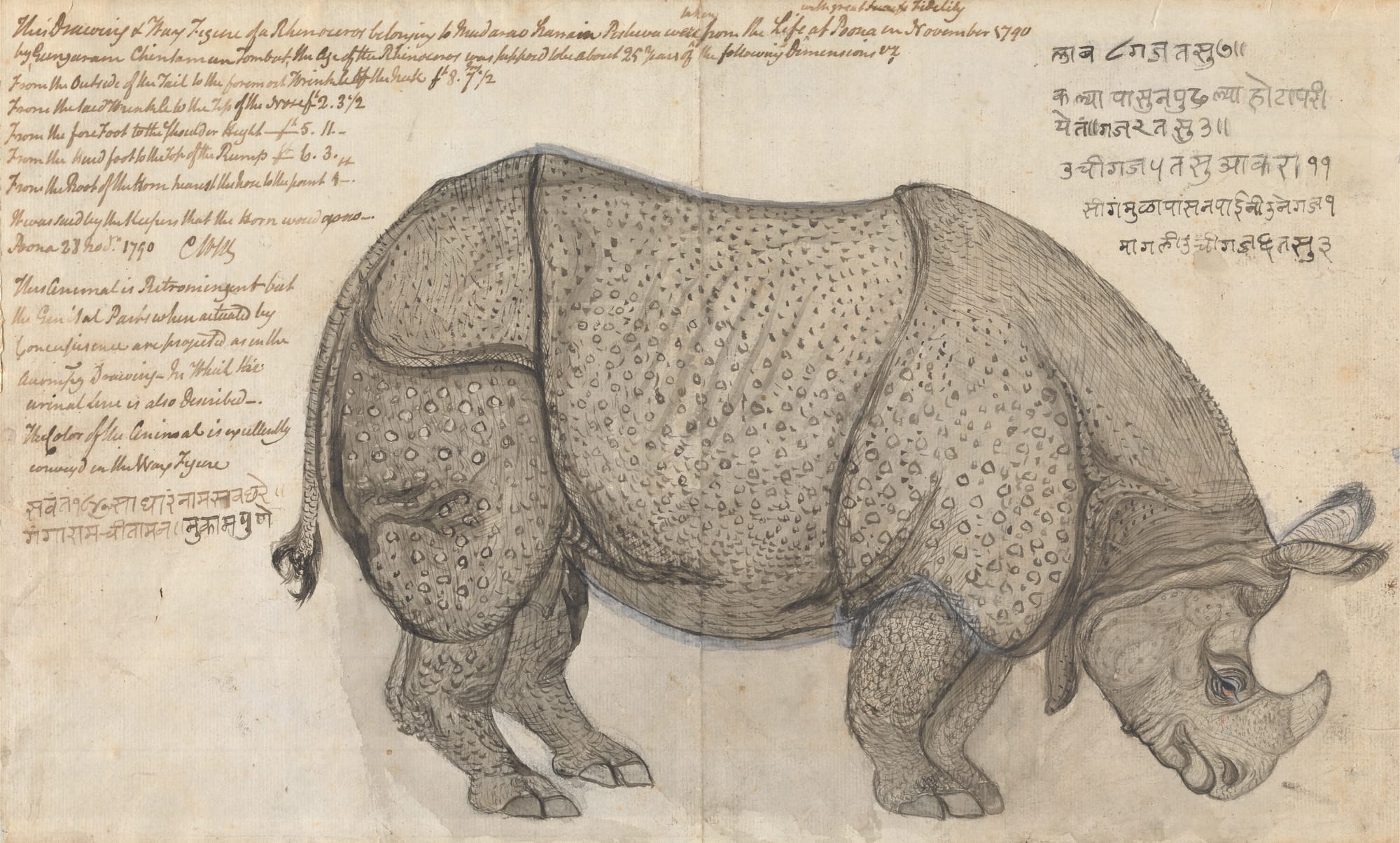
On the most basic level, artists in a new place had a lot of new things to look at, especially flora and fauna.
"Artists documenting the plants and animals of Asia often reacted with wonder," an accompanying note relates. Artist "William Daniell, traveling in the foothills of the Himalayas, recorded a rare rhinoceros drinking from a stream," and his sketch of it formed the basis for an oil painting. And artist "Gangaram Tambat carefully annotated the measurements of a rhinoceros held in a menagerie, noting its perked ears and attentive eye." Other artists captured barking deer, birds, bats, tigers, and a botanical garden of plant life.
The artists' stance toward plants and animals has an echo in the way artists depict cultural events, with a similar mix of curiosity and distance. The most extreme example in the show is a simple painting depicting a woman immolating herself on her husband's funeral pyre as a gathered crowd watches. "Even as she is consumed by the flames ... the woman at the center of this painting appears to smile," the accompanying note relates. "Onlookers are gathered to watch her perform sati, a historical Hindu practice in which a widow joined her husband's cremation to die. Some women may have seen sati as a religious duty, but many were likely pressured by their families. Widowed women in South Asia were generally prevented from remarrying and often faced poverty and social isolation. The British became obsessed with sati as evidence of the colonial need to reform Indian society. Although the Company banned the practice in 1829, it remained a popular subject in art." The painting of the night procession above has a lower-key version of this. The artist is clearly interested in the subject, taken in by the event, but the painting offers no sense of what is important about the ritual, where we should be looking, or how we should find meaning, beyond soaking up the event itself.
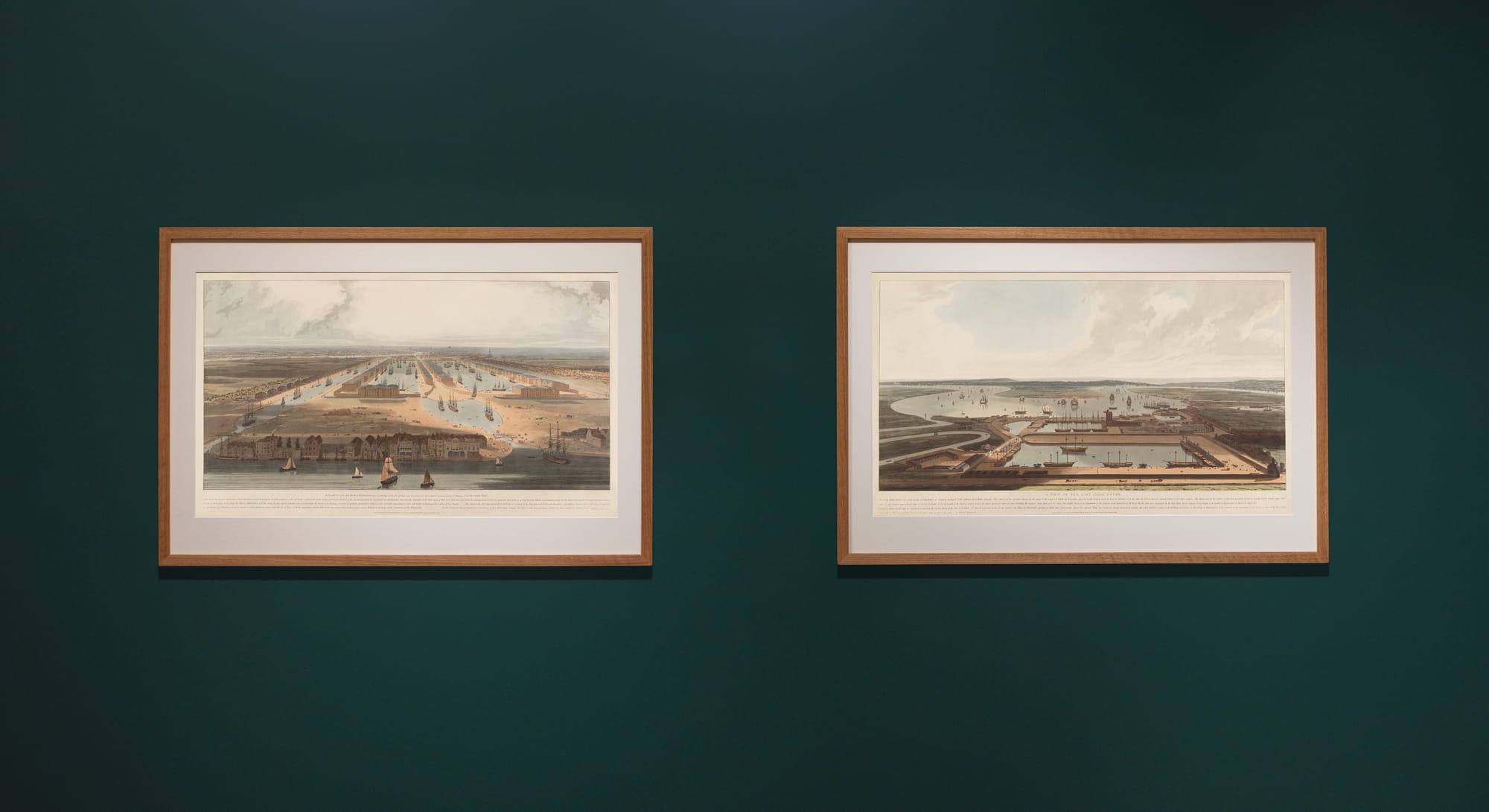
The artists paint with a better sense of understanding when they turn to depicting the East India Company's activities, and what they show helps us wrap our heads around just what an enormous operation the East India Company was in ways that facts and figures can't. The above paintings of the company's docks and ports helps us see that these points of transfer had the sense and scale of small towns. Particularly illuminating are a series of paintings showing the inner workings of the opium trade. A very helpful note explains how it related to the trade in tea. "Tea was the most important commodity traded by the British East India Company," it begins.
"Once an elite beverage, it became widely consumed in Britain across all classes as the Company increased its sales in the 18th and 19th centuries. It was the Company's tea that was thrown overboard during the Boston Tea Party. At this time, tea was grown almost exclusively in China, where trade was tightly controlled by the Qing dynasty. Here, the Company lacked the power it held in India and was just another trading nation. Company agents and other Westerners were not allowed to travel outside the major port cities, so British artists consulted Chinese artworks to learn about the cultivation and manufacturing of tea and other goods."
"To balance the trade in tea," it continues, "the Company smuggled opium, a highly addictive substance made from Indian poppies. Profits from opium funded the purchase of Chinese tea, but the drug's production and use devastated people and lands. Although opium was banned by the Qing dynasty, millions of people in China became addicted, leading to the Opium Wars in 1839. Artists took a keen interest in this subject but typically presented clean and orderly opium trade operations. They rarely showed the destructive impact of opium addiction."
These clean and orderly operations are also remarkable for their sense of scale, especially for an illicit substance. Today, we think of drug shipments as being on the scale of a small boat, a chartered airplane, a shipping container. The facilities shown in the paintings of the opium trade dwarf that. We see the insides of cavernous warehouses, with goods stacked several stories high. Dozens of workers look like ants by comparison as they unstack the packages and deliver them across the warehouse floor to be shipped. The sheer scale of it helps us understand how wars were fought over it and how opium addiction in China was so rampant. It may not show how the drug ravaged its addicts. But it does show the lengths the East India Company was willing to go to make a buck, without worrying much about the human cost.


