
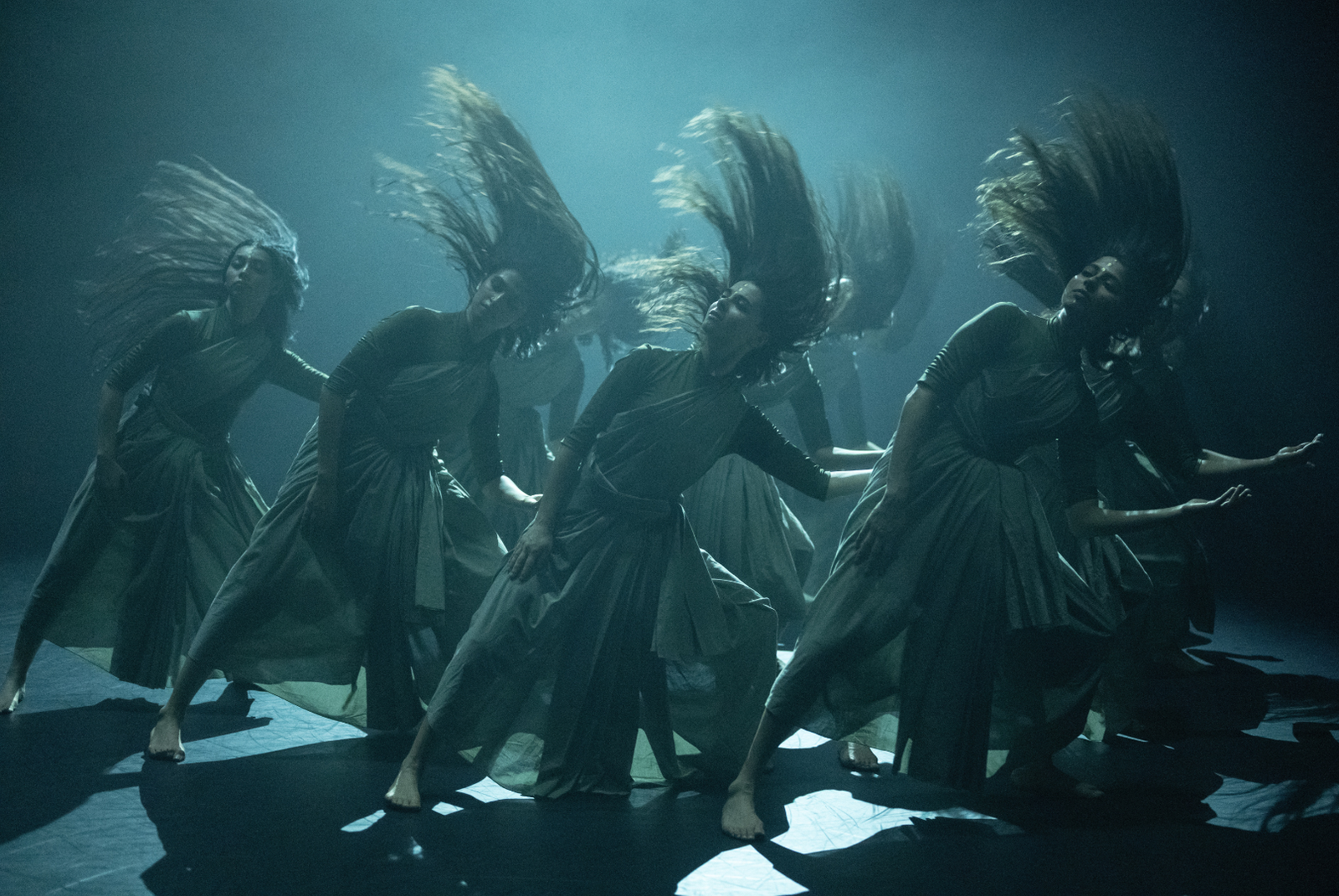
"Thikra: Night of Remembering"
Akram Khan Company
Jacob's Pillow
Becket, Mass.
July 8, 2026
From Arabic, the word “Thikra” translates to memory, remembrance or commemoration. Akram Khan’s newest work “Thikra: Night of Remembering” applies that word to women, exploring the collective memory of the female experience passed down from generation to generation.
Created in collaboration with visual artist Manal AlDowayan, the piece is the Akram Khan Company’s latest and final work before it closes its doors next year. It was performed Wednesday at the Jacob’s Pillow dance festival as part of the company's American tour.
The work goes far beyond simply dance. Among a tribe of women, the Matriarch returns to facilitate a night of exchange with their ancestors. She summons a spirit with the help of the Vessel and the Shaman, represented by dancers, and the approximately hour-long performance is a spiritual passing of energy among them. Sometimes it’s through dance, other times it's through stillness or gestures or somewhere in between.
Aditya Prakash’s score guides the movement with sounds that evoke tribalism and ancient India. The first part of the piece features a strong percussive beat, which often feels like a heartbeat. This is where we’re treated to the greatest ensemble dancing, feeling the full energy of the female collective. It’s powerful, it’s mesmerizing, and it reminds us of the strength in feminine unity.
Echoing the music, the movements of the piece are inspired by the sharp angles of Indian dance tradition. Bent elbows, flexed feet and turned-out knees in deep squats are a common motif. Hair – a representation of femininity – hangs wild and loose. It conveys the raw, unbridled nature of the tribe and is frequently incorporated into the choreography. Sometimes the dancers hold it taut in chunks away from their heads. Other times they whip it around wildly. A few hair moments are more intimate, a maternal smoothing from one dancer to another, or a joining of hair that connects them directly.
The piece is almost haunting, but the women’s collective spirit is life-giving, not life-taking, with a sustaining force passed from one to the next. Still, the vibe is intense, leaning into a mystical energy and uncontained feminine power, which has historically felt threatening to society, often deemed witchcraft.
The dancers bring Khan’s vision to life. They embrace their tribal natures with an almost unhinged power, their unbound hair framing wild eyes and yearning spirits. In the latter half of the piece, one dancer “controls” another, using forceful arm movements to wake her from a sleep and move her across the stage. The duet – and later trio – is magical, the dancers working in perfect time with one another, made more impressive given the unstructured nature of the music.
The entire experience is framed to place us with the tribe in its natural territory, beginning when we first walk into the theater to find it covered in mist. Sounds of birds chirping, percussion and distant chanting awaken our ears in the darkness before the dancing has even begun, and our noses fill with a slight scent of incense. The set features a cave-like temple with dim lighting and a flashing red light to signify fire, from which our spiritual figures descend. It collectively creates a slow build that transports us along for the spiritual experience – and a spiritual experience it is.
“Thikra: Night of Remembering” is unlike anything I’ve ever seen, a thought-provoking exploration of the power of the female divine and an ode to women’s roles in preserving tradition and memory throughout history. It is something I will remember for far longer than one night.


