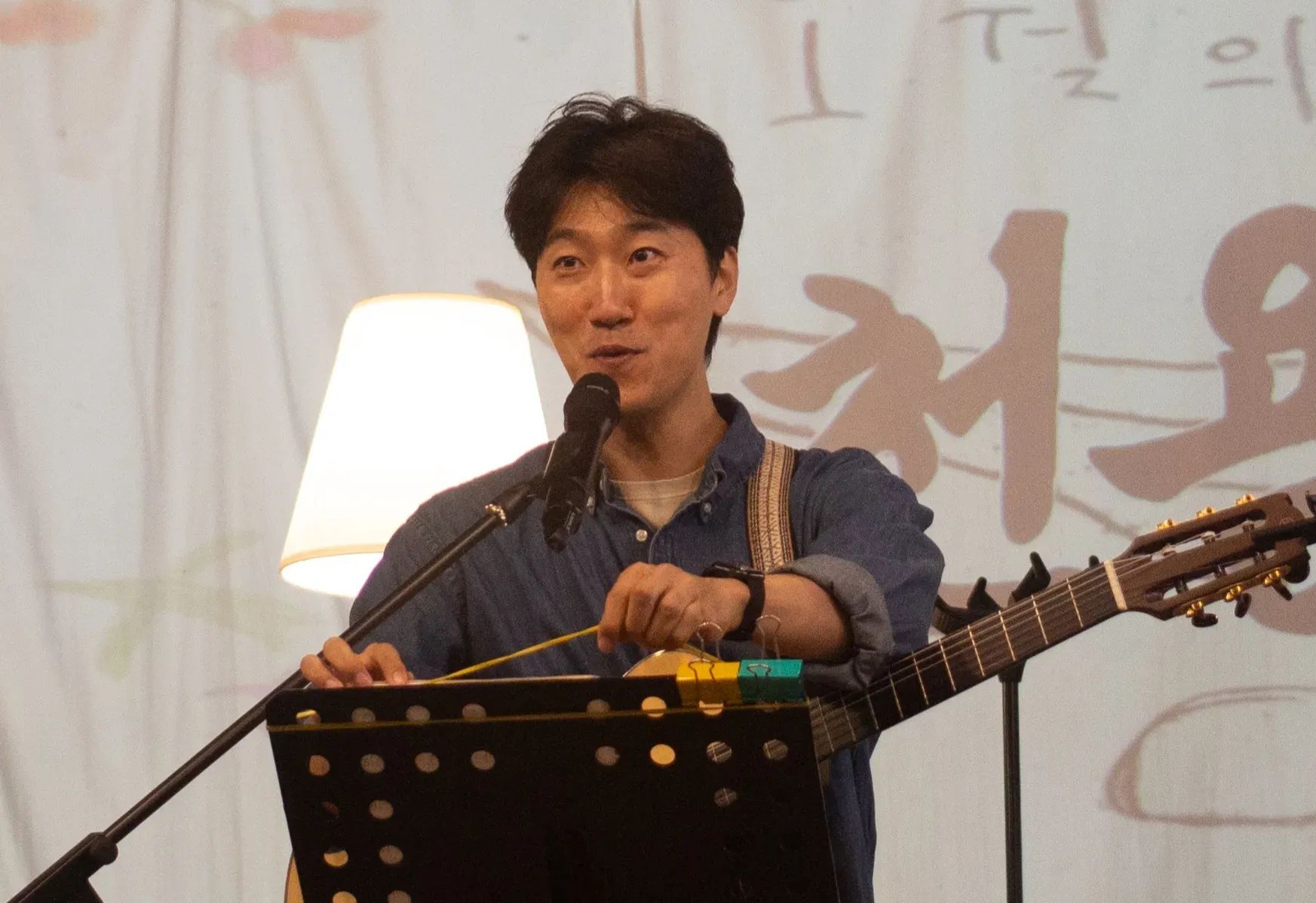
천용성 (Chun Yongsung)
오월의 노래 (May Song)
5.18 Democracy Square
Gwangju
Through May 30, 2026 (except May 16, 17, and 23)
(Jisu Sheen recently moved from New Haven to Gwangju, South Korea, where she’s covering local arts and culture for the New Haven Independent and Midbrow.)
When Chun Yongsung took the stage Wednesday night to sing about the year Kim Il-Sung died, he wasn’t really talking about the first dictator of North Korea. He was referring to something even more impossible to comprehend.
That’s right: the ’90s.
Almost every night for three weeks, an organization called 오월음악 (May Music) has invited musicians to come embody the spirit of the mass citizens’ uprising in Gwangju on May 18, 1980.
It’s a series they call 오월의 노래, or May Song, which they formalized in 2015 after annual organic gatherings of musicians on the square stretching back to the first anniversary. They set up a stage of wooden pallets like a conversation pit, weighed down household lamps with bricks, and installed an impressive amount of speakers to make the subtle notes crispy fresh.
On Wednesday, kids filmed a skate video to the side as Chun poured folk indie musings through the white noise of the almost-summer night in Gwangju’s 5.18 Democracy Square. Chun was new to the city and ready to feel like a Gwangju citizen. The day before, he had gone to the Kia Champions Field baseball stadium to watch Gwangju’s Kia Tigers play—“they lost”—and planned to climb Mudeungsan before learning how tall the mountain was—“like a thousand meters”—and resolving to do it next time. Both in his music and his stories, Chun seemed like the kind of person to respond to any new development with, “Oh, OK.”
Baseball teams lose. Supreme leaders die. Contemplative kids grow up to become singer-songwriters, and nostalgia reveals itself to be a moving target.
The pre-dot-com-era was a turbulent time. It shaped a generation of artists with an analog sense of self. You can see all the buttons on the Nintendo 64; there is no wizard behind the screen.
Chun’s songs, meanwhile, have been recognized as sharing a resonance with Korean pop songs of the early ’90s. To understand this, we can put ourselves in the shoes of an elementary school student in the mid-‘90s, already turning his head back to a moment he just missed.
Singing “Year of Kim Il-sung's Death” on the lamplit outdoor stage, Chun placed us there.
It’s 1994. The adults are anxious and trying to hide the fact. The kids—what else can they do?—are copying them.
Telling his song’s tale, Chun conveyed worlds of emotion in a calm voice:
The misplaced hopes of a kid begging his mom for a doll as a birthday present for someone he liked. The small hopes she may have had upon relenting. And the bullying that ensued when the kid wasn’t invited to the birthday party.
What does it mean? What does any of it mean? Some children believe they’ll understand when they get older. I have a feeling Chun never found comfort in the illusion.
He ended his song with a question repeated over and over, a tug-of-war between reassurance and uncertainty.
김일성이 죽던 해 샀던 인형은 어디에 (Where is the doll that was bought the year Kim Il-Sung died?), he sang.
The line arrived with relief from somewhere deep inside. We had reached the title of the song, something I didn’t realize I was waiting for. And the first part of the line, “the year Kim Il-Sung died,” had a lilting, cozy melody.
Where is the doll that was bought the year Kim Il-Sung died? he sang again.
The second part, “Where is the doll that was bought…?” took a sonic twist, dropping the floor out and replacing it with the unexpected. Its rhythm was an echo of the first half, but the tone was murkier than where Chun had just left it. We’d landed somewhere, but where? And where was that doll?
Where is the doll that was bought the year Kim Il-Sung died?
Chun kept asking, and we had no answer. We were in the 5.18 Democracy Square in 2026, but we were also in the ‘90s. Somewhere, a dictator was having a heart attack. And somewhere else, a kid was trying to make sense of this frightening, beautiful world.
Sign up here to get Gwangju Midbrow email updates delivered straight to your inbox.


