
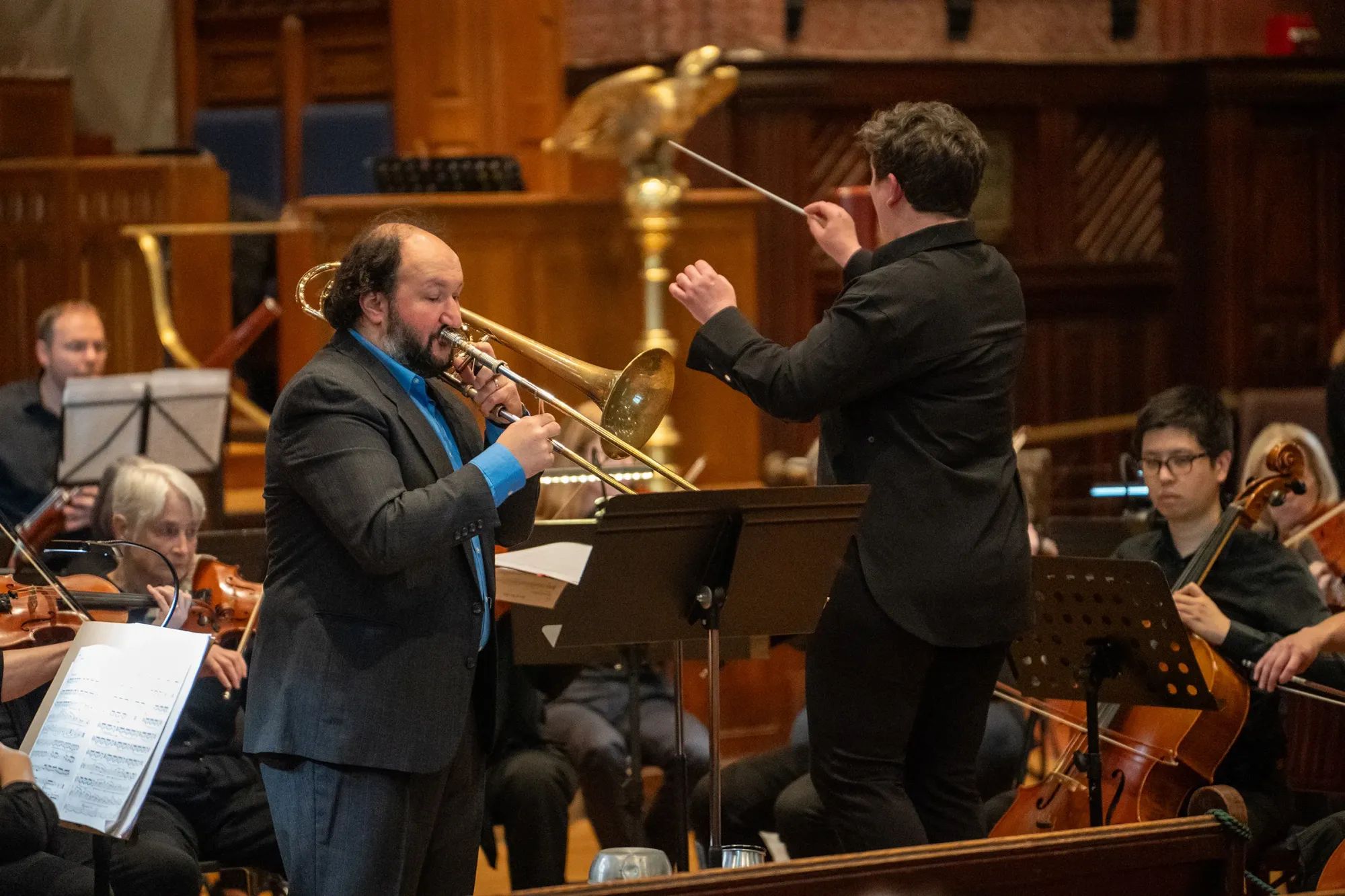
Civic Orchestra of New Haven presents “Glow & Grace”
Battell Chapel
New Haven
May 9, 2026
If instruments serve as the voice for musicians, Matthew Russo’s trombone sang like the superstar Beyoncé at Battell Chapel Saturday afternoon.
Glow & Grace was the Civic Orchestra of New Haven’s spring show. The emotional centerpiece was the trombone concerto “Sonorous,” conceived by rising composer Quinn Mason (b. 1996).
When introducing “Sonorous,” Potemkina stated, “This should be the year of the trombone.”
Most people seem to be unaware of the underrated instrument’s capacity for complexity. There are few opportunities for trombone solos in musical compositions these days. According to Russo, it seemed to be most popular during the Renaissance period.
“There was this really small period of time where there was a rock star alto trombone player, and all these composers wrote pieces for him. Then no one wrote another piece for a solo trombone for like 50 years,” said Russo. “So, we had that one moment with a Mick Jagger on the alto trombone, and then we never saw it again.” He named the trumpet and horn as more popular brass instruments.
Russo added, “I think my job is to make everyone love the trombone. [“Sonorous”] is such a great vehicle for it.”
“Sonorous” opened with a gentle chorus of strings trailed by delicate notes from Russo’s tenor trombone. Those notes crystallized into a lilting phrase that was echoed by the strings. The brass and woodwind sections joined the musical dialogue, surging to a crescendo. Just as quickly, the music softly settled.
Then the brass section emitted sharp heralding notes; the trombone reflected them back. Russo’s notes turned punchy, adding bounce. Then bright notes rang out of a morass of deeper tones. Russo placed a mute in the bell of his trombone, softening the resonance. He stretched out melodic phrases that faded into thin air, as music director Nadya Potemkina conducted the musicians with ease and constrained power.
As golden notes poured out of the trombone, the violinists’ bows flirted with their strings, lightly playing whorls of notes that floated over the audience. The music swelled with reverberations from the cymbals and rumblings from the brass and woodwind instruments. Like a thunderclap, the drums suddenly went frenetic and the trombone kept pace, releasing a flurry of notes that displayed Russo’s technical dexterity. The violinists’ heads snapped and hands glided in impressive synchronicity as their bowing intensified.
Mason composed the concerto to display the trombone’s likeness to the human voice and its expressive singing quality. The esteemed Russo proved to be an ideal vessel to showcase the piece’s depth during this momentous New England premiere.
“When I first heard it, I was just like,‘I gotta play this. This is fantastic,’” remarked Russo. Potemkina said she enjoyed working with a newer piece because she could actually ask Mason questions to enhance her interpretation of the piece. “It’s so wonderful because all the dead guys are very, very dead. Very hard to reach,” she laughed.
Potemkina said that “Sonorous” fit perfectly into the orchestra’s program, alongside Gioachino Rossini’s capricious Overture to “The Barber of Seville” and César Franck’s vast “Symphony in D minor.” The concerto’s inclusion also fulfilled her goal of reaching beyond the community of classical music enthusiasts, as she considers the piece to be more accessible for people unfamiliar with the genre. The Civic Orchestra is deeply committed to impacting people and contributing to the richness of the New Haven community.
“Classical music is for everybody,” Potemkina emphasized. “It can touch you regardless of how much experience you have with it. You should just sit down with an open heart and soak it in.”
There was a lot to soak in with “Sonorous.” The elegance and agility of the trombone were a delightful surprise. It’s harmonious conversation with the orchestra filled the Chapel with a tender warmth that enveloped the audience in a cocoon of resonance. The sweeping sonic landscape evoked picnicking on a perfect spring day, lying in the grass, staring up at the sun and soaking in the beauty of the natural world. There was a collective joyous calm in the room. As attuned as the orchestra was on stage, it also felt like the audience belonged to that same tight-knit connection. We existed in a shared sanctuary of feeling.
The concerto ferociously closed with a phalanx of sound, rattling the ground like an advancing army, and straining against Battell’s walls and ceiling.
“Wow,” said a woman behind me, awe wavering her voice.
The Civic Orchestra of New Haven is currently preparing their new season (the anniversary of Beethoven’s death is approaching!) and has lots more creative programming in the works. Visit their website to sign up for updates.


